Democratic Party 42%, People Power Party 45% in a close race within the margin of error
Under 50s support Democratic Party
60s and older favor People Power Party
[Asia Economy Reporter Naju-seok] With the presidential and local elections ending in a victory for the People Power Party, the results of the general election, which is 1 year and 7 months away, are the biggest concern not only for the future but also for the current political sphere. If the general election, scheduled to be held on April 10, 2024, were held today, what would the results be for the ruling and opposition parties?
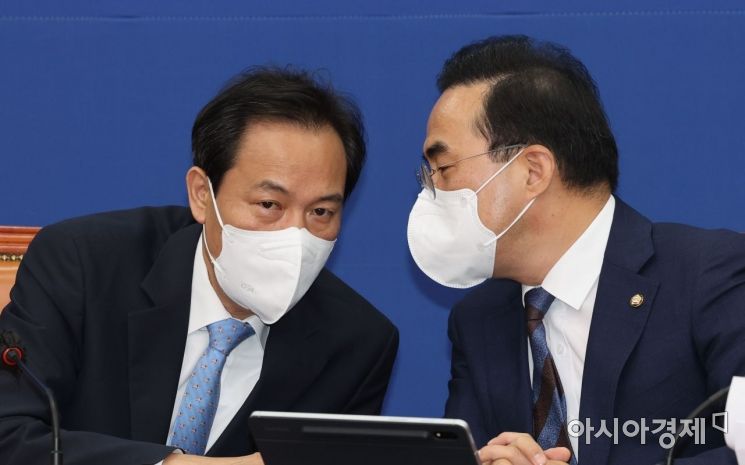 Woo Sang-ho, Emergency Response Committee Chairman of the Democratic Party of Korea, and Park Hong-geun, Floor Leader, are attending the expanded executive meeting held at the National Assembly on the 1st and are talking during the meeting. Photo by Yoon Dong-joo doso7@
According to public opinion polls, the People Power Party is slightly ahead but the race is predicted to be close within the margin of error, making the election outcome uncertain.
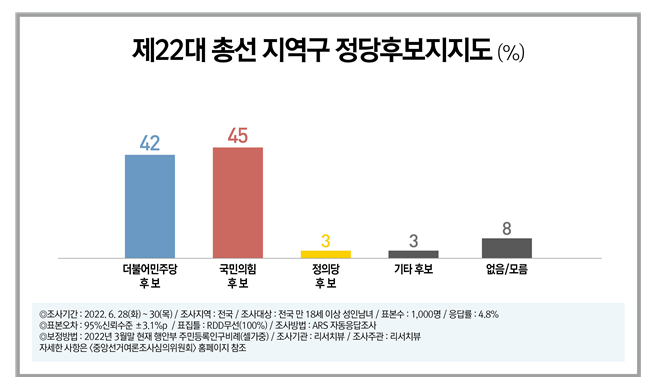
A public opinion poll released on the 3rd by the polling agency Research View (conducted from the 28th to 30th of last month, surveying 1,000 adults aged 18 and over nationwide using an ARS automated response system) included the question, "If the election for the 22nd local district National Assembly member were held today, which party's candidate would you vote for?"
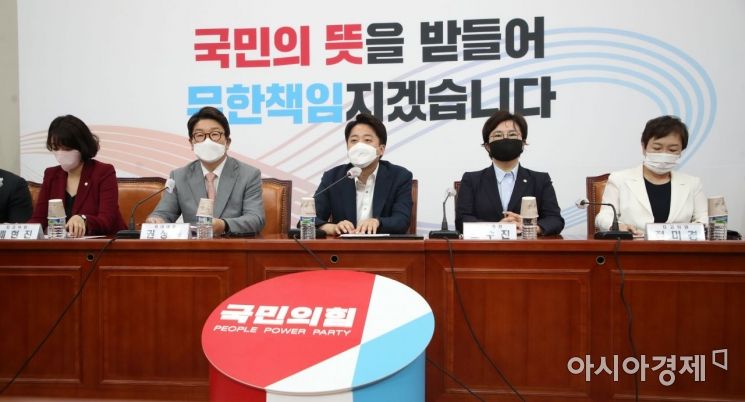 Lee Jun-seok, leader of the People Power Party, is attending the Supreme Council meeting held at the National Assembly on the 23rd and delivering opening remarks. Photo by Yoon Dong-joo doso7@
In response, 42% of respondents chose the Democratic Party, while 45% chose the People Power Party. The gap between the two parties was within the margin of error (sampling error at a 95% confidence level is ±3.1 percentage points). Although the People Power Party is ahead on the indicator, statistically, it is a situation where superiority cannot be determined.
By generation, the Democratic Party led among those aged 50 and under: 20s (including 18 and 19-year-olds) (Democratic Party 41% vs. People Power Party 39%), 30s (41% vs. 39%), 40s (51% vs. 37%), and 50s (52% vs. 37%). The People Power Party showed strength among those aged 60 and over: 60s (37% vs. 55%) and 70 and above (26% vs. 66%).
By ideological inclination, 73% of conservatives supported the People Power Party, while 73% of progressives supported the Democratic Party candidates. Among the centrist voters, who are decisive for victory, the Democratic Party candidate led with 40% compared to 30% for the People Power Party candidate, showing a 10 percentage point advantage for the Democratic Party.
In a survey on the suitability of future political leaders within the conservative camp, Minister of Justice Han Dong-hoon and Seoul Mayor Oh Se-hoon tied for first place with 15% each. They were followed by Daegu Mayor Hong Joon-pyo (12%), former lawmaker Yoo Seung-min (9%), People Power Party lawmaker Ahn Cheol-soo (8%), People Power Party leader Lee Jun-seok (6%), and Minister of Land, Infrastructure and Transport Won Hee-ryong (4%).
In the survey on the suitability of political leaders within the progressive camp, Democratic Party lawmaker Lee Jae-myung ranked first with 33%, followed by former Democratic Party leader Lee Nak-yeon (15%), Gyeonggi Province Governor Kim Dong-yeon (11%), Justice Party lawmaker Shim Sang-jung (5%), Democratic Party lawmaker Park Yong-jin (4%), former Gangwon Province Governor Choi Moon-soon, and Democratic Party lawmaker Yoon Gun-young (2%).
© The Asia Business Daily(www.asiae.co.kr). All rights reserved.
![Clutching a Stolen Dior Bag, Saying "I Hate Being Poor but Real"... The Grotesque Con of a "Human Knockoff" [Slate]](https://cwcontent.asiae.co.kr/asiaresize/183/2026021902243444107_1771435474.jpg)


















