Professor Joo-Hyung Lee's DGIST Team
Potential Use of Triboelectric Generator as a Tactile Sensor
[Asia Economy Reporter Kim Bong-su] What will future computers or smartphones look like? A world is expected where separate 'devices' are not carried around, and clothes, glasses, skin, etc. are used as interfaces, displays, and hard disks. In particular, research on flexible wearable devices that can be worn like clothes is being actively pursued.
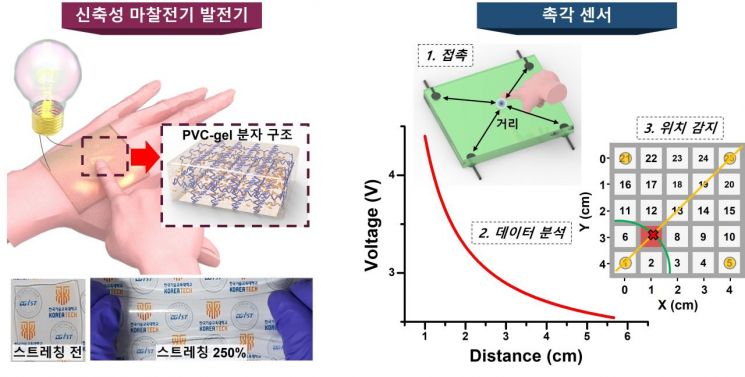
According to the Korea Research Foundation on the 3rd, a research team led by Professor Lee Joo-hyung at Daegu Gyeongbuk Institute of Science and Technology (DGIST) recently developed a tactile sensor that can recognize location and pressure using energy obtained from static electricity by implementing a triboelectric nanogenerator applied with an elastic polyvinyl chloride polymer gel. It consists of a single layer of transparent and stretchable polymer gel. As an energy harvesting device, it can harvest mechanical energy, and it can also be implemented as a tactile sensor that detects the touched location without an electrode grid pattern.
Recently, with the diversification of wearable and stretchable electronic devices, attempts to implement stretchable electronics have been actively made, and the development of power supply devices applicable to these has also been actively pursued. In particular, triboelectric nanogenerators are devices that harvest wasted energy such as pressure, vibration, and wind energy and convert it into electrical energy, attracting attention for their potential use as power supply devices.
However, existing triboelectric nanogenerators consist of at least two or more layers such as substrates, electrodes, and dielectric materials, making them thick and limiting flexibility and transparency, and they have required complex fabrication processes.
The research team succeeded in developing a high-output triboelectric nanogenerator with a single transparent and highly stretchable layer using a plasticizer-containing polyvinyl chloride gel. This not only efficiently converts mechanical energy into electrical energy but also confirmed improved energy harvesting efficiency through contact. For location detection of the tactile sensor, by utilizing the characteristic that triboelectric output varies according to contact distance without the essential electrode grid pattern, it demonstrated potential use as a tactile sensor capable of detecting contact location and pressure.
The research team stated, "The developed energy harvesting device has transparent and highly stretchable properties, so we expect its potential as an energy source for future flexible electronic devices," and added, "Its structurally simple design can reduce process costs, and through continuous research, it is expected to be applicable to fields related to AR/XR, electronic skin, and wearable devices."
The research results were published online on May 26 in the international academic journal Advanced Science and were selected as a cover paper.
© The Asia Business Daily(www.asiae.co.kr). All rights reserved.
!["The Woman Who Threw Herself into the Water Clutching a Stolen Dior Bag"...A Grotesque Success Story That Shakes the Korean Psyche [Slate]](https://cwcontent.asiae.co.kr/asiaresize/183/2026021902243444107_1771435474.jpg)
















