2.15 Million 'Cancer Survivors'
High Risk of Developing Secondary Cancers as Well as Primary Cancer
Need to Manage Lifestyle Habits and Chronic Diseases Beyond Prevention and Screening
Attention Required for Osteoporosis and Infectious Diseases Too
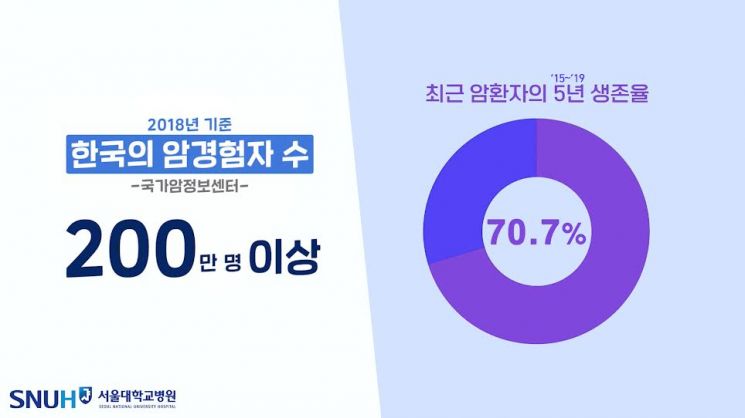
[Asia Economy Reporter Chunhee Lee] 2.15 million. This is the number of "cancer survivors" in South Korea, referring to those diagnosed with cancer and currently undergoing treatment or who have been cured, as surveyed in the 2019 National Cancer Registry Statistics. This accounts for about 4 out of every 100 people in the population. In particular, 255,000 patients were newly diagnosed with cancer in 2019 alone. This figure has been steadily increasing since 2015.
However, at the same time, as treatment outcomes have improved, the 5-year relative survival rate of cancer patients diagnosed in the recent 5 years (2015-2019) has also risen to 70.7%. This means that 7 out of 10 cancer patients survive for more than 5 years. It indicates that not only cancer treatment but also life after treatment has become important.
Cancer survivors refer to all individuals who have been diagnosed with cancer. Recently, with better early detection and advancements in cancer treatment methods, the number of people living long after experiencing cancer has increased, leading to the concept emphasizing life after cancer treatment. To prevent existing cancer recurrence or newly occurring 'secondary cancer' unrelated to the original cancer, continuous efforts in health management are necessary.
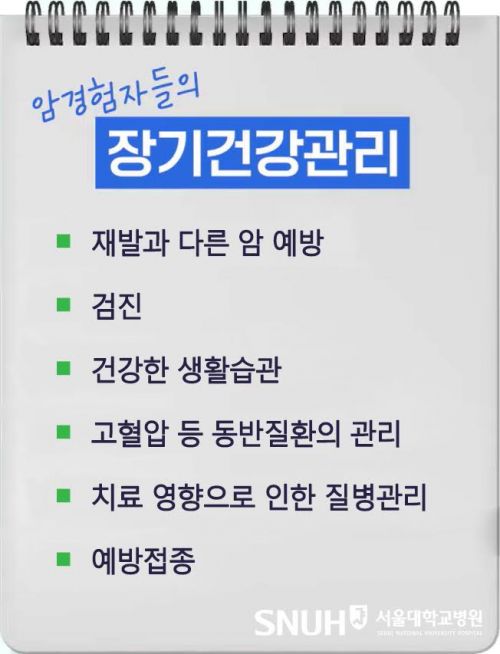
First and foremost, prevention and screening are crucial. Cancer survivors have a higher likelihood of developing secondary cancers due to genetic tendencies and lifestyle habits, in addition to their original cancer. In fact, the probability of developing secondary cancer is about 1.1 times higher compared to those without a history of cancer. Professor Jieun Lee from the Department of Family Medicine and Cancer Health Promotion Center at Seoul National University Hospital emphasized, "This is why screening for prevention and early detection is necessary," adding, "Regular health check-ups should be conducted to identify not only the cancer one has experienced but also the presence of secondary cancers."
Managing lifestyle habits and comorbidities is also important. According to a large-scale study conducted in the United States, maintaining good health in 6 out of 7 factors?including smoking, physical activity, obesity, diet, cholesterol, blood pressure, and blood sugar?resulted in a 51% lower risk of cancer compared to those unhealthy in all factors.
Previously, lifestyle and chronic disease management were mainly emphasized for the prevention of cardiovascular and cerebrovascular diseases. However, recent research has increasingly shown that maintaining a healthy weight and engaging in regular exercise reduce cancer recurrence and the occurrence of secondary cancers, leading to recommendations for proper management of lifestyle and chronic diseases from a cancer prevention perspective as well. However, specific methods such as exercise and weight management should be appropriately planned through consultation with medical professionals.
Cancer survivors should also pay attention to preventing other diseases or infectious diseases that may arise due to treatment effects. There are concerns that anemia may occur after stomach cancer treatment and osteoporosis after breast cancer treatment. Depending on the type of treatment, bone deterioration can progress up to seven times faster than the natural aging process. Additionally, since cancer survivors have a higher likelihood of contracting infectious diseases or developing complications from them, more proactive vaccinations are recommended. Influenza, pneumonia, and shingles vaccines are primarily advised.
Professor Jieun Lee of Seoul National University Hospital stated, "Traditionally, cancer has been considered cured after 5 years, which leads many cancer survivors to neglect management after 5 years of cancer treatment," adding, "However, although the risk of recurrence and secondary cancer may decrease over time, it does not disappear, so it is important to maintain necessary screenings and treatments, regularly monitor habits and symptoms, and consult with doctors."
© The Asia Business Daily(www.asiae.co.kr). All rights reserved.


















