Democratic Party to Elect Speaker Alone on 4th if No Concession from People Power
People Power Says Plenary Session Without Bipartisan Agreement Impossible
According to People Power's Interpretation of National Assembly Act, Indefinite Suspension of Legislature Functions Possible
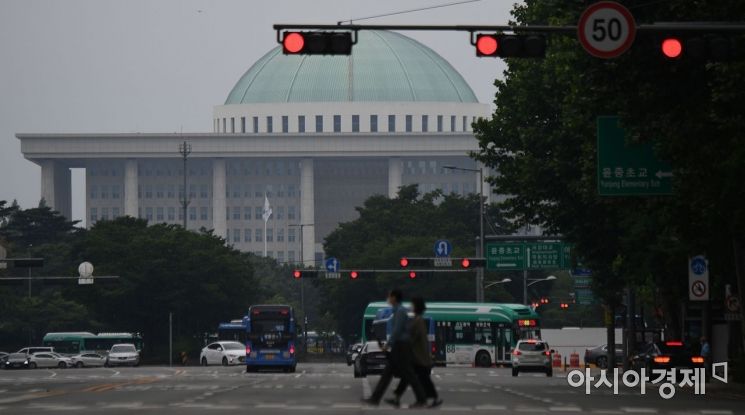 As negotiations between the ruling and opposition parties over the reorganization of the 21st National Assembly's second half remain stalled, the National Assembly has been in a state of vacancy for the fourth consecutive week. On the 26th, the red traffic light in front of the National Assembly reflects the current state of the legislature. Photo by Yoon Dong-joo doso7@
[Asia Economy Reporter Naju-seok] As the ruling and opposition parties clash over the negotiation of the parliamentary organization, the National Assembly has been at a standstill for over a month. There is no Speaker of the National Assembly, nor any standing committees, resulting in a legislative absence. Although the Democratic Party of Korea has begun efforts to convene the National Assembly even unilaterally, a critical “blind spot” has been identified in the current National Assembly Act that makes it impossible for the Assembly to open under these circumstances. According to the interpretation of the People Power Party, if the ruling and opposition parties fail to reach an agreement, the legislature will inevitably fall into an indefinite suspension of functions due to the organizational issue.
Despite the concession to hand over the chairmanship of the Legislation and Judiciary Committee, which was the biggest point of contention in the organizational negotiations, to the People Power Party, the Democratic Party has announced its intention to elect the Speaker and others unilaterally as the People Power Party has not taken additional corresponding measures. Initially, the plan was to hold a plenary session on the 1st to elect the Speaker, but the start of the session was postponed to the 4th due to objections from candidates such as Kim Jin-pyo, the Speaker nominee.
The People Power Party holds the position that under the current National Assembly Act, it is impossible to elect the Speaker without an agreement between the ruling and opposition parties while the Speaker’s position is vacant. Seong Il-jong, the Policy Committee Chair of the People Power Party, stated, “According to Article 14 of the National Assembly Act, the role of the Secretary-General of the National Assembly is to ‘announce the convocation of a temporary session.’ Also, as the temporary presiding officer, the most senior member does not have the authority to convene the plenary session or set the agenda. Without the Speaker, the National Assembly operates only by agreement among negotiation groups, which is the intent of the National Assembly Act,” he argued.
On the other hand, Park Hong-geun, the floor leader of the Democratic Party, stated on the 1st, “It is clear that there is no procedural defect in electing the Speaker for the second half of the term according to Articles 14 and 18 of the National Assembly Act.” The Democratic Party argues, “Article 14 of the National Assembly Act stipulates that if there is no Speaker, the Secretary-General can convene a temporary session, and if the Speaker is not elected within the period stipulated by the Act?specifically, if the Speaker is not elected five days before the expiration of the previous Speaker’s term?the temporary Speaker is the most senior member, and if there are two or more senior members, the eldest among them can convene the plenary session to elect the Speaker.”
The problem lies in the difference in interpretation between Articles 14 and 18 of the National Assembly Act, which regulate the procedure and method for electing the Speaker, and this difference reveals a subtle gap in the law. Article 14 allows the Secretary-General to announce the convocation of a temporary session when there is no Speaker. Article 18 states that during the Speaker election process, the most senior or eldest member shall perform the Speaker’s duties. However, the regulations concerning the convening of the plenary session and the preparation of the agenda in the absence of the Speaker are not clearly defined. The People Power Party’s stance is “therefore, it is not possible,” while the Democratic Party’s stance is “it is possible.” This divergence arises from the legislative gap due to the lack of provisions for such a special situation.
What is noteworthy is the interpretation of the People Power Party.
If the People Power Party’s interpretation is followed, hypothetically, if the plenary session of the National Assembly can only be convened by agreement among negotiation groups, a constitutional crisis would occur. If either the People Power Party or the Democratic Party continues to oppose the organizational formation, the National Assembly cannot convene indefinitely. While the presence of the Speaker could prevent such a legislative vacuum crisis, in the current situation without a Speaker, there is no way other than an agreement between the ruling and opposition parties. A National Assembly official pointed out, “If the Assembly cannot convene due to legislative gaps, the National Assembly Act must be amended. However, since the Assembly must be convened to amend the Act, even the amendment cannot be made.”
© The Asia Business Daily(www.asiae.co.kr). All rights reserved.
![User Who Sold Erroneously Deposited Bitcoins to Repay Debt and Fund Entertainment... What Did the Supreme Court Decide in 2021? [Legal Issue Check]](https://cwcontent.asiae.co.kr/asiaresize/183/2026020910431234020_1770601391.png)















