"Will Conduct Interviews with Candidates for Next Police Chief"
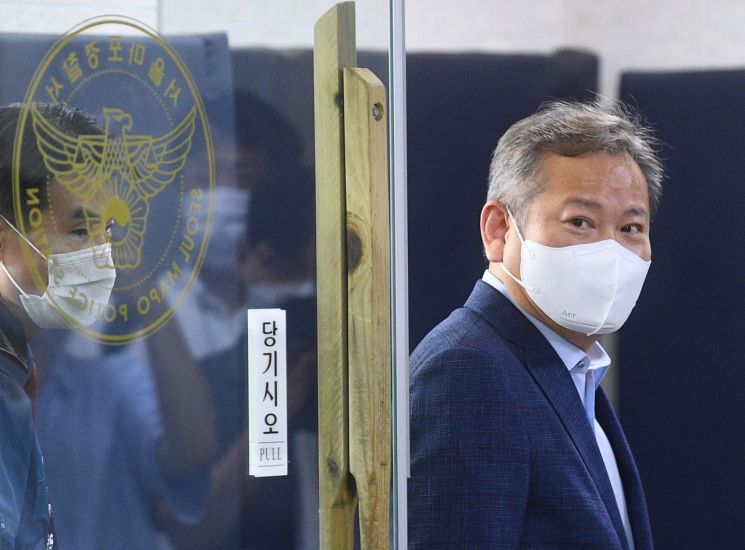 Minister of the Interior and Safety Lee Sang-min, who is proactively leading police control efforts, is entering the Hongik Police Substation of Mapo Police Station, Seoul Metropolitan Police Agency, Mapo-gu, Seoul, on the afternoon of the 1st.
 [Image source=Yonhap News]
[Asia Economy Reporter Oh Gyumin] The presidents of the police workplace councils, who have strongly opposed the so-called 'Police Bureau' establishment within the Ministry of the Interior and Safety (MOIS) by issuing a joint statement of opposition, have expressed no intention to meet with Minister of the Interior and Safety Lee Sang-min.
On the 1st, after visiting the Hongik Police Substation of Mapo Police Station in Seoul and holding a meeting with frontline police officers, Minister Lee told reporters asking why he visited the frontline substation instead of the workplace council, "This visit is to vividly hear the stories of police officers working at the frontline, not to build a justification after the announcement of the MOIS Police System Improvement Advisory Committee's recommendations." When asked about plans to visit the workplace council, he said, "We intend to listen to the opinions of the public and police officers scattered across the country regarding the advisory committee's recommendations and announce the final position on the 15th."
Regarding the content of the meeting, Minister Lee said, "The police officers do not understand the recommendations well," and added, "If a police support organization is created, it will have about 15 members, so how can it handle the security duties performed by 140,000 police officers? They are thinking about this uncritically." He further explained, "The newly established organization will support the faithful execution of high-ranking personnel appointment recommendations granted to the MOIS minister by the Police Act, and the agenda referral rights of the National Police Commission."
When asked about whether interviews with candidates for the next National Police Agency Commissioner would be conducted, Minister Lee said, "I think interviews with candidates are naturally necessary," adding, "It is necessary to have an opportunity to focus on leadership capable of leading a large organization of 140,000 people, a strong sense of mission to the nation, and internal trust."
Earlier that day, around 2:30 p.m., Minister Lee visited the Hongik Substation to directly explain the contents of the police system improvement plan promoted by MOIS and to hear opinions from the field. Before the meeting, he told reporters, "The newly established organization will support the faithful execution of high-ranking personnel appointment recommendations granted to the MOIS minister by the Police Act, and the agenda referral rights of the National Police Commission."
Regarding concerns about the infringement of police organizational independence, Minister Lee said, "(The new organization) will not perform the National Police Agency's budget, organizational functions, or inspection and audit functions," and added, "The law is structured so that no one, including the MOIS minister or the National Police Agency Commissioner, can influence individual case investigations."
Minister Lee also rebutted criticisms that this move is a return to the era when the police were directly controlled by the Ministry of Home Affairs, the predecessor of MOIS. He explained, "31 years ago, the Ministry of Home Affairs' Security Headquarters had 12 divisions and directly performed security duties, but the new organization is a single unit that supports the legal functions of the MOIS minister." He continued, "We will carefully review your opinions and reflect them in policies if necessary," and said, "We will also strive to break the monopoly of high-ranking positions by Police University graduates, improve treatment, reform the rank retirement system, and strengthen investigative expertise."
Minister Lee stated, "There is a need to command and supervise the police, whose authority has increased due to the adjustment of investigative rights between prosecutors and police," and added, "We announced the police system improvement plan on the 27th of last month, which centers on creating a police affairs organization within MOIS and establishing command regulations for the National Police Agency Commissioner, and we will promptly implement it." Visits by the MOIS minister to frontline substations for encouragement are not unusual. During the Moon Jae-in administration, ministers Jeon Hae-cheol, Jin Young, and Kim Boo-kyum visited local police substations during holidays such as Lunar New Year and Chuseok for encouragement, and during the Park Geun-hye administration, ministers Jeong Jong-seop and Hong Yoon-sik also visited police stations in island areas to hear voices from the field.
However, Minister Lee's recent visit has sparked police opposition amid fierce controversy over 'police control' following the announcement of the police system improvement plan, especially since the meeting requested by National Police Agency Commissioner Kim Chang-ryong with the minister did not materialize. Commissioner Kim has currently expressed his intention to resign.
© The Asia Business Daily(www.asiae.co.kr). All rights reserved.
![Clutching a Stolen Dior Bag, Saying "I Hate Being Poor but Real"... The Grotesque Con of a "Human Knockoff" [Slate]](https://cwcontent.asiae.co.kr/asiaresize/183/2026021902243444107_1771435474.jpg)
















