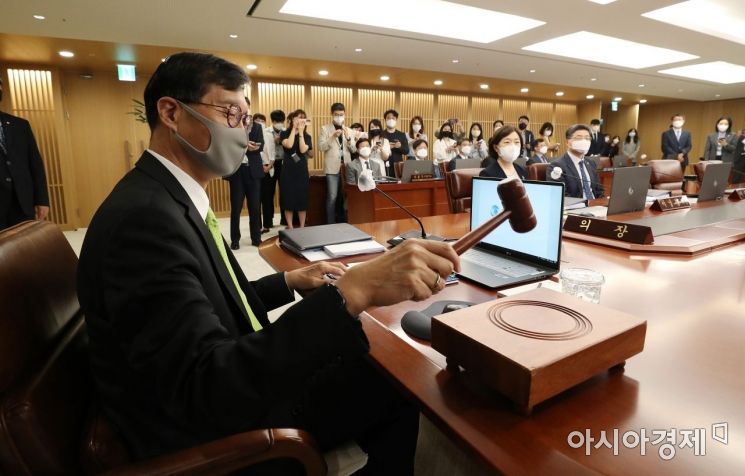
 Lee Chang-yong, Governor of the Bank of Korea, is presiding over the Monetary Policy Committee meeting held on the 26th at the Bank of Korea in Jung-gu, Seoul. Photo by Joint Press Corps
[Asia Economy Reporter Hwang Junho] Following July, there is a growing expectation that the Bank of Korea's Monetary Policy Committee may implement a big step in August as well, with analyses suggesting that the latter part of the interest rate hike cycle is gradually approaching.
On the 1st, Jaekyun Lim, a bond researcher at KB Securities, stated, "Amid continued volatility in government bond yields, the peak is expected to form around the August Monetary Policy Committee meeting," adding, "The 3-year bond yield will be around 3.36~3.60%, and the 10-year bond yield around 3.42~3.63%."
The expansion of interest rate volatility is inevitable given the high possibility that the Bank of Korea will implement a big step (50bp). The Bank is likely to take a big step to cool soaring inflation, including Korea's expected inflation rising to 3.9% and the consumer price index for June expected to exceed 6%.
In particular, since the Federal Reserve (Fed), which determines U.S. monetary policy, is expected to take a giant step (75bp) in July, a big step could also be taken at the August Monetary Policy Committee meeting. In such a case, the expansion of interest rate volatility could become even greater.
However, if the interest rate direction is set according to this scenario by next month, there could be a perception that the interest rate hike cycle has entered its latter phase. This is because, amid the inevitable negative impact on exports due to the global economic slowdown, the increase in household interest expenses caused by rising inflation and interest rates reduces real consumption capacity. If the revised economic outlook to be announced in August lowers next year's growth rate from the existing 2.4% to the potential growth rate level in the low 2% range, expectations may form that the Bank of Korea will not be able to raise rates next year.
Researcher Lim explained, "Following the Fed's consecutive giant steps, the rate hike magnitude may decrease for the first time in September," adding, "If the reduction in the rate hike magnitude is confirmed, market interest rates will stabilize quickly, but the leading nature of the market must be considered."
He stated, "If the future economic cycle environment is not the typical 'disinflation -> deflation' recession seen since the 1980s, but rather a transition to 'stagflation -> deflation' where inflation and recession occur simultaneously, bond investors should focus on buying the dip mainly in tenors under 3 years for the time being," adding, "However, it is not necessary to be proactive, and portfolios should be gradually adjusted by reducing credit duration and increasing quality."
© The Asia Business Daily(www.asiae.co.kr). All rights reserved.

















