[Asia Economy Yeongnam Reporting Headquarters, Reporter Hwang Du-yeol] The preliminary feasibility study for the Busan city urban railway construction project ‘Hadan~Noksan Line’ passed the final administrative procedure, the Ministry of Strategy and Finance’s Fiscal Project Evaluation Committee, on June 30.
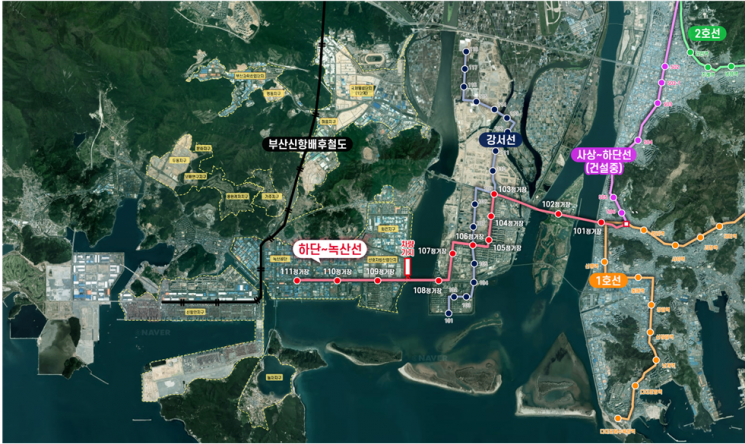
The ‘Hadan~Noksan Line’ is a new urban railway project extending the currently under-construction ‘Sasang~Hadan Line.’ The railway will connect a total of 13.47 km from Hadan Station, passing through Eulsukdo and Myeongji International New City, to the Noksan National Industrial Complex.
Starting from Hadan Station, the terminus of the Sasang~Hadan Line on Urban Railway Line 1, 11 stations and one vehicle depot are planned, with the vehicle type being a light rail (K-AGT) with rubber tires.
The total project cost is 1.1265 trillion KRW, with 605 billion KRW from the national government, 403.2 billion KRW from the city, and 118.3 billion KRW from LH Corporation’s development profit-sharing for Myeongji International New City, aiming for completion in 2029.
The city conducted a preliminary feasibility study by the Ministry of Strategy and Finance from May 2018 to May 2020 to expedite the construction of the ‘Hadan~Noksan Line,’ but unfortunately did not pass, receiving an economic feasibility (B/C) of 0.85 and a comprehensive evaluation (AHP) of 0.497.
Accordingly, to secure operational efficiency and economic feasibility, the city re-planned the project by deleting two stations and reducing the 930m extension at the terminus, and reapplied for the preliminary feasibility study at the end of 2020.
Subsequently, the preliminary feasibility study restarted in February 2021, and through various administrative procedures such as site inspections, interim review meetings, subcommittee meetings, and the Fiscal Project Evaluation Committee, the project’s necessity and policy effects were recognized, leading to the final approval of the preliminary feasibility study.
According to the Ministry of Strategy and Finance and Korea Development Institute (KDI) preliminary feasibility study results, the re-planned ‘Hadan~Noksan Line’ construction project received an economic feasibility (B/C) of 0.89 and a comprehensive evaluation (AHP) of 0.542, showing somewhat insufficient economic feasibility but passing the comprehensive evaluation criteria.
The Gangseo area is home to about 74,000 workers across approximately 3,700 companies in the Noksan National Industrial Complex, general industrial complexes, and the Busan New Port hinterland industrial logistics complex.
Moreover, despite the massive population influx due to large-scale developments such as Myeongji Ocean City and Myeongji International New City, the geographical conditions of crossing the Nakdong River have limited the expansion of urban infrastructure, causing chronic traffic congestion on major thoroughfares leading into the city center.
This traffic congestion has exacerbated the labor shortage in the Gangseo-gu industrial complexes.
Similar western Busan areas like Sasang-gu and Saha-gu have significantly higher job-seeker rates than job vacancy rates, but Gangseo-gu, suffering from long commute times and insufficient public transportation infrastructure, faces severe labor shortages, making urban railway construction urgent.
The city expects the ‘Hadan~Noksan Line’ to be the most fundamental and innovative solution to severe traffic congestion by ▲preemptively addressing future traffic demand increases in the western Busan area undergoing large-scale development projects ▲expanding public transportation options and creating a pleasant and safe transportation environment ▲improving employment conditions in national and general industrial complexes to revitalize industry ▲enhancing east-west accessibility to promote balanced urban development and strengthen urban competitiveness.
Above all, it is expected that reduced travel times will improve the quality of life for industrial complex workers by allowing more relaxed morning preparations, sufficient sleep, and increased family time, while expanding the shared living area will double the happiness levels felt by local residents.
Additionally, the project is projected to generate significant economic ripple effects, including ▲production inducement effect of 2.0581 trillion KRW ▲value-added inducement effect of 815.4 billion KRW ▲employment inducement effect of 14,172 people ▲job inducement effect of 16,079 people, which will greatly contribute to revitalizing Busan’s regional economy, long stagnant due to COVID-19 and other factors.
Busan Mayor Park Hyung-jun stated, “Although the Gangseo area and western Busan have played a pivotal role in Busan’s economy for over 30 years, they have lived with feelings of alienation and deprivation due to development disparities,” adding, “With the preliminary feasibility study approval for the ‘Hadan~Noksan Line,’ we can now meet the aspirations of the western Busan residents.”
Mayor Park added, “I hope that, based on the railway, western Busan will establish itself as the future center of Busan and further become a new growth axis for the Republic of Korea.”
The city plans to expedite the completion of prior administrative procedures such as basic plan approval, basic and detailed design, and project plan approval after consultations with central government ministries to ensure smooth opening within the target year.
© The Asia Business Daily(www.asiae.co.kr). All rights reserved.

















