June Exports $57.73 Billion... Trade Deficit $2.47 Billion
Cumulative Trade Deficit This Year $10.3 Billion... Faster Than Foreign Exchange Crisis
Supply Chain Disruptions Hit Hard... Energy Imports Double in One Year
[Asia Economy Sejong=Reporter Lee Jun-hyung] The trade balance recorded a deficit for three consecutive months for the first time in 14 years since the 2008 financial crisis. The pace at which the trade deficit is accumulating is faster than during the 1997 foreign exchange crisis. While exports decreased due to global economic instability, imports increased as a result of the sharp rise in energy prices. Analysts say that warning lights have turned on for trade, the 'growth engine' of the Korean economy.
According to the 'June Export-Import Trends' announced by the Ministry of Trade, Industry and Energy on the 1st, the trade balance recorded a deficit of $2.47 billion last month. Imports last month were $60.2 billion, up 19.4% compared to the same period last year, while exports increased by only 5.4% to $57.73 billion. The trade balance has been in deficit for three consecutive months since April, which posted a $2.46 billion deficit. This is the first time since June to September 2008, when the global financial crisis hit, that the trade balance has recorded a deficit for three consecutive months.
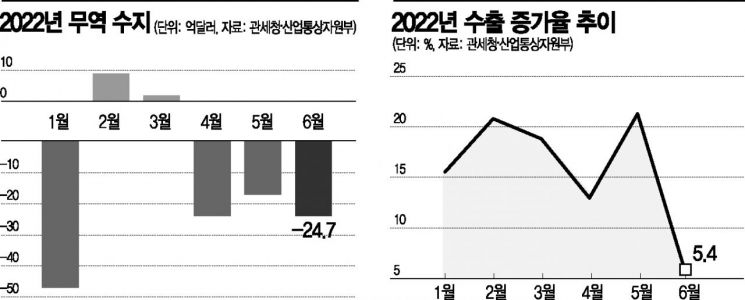
As a result, the cumulative trade deficit for this year has been tallied at $10.3 billion. The trade deficit accumulated up to the first half of this year has already surpassed the $9.1565 billion deficit recorded in the first half of 1997, just before the foreign exchange crisis. During the 2008 financial crisis, the cumulative trade deficit exceeded $10 billion only in August.
The unprecedented scale of the soaring trade deficit is due to the sharp rise in global energy prices, which significantly increased import amounts. Last month, imports of the three major energy sources?crude oil, gas, and coal?amounted to $13.73 billion, an increase of $5.34 billion compared to the same period last year ($8.39 billion). Based on the first half of this year, energy imports reached $87.9 billion, nearly double the $46.9 billion recorded in the same period last year. A Ministry of Trade, Industry and Energy official said, “Energy imports are the core factor of the trade deficit,” adding, “Agricultural products, which have shown an increase in imports due to high prices, also partially influenced the deficit.”
The problem is that the trade deficit is likely to continue in the second half of this year. This is because international oil prices show no signs of stabilizing, and major countries are strengthening their 'food protectionism' policies, causing grain prices to soar. In fact, agricultural product imports in the first half of this year amounted to $13.5 billion, an increase of $2.2 billion compared to the same period last year ($11.3 billion).
There is also an analysis that this year's trade balance could reach the highest level since the 2008 financial crisis. The Korea International Trade Association recently forecasted in a report that the annual trade balance would record a deficit of $14.7 billion. During the financial crisis, the annual trade deficit was $13.26741 billion.
The government is also concerned about the impact on exports due to the deterioration of external trade conditions. Minister of Trade, Industry and Energy Lee Chang-yang stated, “Consecutive deficits have occurred due to the surge in imports caused by the sharp rise in energy prices,” adding, “This is a serious situation where uncertainties in trade overall are intensifying due to the slowdown in global growth and worsening supply chain instability.” He continued, “The expansion of energy demand in the summer and the trend of high oil prices are combined, increasing concerns about the continuation of the trade deficit,” and added, “It is a time when thorough management of risks surrounding our industry and trade is necessary.”
© The Asia Business Daily(www.asiae.co.kr). All rights reserved.


















