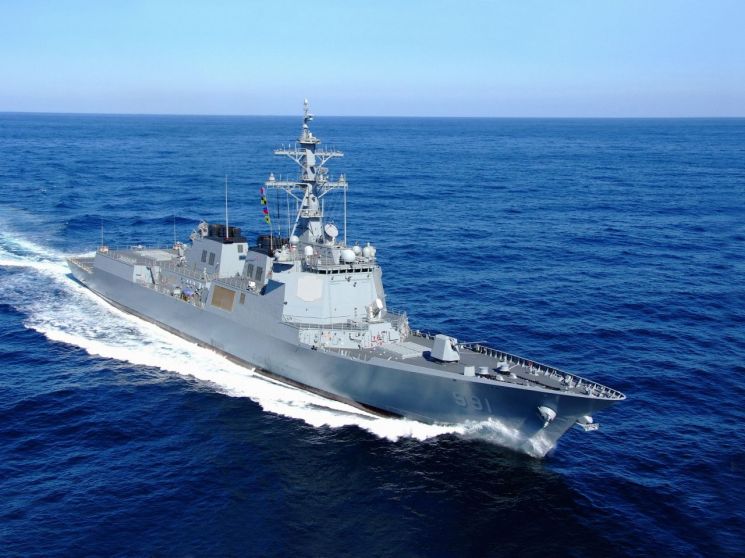
[Asia Economy Yang Nak-gyu, Military Specialist Reporter] The Navy plans to begin measuring marine radioactive contamination in response to Japan's planned discharge of Fukushima nuclear power plant water in March next year.
According to military officials on the 1st, the Navy plans to introduce a mobile measuring device capable of real-time radiation monitoring at sea within this year.
Contaminated water mixed with high concentrations of radioactive substances is generated daily at about 140 tons from Units 1 to 4 of the Fukushima Daiichi Nuclear Power Plant. Since the radioactive contaminated water is expected to reach the waters around the Korean Peninsula within 2 to 3 years after Japan begins discharging it into the ocean, the Navy intends to prepare in advance.
The issue is that if radiation is detected on naval vessels after the discharge, it could affect military operations. Although desalination devices exist, they become useless when exposed to radiation. These devices filter out salt and impurities from seawater for use as drinking water and other purposes on board.
If radiation is detected, only the water on the vessel can be used. Destroyers have enough water for up to about 15 days. The Navy plans to shorten the vessel rotation cycle if radiation is detected, but operational losses are inevitable.
A military official said, "If radioactive contamination occurs in our waters, there is a possibility of military friction between Korea and Japan, similar to the low-altitude threat flight incident by the Japan Maritime Self-Defense Force patrol aircraft targeting our naval vessels in 2018."
However, there is also an assessment that it will not affect the diplomatic relationship framework significantly. A diplomatic expert stated, "If Japan raises this as an issue, there is nothing we can do," indicating that the possibility of it affecting the improvement of bilateral relations is low.
© The Asia Business Daily(www.asiae.co.kr). All rights reserved.
![User Who Sold Erroneously Deposited Bitcoins to Repay Debt and Fund Entertainment... What Did the Supreme Court Decide in 2021? [Legal Issue Check]](https://cwcontent.asiae.co.kr/asiaresize/183/2026020910431234020_1770601391.png)















