7th and 9th Grade Civil Servant Competition Rate Plummets
Increase in Voluntary Resignations Among Low-Rank Civil Servants
Junior Employees Value 'Compensation' and 'Freedom', Seniors Value 'Achievement' and 'Belonging'... Changing Perceptions of Job Culture
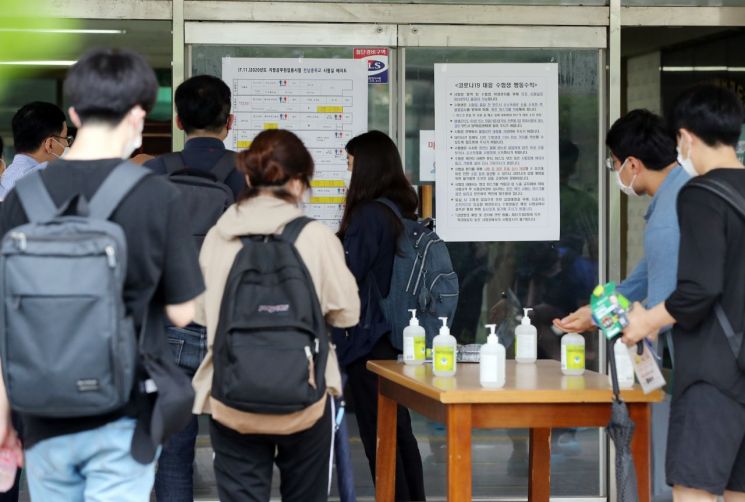 On the morning of July 11, 2020, examinees are sanitizing their hands and entering the examination room set up at a middle school in Seo-gu, Gwangju, for the national civil service level 9 written exam. [Image source=Yonhap News]
[Asia Economy Reporter Kim Jung-wan] #. Kim (26), a job seeker who has been preparing for the civil service exam for the past year, has decided to shift focus to preparing for private sector jobs. Although he initially challenged himself with the belief that passing the exam would secure a stable job, he heard that there are many overtime hours and weekend shifts. He stated, "Since the salary is low and the workload is heavy, I felt it wasn't worth spending over a year preparing for this."
Due to the guarantee of stable employment, the so-called "iron rice bowl" civil service exam competition rates have hit rock bottom. While there is analysis that the job perspectives of the MZ generation are changing, there is also an interpretation that the advantage of "stability" itself has disappeared.
In recent years, the number of applicants for civil service has noticeably decreased. According to the Ministry of Personnel Management, the competition rate for the Grade 7 civil service exam this year was 42.7 to 1, down more than 10% from last year's 47.8 to 1. This competition rate is the lowest since 1970, when it was 23.5 to 1. The Grade 7 open recruitment competition rate, which was 76.7 to 1 in 2016, declined to 66.2 to 1 in 2017, 47.6 to 1 in 2018, 46.4 to 1 in 2019, and 46 to 1 in 2020. The Grade 9 civil service exam competition rate also recorded 29.2 to 1 this year, the lowest since 1992 when it was 19.3 to 1.
The number of voluntary resignations among young civil servants is also increasing. According to the Government Employees Pension Service, 5,961 civil servants aged 18 to 35 retired in 2020, an increase of more than 1,500 compared to 4,375 in 2017. Those who retired within five years of service numbered 9,968, accounting for 21% of all retired civil servants.
In this way, the preference for civil service among the younger generation is declining. According to last year's Statistics Korea social survey, the top workplace where 13- to 34-year-olds most want to work was large corporations (21.6%). National institutions (21.0%) ranked third, following public enterprises (21.5%). This contrasts with 2009, when national institutions (28.6%) ranked first, ahead of public enterprises (17.6%) and large corporations (17.1%).
 Junior public officials and senior public officials gave different answers about occupational culture.
 [Image source=Getty Images]
This change in civil service demand is analyzed to be due to changing perceptions of work culture. According to a 2020 survey conducted by the Ministry of the Interior and Safety targeting central administrative agencies and local government civil servants, juniors responded to the keyword "work life" with answers like "reward according to work" and "freedom," whereas seniors cited "sense of achievement" and "sense of belonging." Regarding the "meaning of company dinners," juniors viewed them as "infringement on leisure time," while seniors evaluated them as "opportunities for communication."
A first-year local government civil servant A (in their 20s) sighed, saying, "The workload is more excessive than I expected." He added, "I knew the salary was low when I started, but it feels too little compared to the work. When I think that income is not guaranteed according to the work, I wonder if I can continue in this job for a long time."
Among low-ranking civil servants, there are also criticisms that the "stability" itself has decreased. This is because, with the pension payment rate reformed, contributions have increased while refunds have decreased. The civil servant pension has been reformed since 2016. Currently, the personal contribution rate has increased by 2 percentage points (p) to 9%, while the payment rate has decreased by 0.2 p to 1.7%.
© The Asia Business Daily(www.asiae.co.kr). All rights reserved.

















