2026 Global Blood Glucose Device Market Expected to Reach 35 Trillion Won
Rapid Expansion Surpassing Self-Monitoring Devices
Low Accuracy Cited as Limitation
Domestic Companies Like i-SENS Challenge Localization
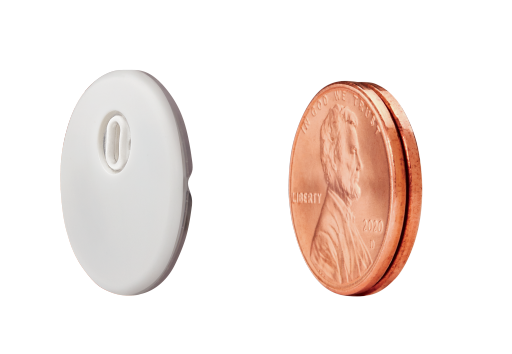 Abbott's continuous glucose monitoring device 'FreeStyle Libre 3' body-attached sensor. With a diameter of 21 mm, it is similar in size to a US one-cent coin (19 mm).
[Asia Economy Reporter Lee Chun-hee] The landscape of the blood glucose monitoring device market, essential for diabetes patients to check their blood sugar levels, is undergoing significant changes. Continuous Glucose Monitoring (CGM) devices, which automatically measure blood sugar when attached to the body, are rapidly spreading, overtaking Self-Monitoring of Blood Glucose (SBGM) devices that require direct blood sampling.
According to industry sources on the 1st, the International Diabetes Federation (IDF) recently estimated that the number of adult diabetes patients, which was around 540 million last year, will increase to 780 million by 2045. Since regular blood sugar checks are essential for diabetes patients, the blood glucose monitoring device market is expected to grow rapidly. However, SBGM involves cumbersome processes such as pricking fingers for blood sampling, causing psychological burden on patients. In contrast, CGM devices, when attached to the arm or abdomen, continuously and automatically measure blood sugar levels.
Market research firm Mordor Intelligence forecasts that the global blood glucose device market will grow from $17.2 billion (approximately 22 trillion KRW) last year to $27.2 billion (approximately 35 trillion KRW) by 2026. In particular, the market share of CGM is continuously increasing. In South Korea, after applying health insurance coverage for CGM and consumables for type 1 diabetes patients in 2020, the government recently decided to apply health insurance fees for medical procedures such as CGM-based testing and interpretation of test results, accelerating CGM adoption.
However, the lower accuracy compared to SBGM has been pointed out as a limitation of CGM. It has been difficult to reduce the Mean Absolute Relative Difference (MARD), which indicates the difference between actual blood sugar and continuous glucose measurements, below 10%. This is why Abbott’s ‘Freestyle Libre 3’ received attention at the American Diabetes Association (ADA) conference held last month. Libre 3 succeeded in lowering the MARD to 7.9%. Dexcom also recently received approval in Europe for its ‘G7’, which reduces the sensor size by 60% compared to previous models, indicating intensifying global market competition.
When Will Domestic CGM Be Available?
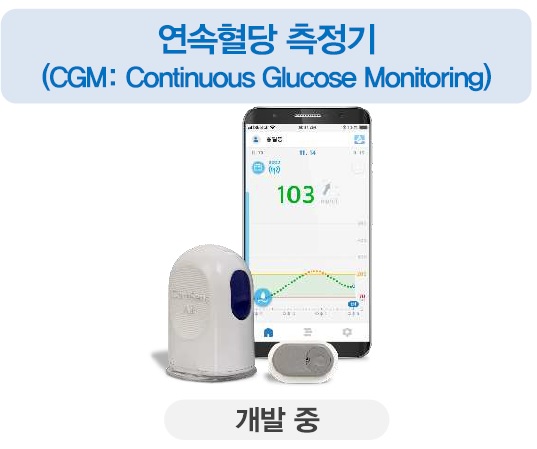
However, domestic CGM devices have yet to be developed. Only imported and distributed products such as Abbott’s Freestyle Libre, Dexcom’s ‘G6’ imported and sold by Huons, and Medtronic Korea’s ‘Guardian’ are available in the domestic market.
Challenges from domestic biotech companies aiming to develop CGM continue. Currently, i-SENS, UXN, and Philosys have entered the localization race. The most advanced among them is i-SENS, which has been conducting CGM confirmatory clinical trials in South Korea since January. Unlike pharmaceuticals, which undergo phases 1 to 3 clinical trials, medical devices are divided into ‘exploratory clinical trials’ at the initial research stage and ‘confirmatory clinical trials’ at the product development stage. Successfully completing confirmatory trials means product commercialization is imminent.
Nam Hak-hyun, CEO of i-SENS, said, “We expect the confirmatory clinical trial results to be available around September,” adding, “Considering the analysis of clinical data and subsequent approval processes, we expect to launch the product in the first half of next year.” Currently, i-SENS’s MARD is around 9-10%. CEO Nam explained, “MARD will inevitably decrease as actual patient data accumulates,” and “We will continue to reduce it after market launch.”
UXN, developing a platinum-based ‘AGMS’, received a 40 billion KRW investment from SD Biosensor last year, boosting product development momentum. They are targeting a MARD of 9.9% and plan to pursue domestic clinical trials and regulatory approval next year.
© The Asia Business Daily(www.asiae.co.kr). All rights reserved.


















