Stock Market Expected to Enter Deeper Bear Market with Additional 50% Drop
"Central Banks Worldwide Likely to Struggle Maintaining Hawkish Stance"
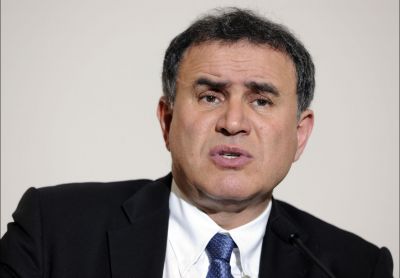 Photo by Professor Rubini Bloomberg
[Asia Economy Reporter Kim Hyunjung] Professor Nouriel Roubini of New York University, a leading pessimist who predicted the 2008 global financial crisis known as 'Dr. Doom,' has warned of a complex crisis combining the characteristics of the 1970s and 2008. He stated that the upcoming situation, involving deflation (economic recession) and financial crisis, will not be short-lived or mild, and forecasted that the stock market could drop by as much as 50%.
On the 30th (local time), Professor Roubini posted an article on the international opinion platform 'Project Syndicate,' raising the possibility of a 'stagflationary debt crisis.' Diagnosing that the supply-side issues are increasingly dominant behind the recent inflation, which was a mix of demand and supply factors, he argued, "Inflation caused by supply problems is stagflationary, and therefore tightening monetary policy increases the risk of a hard landing."
He particularly expressed skepticism that central banks around the world will maintain a hawkish (monetary tightening) stance due to concerns about an economic hard landing. Professor Roubini explained, "If central banks ease tightening, inflation will persist, leading to economic overheating (inflation exceeding targets and potential growth) or stagflation." He added, "While most analysts seem to believe central banks will remain hawkish, when a hard landing is imminent, they will accept and tolerate higher inflation."
Regarding some forecasts that the upcoming recession will be mild and short-term, he criticized them as "dangerously naive." Citing that the global public and private debt level relative to GDP has surged from 200% in 1999 to 350% recently, he predicted that the future recession will follow a severe stagflationary path.
Professor Roubini emphasized, "The upcoming crisis will not be like before," noting, "During the 1970s stagflation, there was no debt crisis, and after 2008, the debt crisis led to low inflation or deflation." He warned, "Today, we are heading toward a crisis that combines 1970s-style stagflation and 2008-style debt crisis."
He expressed concern that "the current situation is fundamentally different from the early months of the global financial crisis or the pandemic, when central banks could aggressively ease monetary policy in response to reduced aggregate demand and deflationary pressures," adding, "Fiscal expansion will be more limited this time." In particular, he noted, "Most fiscal ammunition has been used up, and public debt is unsustainable."
At the end of his article, he predicted that the stock market, which has been in a bear market, will mostly continue to decline without a rebound, with a drop close to 50%. He explained, "During recessions, U.S. and global stocks fell about 35%, but this recession will be accompanied by stagflation and a financial crisis, so the decline could approach 50%."
© The Asia Business Daily(www.asiae.co.kr). All rights reserved.
















