Industry "Raw material prices more than doubled"
Park Hong-geun "Must introduce linked delivery price system"
[Asia Economy Reporter Koo Chae-eun] The Democratic Party of Korea has promised to legislate the 'Introduction of the Delivery Price Linkage System' within this year. The delivery price linkage system is a mechanism that automatically reflects changes in raw material prices in the delivery price during subcontract transactions between the original contractor and subcontractors. The purpose is for large and small-to-medium enterprises to share the burden of rising raw material costs. The Democratic Party had already proposed amendments to the Win-Win Cooperation Act and the Subcontracting Act last year.
Since the ruling party and government have also included the implementation of the delivery price linkage system as a campaign pledge for the presidential election, related discussions are expected to gain momentum once the parliamentary organization is completed in the second half of the year.
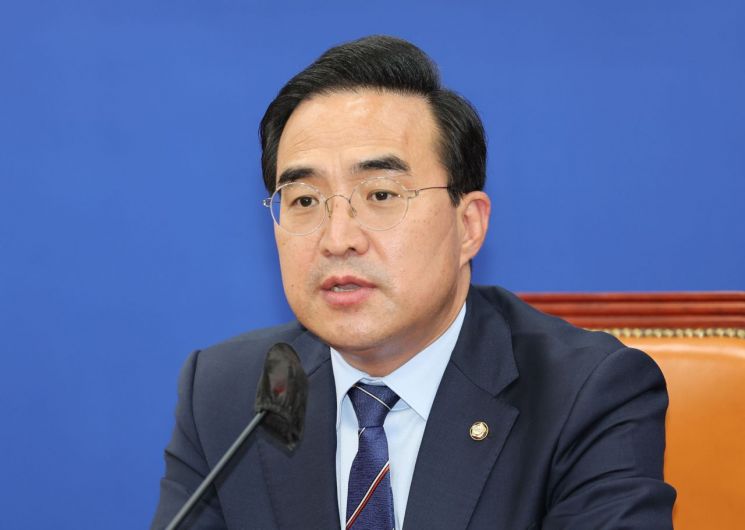
On the 30th, Park Hong-geun, the floor leader, said at the Democratic Party’s Livelihood Priority Practice Group legislative forum on the introduction of the delivery price linkage system held at the National Assembly in Yeouido, Seoul, “Raw material prices have risen so much that we are losing money every time we deliver. Moreover, we do not know how long the global adverse conditions will continue,” adding, “The National Assembly will step up and do what it must.”
He particularly emphasized, “Following the triple hardships of high interest rates, high exchange rates, and high oil prices, electricity and gas prices are also rising. Small and medium enterprises are bearing losses due to increased costs,” and added, “The Democratic Party will achieve definite legislative results centered on the Livelihood Priority Practice Group by introducing the delivery price linkage system.” He continued, “If we fail to overcome this crisis, not only small and medium enterprises but also large corporations and the entire Republic of Korea will be shaken. We will resolve unfairness so that small and medium enterprises can focus on their business activities.”
Kim Nam-geun, a lawyer who presented at the forum, repeatedly stressed the need for legislation related to the delivery price linkage system. Lawyer Kim said, “Generally, sales are one-time contracts, so only the issue of performance remains. However, current contracts only set the basics and require continuous transactions,” adding, “In the U.S., this is called a relational contract. Continuous and relational contracts set only the basics and require cooperation to maintain the contractual relationship.”
He further explained, “Long-term transactions like delivery transactions must follow this theory. It is necessary for small and medium enterprises and large corporations to reasonably modify contract terms while maintaining the contract.”
Yoo Byung-jo, president of the Korea Window Curtain Wall Association, who gave a case presentation, said, “Our company manufactures windows using aluminum. As of June 2021, the price of aluminum was 3,000 KRW per kilogram, but after the Ukraine-Russia war, it rose to 6,200 KRW and has slightly eased since,” emphasizing, “If the political sector had not taken interest, more than 90% of the industry would have gone bankrupt. The introduction of the delivery price linkage system is necessary to ensure this never happens again.”
Song Gap-seok, head of the Democratic Party’s delivery price linkage system introduction team, said, “Since there are many voices and concerns from the field due to rising raw material prices, we will ensure that the delivery price linkage system can be implemented within this year,” adding, “Because there are many stakeholders and complexities, we will refine the bills to ensure the system settles in the market without side effects.”
© The Asia Business Daily(www.asiae.co.kr). All rights reserved.

















