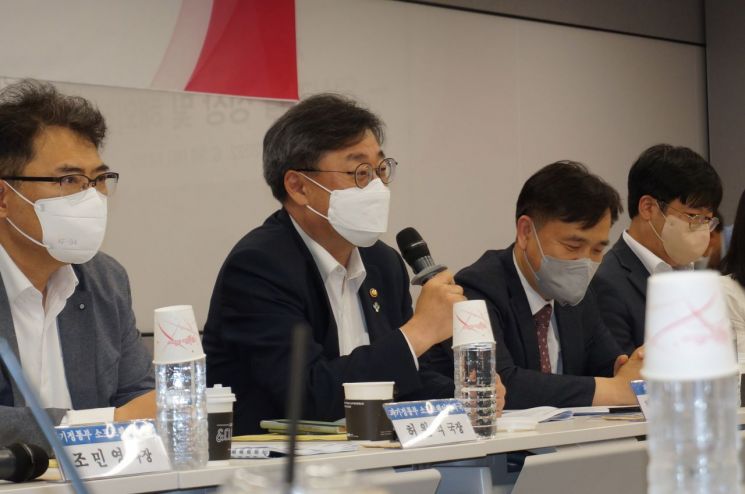
 Park Yoon-kyu, the 2nd Vice Minister of the Ministry of Science and ICT (second from the left), is attending the "2nd Digital National Agenda Continuous On-site Meeting" held on the afternoon of the 30th at the Hankook Tire Building in Gangnam-gu, Seoul, discussing support measures for the growth and overseas expansion of software companies.
[Asia Economy Reporter Lim Hye-seon] Park Yoon-kyu, the 2nd Vice Minister of the Ministry of Science and ICT, held the "2nd Digital National Agenda Continuous On-site Meeting" on the 30th under the theme of "Support Measures for the Growth and Overseas Expansion of Domestic Software (SW) Companies for the Qualitative Leap of the Software Industry."
The meeting was attended by Yoo Seok-hwan, CEO of Rokit Healthcare; Lim Jin-seok, CEO of Goodoc; Jang Ji-ho, CEO of Dr. Now; Kwak Young-ho, CEO of Hunter Global; Lee Seon-woong, CEO of Cloudike; Oh Young-soo, Vice President of Younglimwon Soft Lab; Shin Sung-won, Vice President of 1toCM; Lee Sang-guk, Executive Director of AhnLab; and Woo Kyung-il, Director of Hancom Intelligence, all of whom are active as SW specialized companies in various fields such as healthcare, culture, fintech, information security, and smart cities.
According to the Ministry of Science and ICT, the production value of software reached 66.4 trillion KRW in 2020, growing at an average annual rate of 7.7%. During the same period, software exports amounted to 15.82 billion USD, growing at an average annual rate of 11.3%.
The participants agreed that "for domestic SW companies to grow to a global level, it is necessary not only to advance technologically but also to actively enter overseas markets to accumulate diverse know-how." They also shared opinions on the difficulties faced during overseas expansion and efficient government support measures to overcome them.
Companies requested government policies and technical support to alleviate difficulties such as the need to separately develop SaaS (Software as a Service) tailored to various clouds to expand SaaS development suitable for overseas expansion, and the burden of security certification. SaaS is a method of providing software as a cloud-based service over the internet without installing it on the user's PC.
They also agreed on the need to expand government support for selecting and intensively researching and developing promising R&D fields where global SW technology dominance is possible to realize a "digital economic hegemony nation," and on the necessity of establishing a cooperative system between the government and export companies for small and medium enterprises to comply with the SW strategic materials export licensing system. The strategic materials management system controls the export of goods, software, and technology that require export permits or restrictions for international peace, security maintenance, and national security under the principles of the international export control regime, as they can be diverted for use in weapons, etc.
They also requested the expansion of the "SW High-Growth Club" project, the most preferred government support program by companies. This project targets companies with high growth potential and supports them by allowing the use of funds (100 million to 300 million KRW) without the government predefining the purpose, enabling companies to use the funds as they wish. Companies can use the funds to hire personnel, cover SW quality certification costs, marketing expenses, and other various needs.
Vice Minister Park Yoon-kyu said, "To realize the national agenda of a 'qualitative leap in the SW industry,' our SW companies must enhance their competitiveness not only in the domestic SW market but also in overseas markets." He added, "The government will strive to improve regulations that hinder SW exports overseas and expand R&D support to strengthen the global technological competitiveness of specialized SW companies."
© The Asia Business Daily(www.asiae.co.kr). All rights reserved.

















