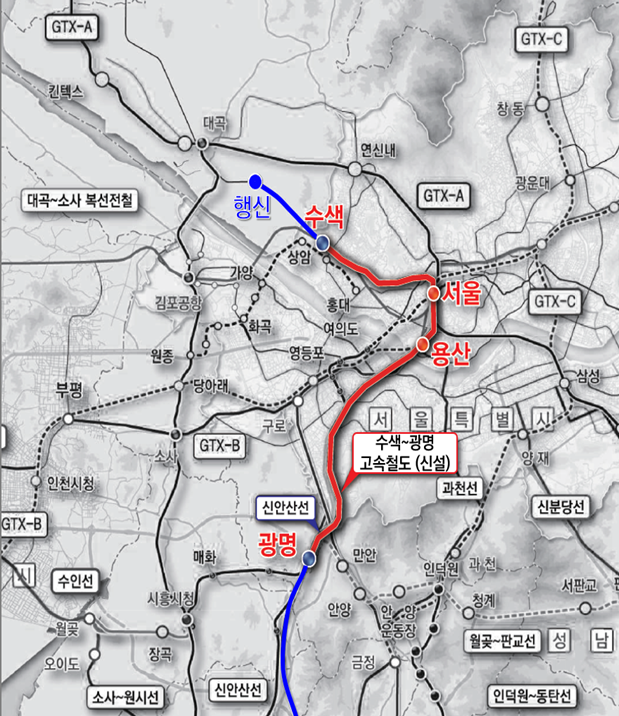
[Asia Economy Reporter Ryu Tae-min] Three projects, including the construction of the Susaek~Gwangmyeong high-speed railway, have passed the preliminary feasibility study.
On the 30th, the Ministry of Land, Infrastructure and Transport announced that the Susaek~Gwangmyeong high-speed railway construction project, the Busan Metro (Hadan~Noksan Line) construction project, and the Jungang Expressway (Gimhae Airport~Daedong section) expansion project have passed the Ministry of Economy and Finance's preliminary feasibility study.
First, the Susaek~Gwangmyeong high-speed railway construction project involves building a dedicated high-speed rail line underground over a total distance of 23.6 km from Gwangmyeong through Yongsan and Seoul Station to the Susaek train depot. The total project cost is 2.4823 trillion KRW. The Ministry of Land, Infrastructure and Transport plans to start establishing the basic plan in the second half of this year, proceed with basic and detailed designs from next year, and begin construction in 2025.
The economic feasibility evaluation (B/C) result for this project is 1.11. A project is considered feasible if the economic feasibility score is 1.0 or higher or the comprehensive evaluation (AHP) score is 0.5 or higher.
Until now, the Seoul~Gwangmyeong section has been operated by various trains such as KTX, freight trains, and electric trains, which prevented it from functioning fully as a high-speed railway, and there were several issues including insufficient track capacity. With this project, the entire section will be constructed as a dedicated high-speed rail line, reducing travel times for all high-speed trains departing from Seoul and Yongsan, allowing KTX passengers to enjoy faster rail services. The travel time from Seoul Station to Gwangmyeong Station, which previously took about 14 minutes and 30 seconds, will be shortened by about 5 minutes to approximately 9 minutes and 30 seconds.
Additionally, increased track capacity will allow for additional KTX operations, enabling passengers to travel more frequently. The interval between trains will be shortened, reducing waiting times and significantly decreasing actual travel time, including travel and waiting times. Currently, 120 KTX trains operate daily between Seoul (Yongsan) Station and Gwangmyeong Station, but this is planned to increase to 180 trains per day by 2029.
Kang Hee-up, Director of the Railway Bureau at the Ministry of Land, Infrastructure and Transport, stated, “With the passage of this preliminary feasibility study, we can complete the last section of the Gyeongbu High-Speed Railway,” adding, “We will provide perfect high-speed rail services to the public by well linking this with the ongoing Gwangmyeong~Pyeongtaek double-tracking and Pyeongtaek~Osong double-tracking projects.”
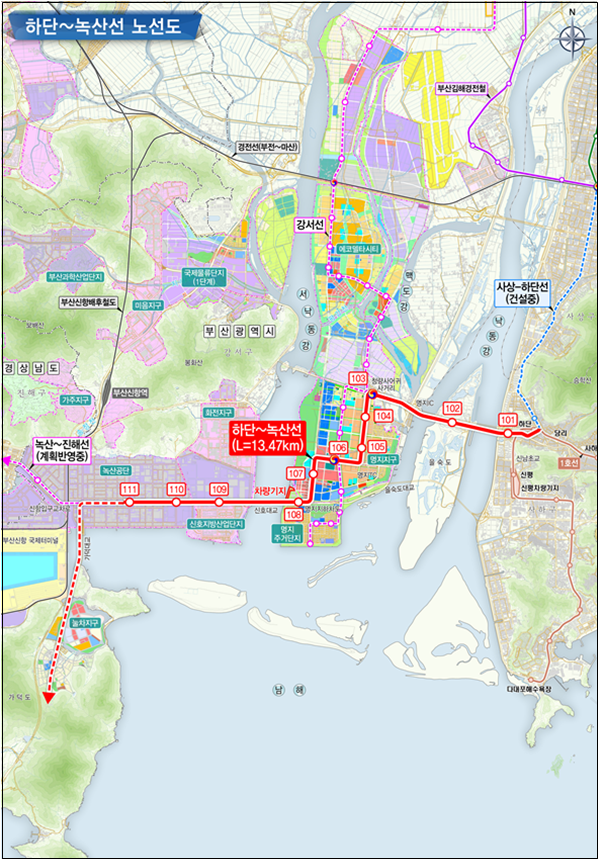
Another approved project, the Busan city ‘Hadan~Noksan Line’ construction project, is an extension of the ‘Sasang~Hadan Line’ (6.9 km from Gwaebeop-dong, Sasang-gu to Hadan-dong, Saha-gu, Busan), which is currently under construction. Starting from Hadan Station, it connects Eulsukdo and Myeongji International New City to the Noksan National Industrial Complex over 13.47 km. There are 11 stations in total, and the total project cost is 1.1265 trillion KRW.
The ‘Hadan~Noksan Line’ initially underwent a preliminary feasibility study from March 2018 to May 2020 but failed to pass with an economic feasibility (B/C) of 0.85 and a comprehensive evaluation (AHP) of 0.497. Subsequently, the project was re-planned to secure economic feasibility by excluding two stations and partially reducing the terminal section extension by 0.93 km, and the preliminary feasibility study was reapplied for in October 2020.
Busan City plans to immediately start follow-up procedures such as establishing the basic plan and aims to shorten the project period as much as possible, expecting to begin construction as early as 2026.
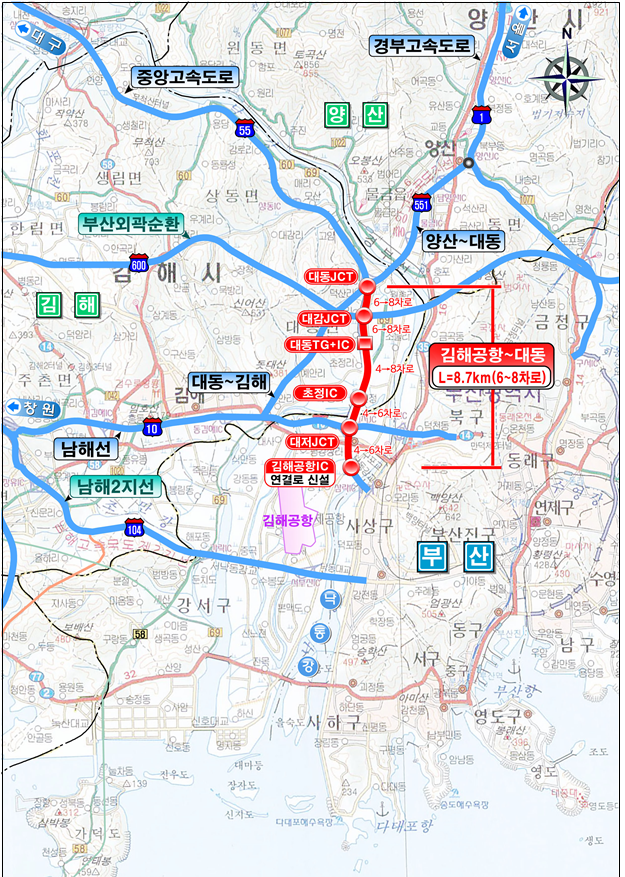
Additionally, the Jungang Expressway Gimhae Airport~Daedong section expansion project also passed the preliminary feasibility study. The Gimhae Airport~Daedong section experiences traffic volumes during rush hours that consistently exceed road capacity, resulting in very low road service levels (D~F level). The high proportion of freight trucks causes congestion and inconvenience even during daytime hours. As of last year, the maximum daily traffic volume was 113,428 vehicles, with freight traffic accounting for 40,889 vehicles per day.
This project connects 8.7 km from Daejeo-dong, Gangseo-gu, Busan Metropolitan City to Daedong-myeon, Gimhae City, Gyeongsangnam-do. The total project cost is 326.1 billion KRW. The expansion of the project section is expected to increase the number of users who can access Gimhae Airport within 30 minutes, making travel more convenient.
Lee Yoon-sang, Director of the Road Bureau at the Ministry of Land, Infrastructure and Transport, said, “Road shoulders are necessary spaces for emergency vehicles in case of accidents. Through this project, we will secure an appropriate number of lanes to restore road safety,” adding, “We will expedite follow-up procedures such as design to create a convenient and safe commuting route for residents of the Busan and Gyeongnam regions and do our best to start construction as early as 2026.”
© The Asia Business Daily(www.asiae.co.kr). All rights reserved.



















