Ministry of Land, Infrastructure and Transport Holds Deliberation Meeting and Lifts Regulation on 17 Areas
Daegu Suseong, Daejeon Yuseong and 6 Other Cities and Districts Removed from Speculative Overheating Zones
7 Districts in Daegu, Gyeongsan in Gyeongbuk, Yeosu in Jeonnam and 11 Other Cities and Districts Removed from Adjustment Target Areas
Sejong City Maintains Regulatory Zones... Subscription Competition Rates Remain High
Only Some Areas in the Seoul Metropolitan Area, Such as Danwon-gu in Ansan and Seosin-myeon in Hwaseong, Are Deregulated
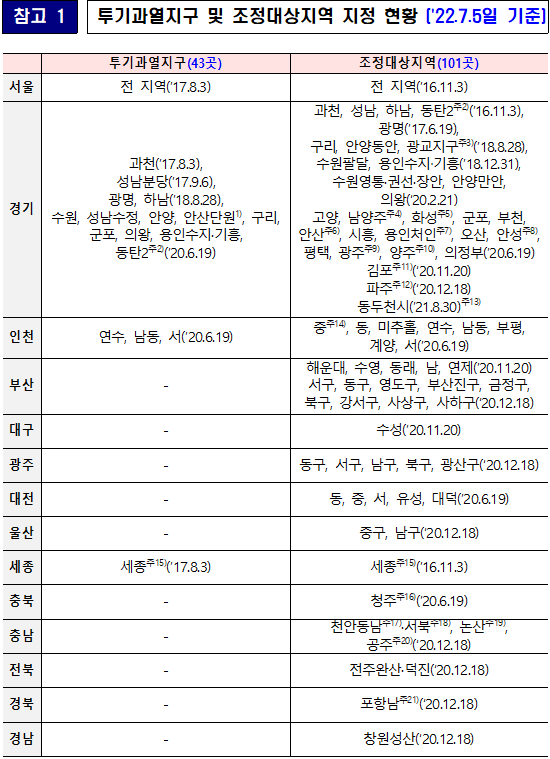
[Asia Economy Reporter Kim Min-young] Starting from the 5th of next month, six cities and districts including Daegu Suseong-gu, Daejeon Dong-gu, Jung-gu, Seo-gu, Yuseong-gu, and Changwon and Uichang in Gyeongnam will be removed from the speculative overheating zones. Six areas including Daegu Dong-gu, Gyeongsan in Gyeongbuk, and Yeosu, Suncheon, and Gwangyang in Jeonnam will be removed from the adjustment target areas. However, Sejong City, which has seen a decline in housing prices since last year, will maintain its regulatory zone designation considering that subscription competition rates remain high.
The Ministry of Land, Infrastructure and Transport announced on the 30th that it held the '2nd Residential Policy Deliberation Committee of 2022' and deliberated and approved the 'Adjustment Plan for Speculative Overheating Zones and Adjustment Target Areas.'
At the meeting, private committee members noted that due to interest rate hikes, concerns about economic recession, and fatigue from rapid housing price increases, buying demand has weakened, leading to an overall stabilization of housing prices recently. However, they analyzed that locally, the effects of housing price overheating remain, and the market situation is very sensitive as the upward trend continues mainly in preferred residential areas and some non-regulated areas.
They also suggested that in addition to quantitative factors such as housing price growth rates, subscription competition rates, and unsold housing trends, expectations for development benefits such as redevelopment projects, regional characteristics, and purchases by outsiders should be sufficiently considered.
Considering all these points, it was decided to partially lift the speculative overheating zones and adjustment target areas mainly in local regions where housing price increases were relatively low and unsold housing was clearly increasing. The committee judged that it was necessary to lift the designation of six speculative overheating zones in local areas, considering factors stabilizing the housing market such as interest rate hikes and the increase in unsold housing in local areas. Accordingly, Daegu Suseong-gu, Daejeon Dong-gu, Jung-gu, Seo-gu, Yuseong-gu, and Changwon and Uichang-gun in Gyeongnam will be removed from the speculative overheating zones.
The Ministry of Land explained, "Since the interest rate hike trend is expected to continue for the time being and loan regulations are being strengthened with the implementation of DSR Stage 3, there is a need to adjust the intensity of regulations in some local areas where unsold housing is increasing."
Previously, in December last year, the Ministry of Land held a residential policy deliberation committee to discuss deregulating regulatory areas such as Daegu and Changwon in Gyeongnam, but decided to maintain all 161 regulatory areas due to concerns about the 'balloon effect' caused by deregulation.
The committee also agreed to lift adjustment target areas in 11 local cities and districts where short- and long-term housing prices have continuously stabilized. As a result, Daegu Dong-gu, Seo-gu, Nam-gu, Buk-gu, Jung-gu, Dalseo-gu, Dalseong-gun, Gyeongsan-si in Gyeongbuk, and Yeosu-si, Suncheon-si, and Gwangyang-si in Jeonnam will be removed from the adjustment target areas.
Sejong City, which has seen a decline in housing prices since last year, will maintain its regulatory zone designation. Although housing prices have continued to decline recently, subscription competition rates remain high, indicating that potential buying demand still exists.
In the Seoul metropolitan area, since housing prices continue to rise in many areas or have not been long since they turned downward, and unsold housing remains low, regulatory zone designations will be maintained for the time being, with additional market monitoring planned.
However, some areas in Ansan and Hwaseong, which were designated as regulatory zones at the city and district level despite being island areas without apartments, will be removed from speculative overheating zones and adjustment target areas. The areas subject to deregulation in the speculative overheating zones include Daebudong-dong, Daebunam-dong, Daebubuk-dong, Seongam-dong, and Pungdo-dong in Danwon-gu, Ansan. These same areas in Danwon-gu, Ansan, and Seosin-myeon in Hwaseong will be removed from the adjustment target areas.
As a result of this deliberation, there are now 101 adjustment target areas and 43 speculative overheating zones. The approved adjustment plan for speculative overheating zones and adjustment target areas will take effect from 0:00 on July 5, when it is published in the official gazette.
Being designated as a regulatory zone subjects the area to extensive regulations on loans, taxes, and subscription. In adjustment target areas, the loan-to-value ratio (LTV) is limited to 50% for housing priced below 900 million KRW and 30% for the portion exceeding 900 million KRW. The debt-to-income ratio (DTI) is also capped at 50%, and real estate taxes such as capital gains tax and comprehensive real estate holding tax increase.
In speculative overheating zones, stronger loan regulations apply, with LTV capped at 40% for housing priced below 900 million KRW and 20% for the portion exceeding 900 million KRW, and redevelopment and other maintenance project regulations are tightened.
However, the areas removed from speculative overheating zones and adjustment target areas this time may be re-designated depending on future housing price trends. The Ministry of Land stated, "Since housing prices are currently stabilizing, there were many opinions that it is necessary to closely monitor the housing market situation by region in the second half of the year and, if necessary, adjust regulatory zones in small and medium-sized local cities excluded this time before the end of the year."
Lee Won-jae, 1st Vice Minister of the Ministry of Land, said, "Given the changes in macroeconomic conditions such as interest rate hikes surrounding the housing market, we will promptly respond to market conditions by closely monitoring unsold housing trends in some areas while inducing a clearer market stabilization trend and residential stability for the public through the swift concretization of the new government's supply policy."
© The Asia Business Daily(www.asiae.co.kr). All rights reserved.

















