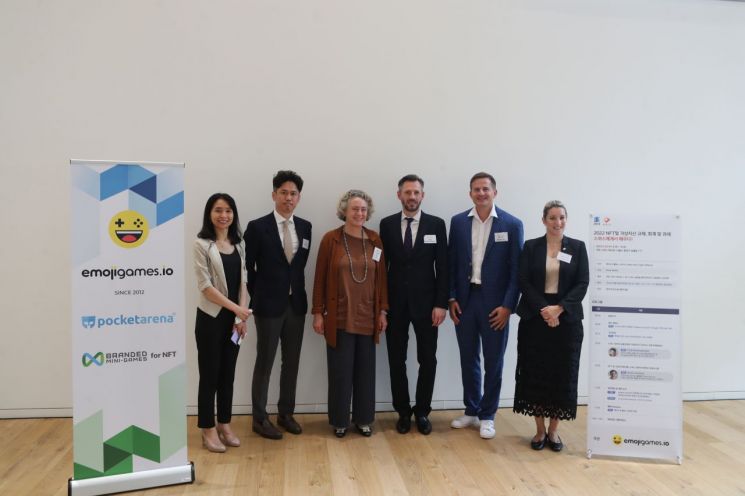
 Swiss Embassy Virtual Asset Conference (Photo by J’sco Holdings)
 Description: (From left) Joohee Lee, President of SACA; Sangmin Han, CEO of J’sco Holdings; Dagma Schmid Tartari, Swiss Ambassador to Korea; Hug Valtenperger, Chief Legal Officer of JB; Silvan Amberg, Partner at Silvan Amberg LLC; Jacqueline Chumi, Head of the Swiss Trade and Investment Office in Korea. /Photo by J’sco Holdings
[Asia Economy Reporter Jang Hyowon] J-Sco Holdings, which is promoting a new business in non-fungible tokens (NFTs), held a conference on virtual asset-related regulations and cases of the Swiss government, a leader in innovation in the digital asset industry, ahead of full-scale business promotion.
J-Sco Holdings announced on the 30th that it held a conference on virtual asset-related regulations, accounting, and taxation systems of the Swiss government and the Financial Market Supervisory Authority (FINMA) at the Embassy of Switzerland in Korea, together with the Swiss Asia Crypto Alliance (SACA).
SACA, which co-hosted this conference with J-Sco Holdings, is a non-profit organization based in the Swiss Crypto Valley, established to promote cooperation between Switzerland and Asia in the blockchain industry. A group of Swiss banking, finance, and cryptography experts supports Asian fintech and blockchain companies and works for mutual cooperation.
Also, the organizer of this conference, Emoji Games, is a company providing enterprise NFT games and sidechain solutions, and is a representative Swiss NFT game company that has grown over the past 10 years in Lucerne and Zug, Switzerland.
Dagmar Schmitti Tartali, the Swiss Ambassador, said in his congratulatory remarks at the conference, “Switzerland has played a pioneering role in establishing guidelines, regulations, and accounting standards necessary for digital assets, enhancing the stability and sustainable development potential of the related industry,” and added, “I hope this seminar will provide inspiration and positive influence on new digital asset policies and serve as an opportunity to deepen understanding of the Swiss industrial environment.”
J?rg Baltensperger, CEO of Jaybee and a speaker at the conference, explained the basic principles of the Swiss government’s virtual asset-related regulations, FINMA’s token classification guidelines, and the regulatory differences according to those classifications. He also introduced Switzerland’s unique virtual asset regulatory approach, the virtual asset business and license acquisition requirements of the self-regulatory organization (SRO), and FINMA’s anti-money laundering (AML) regulations related to virtual assets.
Following this, Silvan Amberg, a partner at Swiss tax consulting firm Silvan Amberg LLC, explained Switzerland’s tax regulations on virtual assets and NFTs. He presented on ▲ the Swiss tax system ▲ requirements for establishing a business in Switzerland ▲ corporate tax regulations on virtual assets ▲ value-added tax (VAT) rates applied to virtual assets ▲ and case studies on NFT investment companies.
The conference speakers, J?rg Baltensperger and Silvan Amberg, were recently appointed as advisors to J-Sco Holdings’ new NFT business. The company explained that as legal and accounting experts in Switzerland, they will provide practical advice on future business in Web3.0 and blockchain fields related to J-Sco Holdings’ new NFT business.
Han Sangmin, CEO of J-Sco Holdings, said in his closing remarks, “The Swiss systems discussed at this conference will be of great help in establishing virtual asset regulations, accounting treatment, and taxation systems suitable for our country in the future,” and added, “I think this was a valuable opportunity to share useful information not only for J-Sco Holdings but also for other domestic companies considering entering the NFT and virtual asset business.”
Meanwhile, the Korean government included “Establishment of digital asset infrastructure and regulatory system” in the 110 national tasks last month, specifying the allowance of domestic ICOs (Initial Coin Offerings) as a task. Although ICOs were completely banned in 2017 due to cryptocurrency speculation overheating, the government plans to establish a “Digital Asset Committee” and prepare necessary laws and guidelines, expecting the virtual asset market to grow substantially in the future.
© The Asia Business Daily(www.asiae.co.kr). All rights reserved.

















