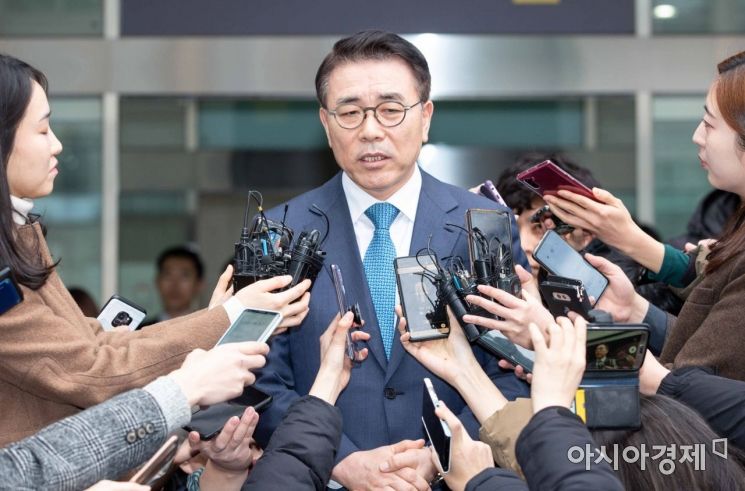
[Asia Economy Reporter Kim Daehyun] Cho Yong-byeong, Chairman of Shinhan Financial Group (65), who was prosecuted on charges of 'Shinhan Bank new employee recruitment corruption,' has been acquitted by the Supreme Court.
On the morning of the 30th, the Supreme Court's 2nd Division (Presiding Justice Lee Dong-won) upheld the lower court's acquittal ruling in Cho's appeal trial on charges including obstruction of business, stating, "There was no failure to conduct necessary hearings for the original judgment, nor any error in the legal interpretation regarding the establishment of the crime of obstruction of business by deception and the conspiracy relationship."
The other defendants, including the then deputy head of human resources who were prosecuted together, also had their original sentences of suspended imprisonment or fines upheld.
Previously, Chairman Cho and seven Shinhan Bank HR personnel were prosecuted in October 2018 on charges of providing preferential treatment during the recruitment process by managing lists of external recommendation applicants and children of Shinhan Bank executives and department heads from the first half of 2013 to the second half of 2016.
The first trial sentenced Cho to six months in prison with a two-year suspension. It found him guilty of obstructing recruitment work by informing the HR department of the application status and personal relationships of three specific applicants while serving as Shinhan Bank president.
However, the second trial acquitted him. It judged that it could not be definitively concluded that two applicants suspected of involvement in the recruitment process were unfairly accepted, and it was difficult to recognize Cho's involvement regarding another applicant who appeared to have passed the document screening unfairly.
The second trial court stated, "Although the defendant conveyed the fact that a certain applicant applied in the document screening to the then HR manager, and the recruitment team could reasonably be expected to consider the applicant as 'recommended by the president' during the selection process, such communication by the defendant cannot be regarded as an 'instruction to pass'."
Furthermore, the court noted, "Currently, there are no specific laws on recruitment corruption or unfair hiring crimes, so recruitment corruption is dealt with under the crime of obstruction of business in criminal law, which protects different legal interests and victims," adding, "The outcome that contradicts general legal sentiment ultimately stems from the absence of separate punitive provisions for recruitment corruption or legislative deficiencies regulating recruitment corruption."
Nonetheless, the court emphasized, "Under the guise of custom, separately distinguishing and managing certain applicants and proceeding with recruitment work while recruitment team members are aware of the application status can raise suspicions of unfair hiring," and "This can cause a sense of relative deprivation among general applicants due to distrust in fairness. If such bad practices continue among Shinhan Bank personnel, it could again become an issue under the name of obstruction of business due to recruitment corruption," the second trial court stressed.
© The Asia Business Daily(www.asiae.co.kr). All rights reserved.

















