Nuri Rocket Performance Verification Satellite to be Deployed from Chosun University Satellite on 29th
Partial Communication with Ground Station Successful on Morning of 30th
University Students and Developers Gaining Satellite Development Experience
"Will Grow as Core Leaders Driving Space Development"
[Asia Economy Reporter Kim Bong-su] "It feels great to launch a launch vehicle with our own hands. Through this opportunity, students who gained satellite development experience and space venture companies will grow into core talents and companies leading Korea's space development in the future."
Korea's first indigenous space launch vehicle, 'Nuriho,' successfully confirmed the status of the performance verification satellite launched by ejecting and communicating with the first CubeSat.
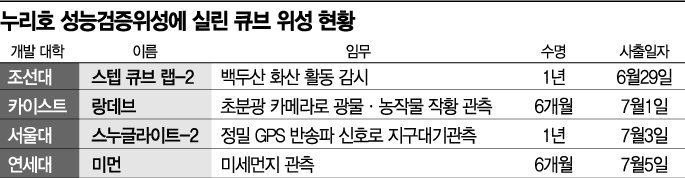
The Ministry of Science and ICT and the Korea Aerospace Research Institute (KARI) announced on the 30th that the performance verification satellite, which entered orbit with the second launch of Nuriho on the 21st, succeeded in ejecting the first CubeSat on the afternoon of the 29th. Subsequently, around 3:48 a.m. on the same day, partial communication with the ground station was also successful. However, it is still uncertain whether this CubeSat will operate normally. Out of the 20 repeated receptions targeted during flight over South Korea, only 2 receptions were received. The status information sent by the CubeSat included the satellite's mode, attitude, satellite navigation system (GPS) status (currently off), battery mode (normal), and battery voltage (normal).
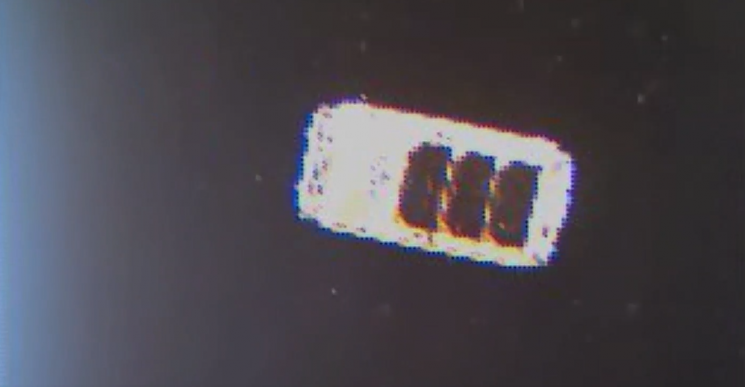
The Ministry of Science and ICT explained, "Based on the CubeSat ejection video, the CubeSat appears to be rotating rapidly at present," adding, "More time is needed for attitude stabilization to achieve complete two-way communication." They continued, "Since the satellite's battery mode and voltage appear normal, if attitude stabilization proceeds properly, positive results can be expected," and stated, "The performance verification satellite will undergo attitude stabilization, and the remaining three CubeSats will be ejected as scheduled."
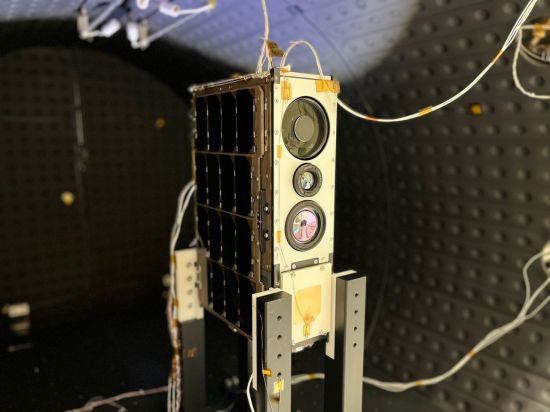
The next communication times are scheduled for 3:48 p.m. and 5:26 p.m. on the same day. Plans include receiving status information and sending communication commands. The CubeSat ejected on this day is 'Step Cube Lab-2,' developed by Chosun University. It is one of the four university teams' projects selected for the Nuriho payload satellite from the 5th CubeSat Competition held in 2019. It plans to study Baekdusan volcanic activity and other phenomena using infrared and visible light for Earth observation.
On the 1st of next month, KAIST's 'Rendezvous,' which can precisely observe the Earth with a hyperspectral camera to identify minerals and crop conditions, will be ejected second. Following that, at two-day intervals, Seoul National University's 'SNUglight-2,' which collects Earth mesospheric observation data using precise GPS carrier signals, and Yonsei University's 'Mimun,' which measures fine dust over a 400 km by 400 km area around the Korean Peninsula with an optical camera of 200 m resolution, will be ejected.
© The Asia Business Daily(www.asiae.co.kr). All rights reserved.



















