[Asia Economy Yang Nak-gyu, Military Specialist Reporter] The South African 2nd Combat Flying Squadron was selected as the July Hero of the Korean War, and Kim Gap, Han Heung-gyo, and Min Je-ho were chosen as the Independence Activists of July.
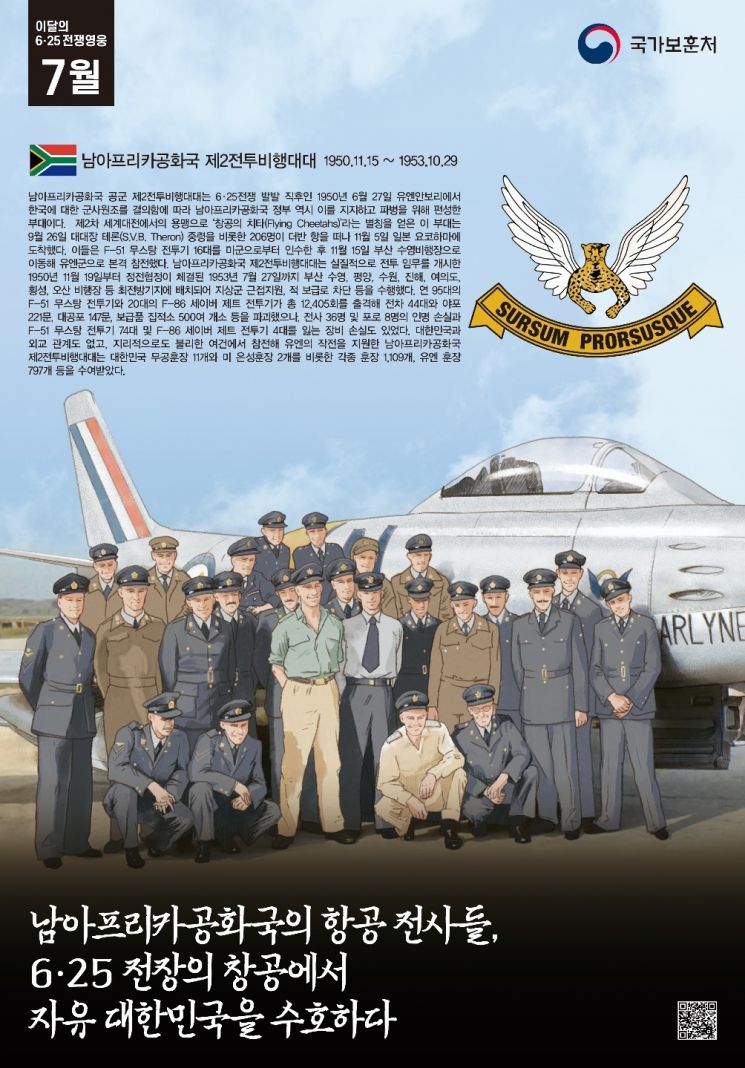
On the 30th, the Ministry of Patriots and Veterans Affairs announced that the South African 2nd Combat Flying Squadron, which achieved numerous victories at the front-line bases during the Korean War, was selected as the 'July Hero of the Korean War.'
During the Korean War, this unit was deployed to airfields including Busan Suyeong, Pyongyang, Suwon, Jinhae, Yeouido, Hoengseong, and Osan, with a total of 826 personnel participating and conducting 12,405 sorties. They destroyed or damaged over 40 enemy tanks, more than 220 field artillery pieces, 147 anti-aircraft guns, and about 500 supply depots.
The South African government decided to dispatch the 2nd Combat Flying Squadron following the United Nations Security Council's resolution on June 27, 1950, to provide military aid to Korea immediately after the outbreak of the war. At that time, South Africa had no diplomatic relations with Korea and was located at the southernmost tip of Africa, making the distance a significant challenge, yet they still sent troops to Korea.
Having also been active during World War II and earning the nickname 'Flying Cheetahs,' the South African 2nd Combat Flying Squadron departed from Durban Harbor, South Africa, on September 26, 1950, with 206 members including Lieutenant Colonel S.V.B. Theron, the battalion commander. They arrived in Yokohama, Japan, on November 5. After receiving 16 F-51 Mustang fighters from the U.S. military, they moved to Busan Suyeong Airfield on November 15 and began actual combat missions on November 19, 1950, continuing their activities until the armistice was signed on July 27, 1953. The South African 2nd Combat Flying Squadron was recognized for its contributions to the Korean War with 11 Republic of Korea Military Merit Medals, 2 U.S. Silver Star Medals, and a total of 1,109 various medals, as well as 797 United Nations medals.
Selected as the 'Independence Activists of July,' Kim Gap, Han Heung-gyo, and Min Je-ho dedicated themselves to the independent sovereignty of their homeland by joining Dongjesa during the Japanese colonial period.
Dongjesa was the first independence movement organization established in 1912 by Shin Gyu-sik in Shanghai, China. It also founded the Bakdal Academy to unite Koreans in Shanghai and educate young independence activists.
Born in 1889 in Dongnae, Busan, Kim Gap joined the Daedong Youth Group, the first secret society in Yeongnam, in 1909 and was active there. In May 1917, he moved to Shanghai and joined Dongjesa. When the Provisional Assembly was established in Shanghai in April 1919, he served as a representative member for Gyeongsang Province. He held positions such as Transportation Committee member, Military Affairs Committee director, and Legislative Committee member in the Provisional Government until he passed away at the age of 44 in 1933 at Gwangje Clinic in the French Concession of Shanghai.
Han Heung-gyo was born in 1885 in Dongnae. He graduated from Okayama Medical School in 1910 and went to Shanghai in 1911 to participate in the Chinese Xinhai Revolution, then fully engaged in anti-Japanese activities. He was active from the formation of Dongjesa and served as a professor at Hangzhou Medical School, providing medical support to Dongjesa comrades. After liberation, he returned to Korea and passed away in 1967 at the age of 82.
Min Je-ho, born in 1890 in Jongno, Seoul, went into exile in Shanghai in 1913 and joined Dongjesa. After being elected as a member of the Provisional Assembly in April 1919, he handled external affairs for the Provisional Government until 1929. When Japanese repression intensified following the assassination by Yun Bong-gil in 1932, he fled with the Shanghai Provisional Government to Hangzhou but soon fell ill and passed away in 1932.
The government posthumously awarded Kim Gap the Order of Independence Merit in 1986, and Han Heung-gyo and Min Je-ho the Order of Patriotic Merit in 1990.
© The Asia Business Daily(www.asiae.co.kr). All rights reserved.

















