Minimum Wage for Next Year Set at 9,620 Won
Both Labor and Management Oppose... Objections Also Emerging
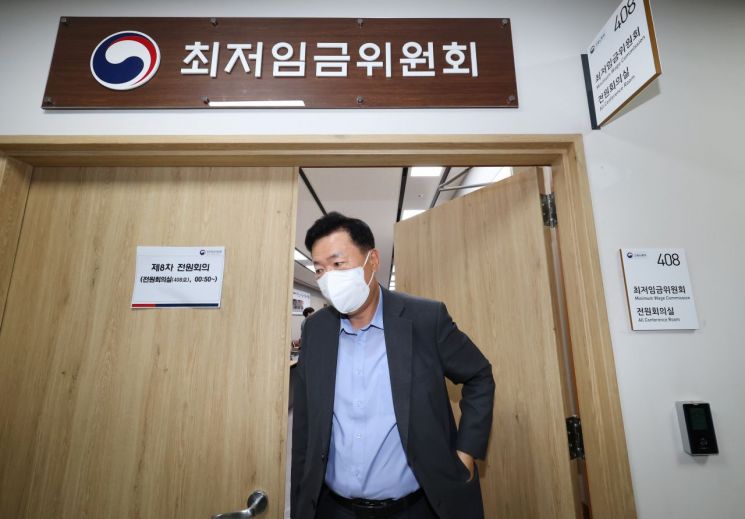 On the afternoon of the 29th, Ryu Ki-jung, Executive Director of the Korea Employers Federation and a user committee member, is leaving after refusing to vote in the Minimum Wage Commission meeting room at the Government Complex Sejong in Sejong City.
 "I even involved my family at the store to try to reduce labor costs somehow, but there is no way left." (Mr. Lee, convenience store owner in Songpa-gu, Seoul)
"The increase is at a level that does not even meet the actual inflation rate, so it is effectively a freeze or even a reduction in real wages." (Park Hee-eun, Vice Chairperson of the Korean Confederation of Trade Unions)
The minimum wage for next year has been set at 9,620 KRW per hour, a 5.0% increase from this year. This is the first time in eight years since 2014 that the decision was made within the legal deadline. Although both labor and management oppose it, considering there has been no precedent of reversal, the prevailing view is that this decision will remain effective as is.
According to the industry on the 30th, the Minimum Wage Commission passed the amount proposed by the public interest members in a vote during the 8th plenary meeting held the previous day. The commission submitted the approved proposal to the Ministry of Employment and Labor, which will announce it by August 5, and it will take effect from next year.
The business community criticized the decision for ignoring the realities of small and micro enterprises and small business owners. The Korea Employers Federation stated in a press release, "Considering the minimum wage level that has risen more than four times faster than inflation over the past five years, the payment capacity of small and micro enterprises and small business owners at their limits, the statutory decision factors, and the recent complex economic crisis, it is difficult to agree with this increase rate."
The Federation of Korean Industries also expressed concern, saying, "If the minimum wage is raised amid soaring prices and increasing economic burdens on the people, it will lead to a vicious cycle of further price increases," and "especially, the job situation will worsen as low-skilled workers lose their jobs."
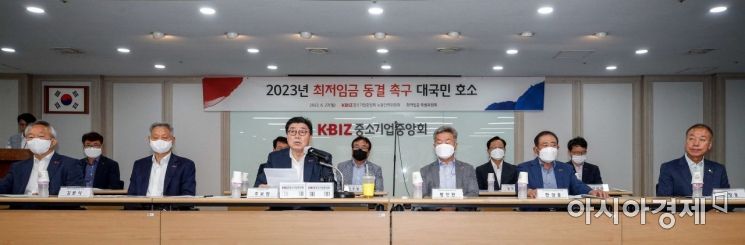 Jubo Won, Chairman of the Labor and Workforce Committee of the Korea Federation of Small and Medium Business, is delivering a speech at the "2023 Minimum Wage Freeze Urgent Appeal to the Public Press Conference" held on the 27th at the Korea Federation of Small and Medium Business in Yeouido, Seoul. Photo by Jinhyung Kang aymsdream@
There are also moves to file objections. Ryu Ki-jung, Executive Director of the Korea Employers Federation, said, "We will file an objection stating that it is difficult to accept this decision." The Korea Federation of Small and Medium Business Owners announced, "We will use all possible means, including objections, to nullify this minimum wage decision as soon as possible."
Objections can be filed before the August announcement. If the Ministry of Employment and Labor accepts the objection, it can request a reconsideration from the Minimum Wage Commission. However, there has never been a reconsideration so far.
Labor opposition is also intense. However, there was a significant temperature difference between the two major trade unions. The Federation of Korean Trade Unions (FKTU) was the only labor representative group to participate in the vote. An FKTU official said, "Considering inflation and other factors, a 5% increase is not satisfactory," but added, "After careful internal review, we judged that participating in the vote was the right decision."
On the other hand, four members affiliated with the Korean Confederation of Trade Unions (KCTU) among the labor representatives walked out of the meeting. Park Hee-eun, Vice Chairperson of KCTU, argued, "The 5% increase will make the lives of low-wage workers even harder." KCTU plans to hold a large-scale rally with about 60,000 people in downtown Seoul on July 2 as scheduled and launch a government struggle including the minimum wage issue.
FKTU plans to focus on blocking sectoral differentiation of the minimum wage. An FKTU official said, "Since the sectoral application of the minimum wage has been rejected seven consecutive times at the Minimum Wage Commission, it has effectively lost its meaning," and "We plan to engage in legislative activities at the National Assembly and elsewhere to make its application impossible."
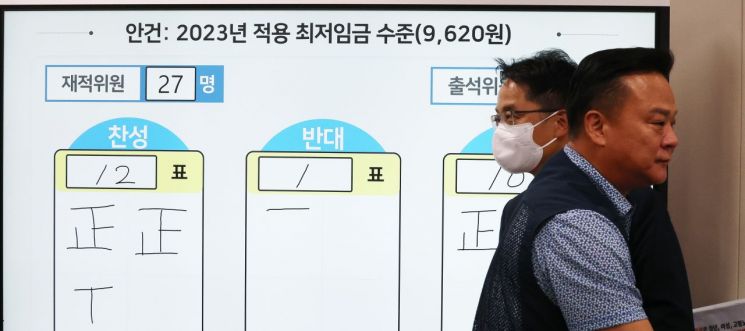 On the morning of the 30th, at the 8th plenary meeting held in the Minimum Wage Commission meeting room at the Government Complex Sejong in Sejong City, the minimum wage for next year was decided to be 9,620 won. Chairman Park Junsik (left) and worker representative Lee Dongho, Secretary General of the Korean Confederation of Trade Unions, are turning away after greeting each other.
 Voices expressing difficulties are emerging from the front lines. Convenience store owner Mr. Lee said, "Due to COVID-19, profits have dropped significantly, so I am employing only part-time workers at the minimum level," and added, "Labor and rent costs are the biggest expenses, and nothing is not increasing, so from next year, I will have to work more."
Convenience stores, which typically operate 24 hours, are considered highly sensitive to minimum wage increases.
The industry estimates that about 70% of convenience store operators are livelihood-type self-employed. The National Convenience Store Franchise Association stated, "Self-employed people are on the brink of collapse, yet the minimum wage and weekly holiday pay keep rising every year," and "It is becoming difficult to bear wage increases, leading to more split shifts, and causing distrust and conflicts between workers and business owners."
© The Asia Business Daily(www.asiae.co.kr). All rights reserved.



















