May Housing Statistics
400,000 Jeonse and Wolse Transactions... 56% Increase from Previous Month
Wolse Share Rises from 50.4% to 59.5%
In May, ahead of the two-year mark since the implementation of the three Lease Laws, the volume of jeonse and monthly rent transactions in the housing lease market surged, with the proportion of monthly rent notably increasing. This phenomenon is understood to have occurred due to the acceleration of the 'jeonse-to-monthly rent' trend and the expiration of the grace period for the jeonse and monthly rent reporting system in May, which led to a sudden influx of reports.
According to the Ministry of Land, Infrastructure and Transport on the 30th, the total number of jeonse and monthly rent transactions nationwide in May was 404,036, a 56.4% increase compared to 258,318 transactions in the previous month. Among these, monthly rent accounted for 59.5% (240,321 transactions), significantly surpassing the jeonse transaction volume (163,715 transactions, 40.5%).
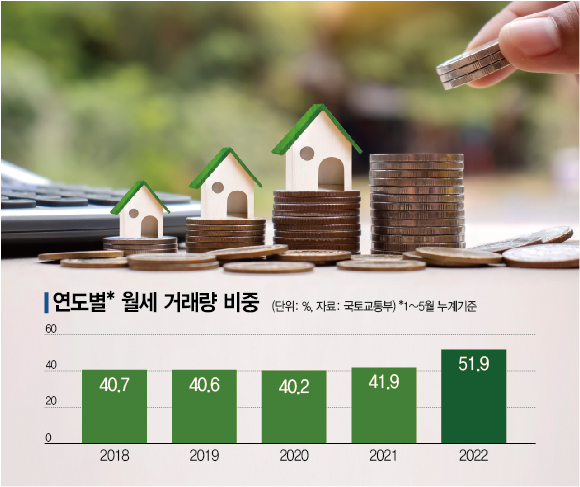
The proportion of monthly rent in jeonse and monthly rent transactions was 50.4% in April (130,295 out of 258,318 transactions), marking the first time since the government began compiling related statistics in 2011 that monthly rent exceeded jeonse. In just one month, this proportion jumped by nearly 10 percentage points (9.1 percentage points), setting a new record high. Based on cumulative transactions from January to May this year, the monthly rent share reached 51.9%, surpassing jeonse for the first time with a 3.2 percentage point increase from the previous month (48.7%). This is 10.0 percentage points higher than the same period last year (41.9%) and 10.5 percentage points higher compared to the five-year average (41.4%).
The increase in the monthly rent proportion is largely attributed to the impact of the two Lease Laws introduced in July 2020 (the right to request contract renewal and the rent ceiling system). As tenants continued to reside in existing homes by exercising the right to request contract renewal, jeonse listings became scarce, and landlords raised jeonse prices significantly by increasing the deposit by four years' worth at once. According to the real estate analysis platform Real Estate R114 Labs, the average nationwide jeonse price increase rate from July 2020 to last month reached 27.69%. With rising interest rates increasing the burden of jeonse loans, tenants unable to afford the sharply increased deposits moved to the monthly rent market. Additionally, landlords' preference for monthly rent due to increased property tax burdens, a phenomenon known as 'tax shifting,' also played a complex role.
Furthermore, since the full implementation of the jeonse and monthly rent reporting system in June last year, the increase in monthly rent contract reports for quasi-housing such as officetels and one-room units, which had previously been underreported, is also seen as a cause for the expansion of the monthly rent share. The Ministry of Land, Infrastructure and Transport analyzed, "With the expiration of the reporting system's grace period on May 31, contracts that had been delayed in reporting temporarily increased, leading to a significant rise in jeonse and monthly rent transactions in May." Regarding the increase in the monthly rent proportion, it added, "This process saw an increase in monthly rent transaction reports for non-apartment properties, which had a high tendency of non-reporting."
The proportion of monthly rent is likely to increase further. Although monthly rent prices are on the rise, the general assessment is that the housing cost burden remains low compared to overseas. The Rent-to-Income Ratio (RIR), which is the proportion of monthly rent to monthly income, stands at 16.6% nationwide (as of 2020), lower than major overseas countries where it exceeds 20% (such as the United States, United Kingdom, Germany, and France). Kim Seong-hwan, a senior researcher at the Korea Research Institute for Construction Industry, explained, "If expectations for housing price increases are not high, tenants may choose to bear the higher monthly rent rather than rush to purchase a home."
Meanwhile, the government has announced short-term measures in response to the increased burden of monthly rent. On the 21st, at the first real estate ministers' meeting of the Yoon Seok-yeol administration, Land Minister Won Hee-ryong stated, "We will strengthen monthly rent support to address youth housing insecurity," and announced plans to expand monthly rent tax credits and increase the limits of the Buttress Loan program.
© The Asia Business Daily(www.asiae.co.kr). All rights reserved.

















