Starting January Next Year, Buildings with a Total Floor Area of 500㎡ or More and Apartment Complexes with 30 or More Households to be Implemented
[Asia Economy Reporter Kim Min-young] The Ministry of Land, Infrastructure and Transport announced on the 30th that it will hold a legislative notice from July 1 to August 10 for a partial amendment to the 'Enforcement Decree of the Green Building Creation Support Act' to expand the mandatory certification target for Zero Energy Building (ZEB) certification when constructing public buildings to those with a total floor area of 500㎡ or more and apartment complexes with 30 or more households.
A Zero Energy Building (ZEB) refers to a green building that minimizes energy demand by maximizing insulation performance and produces renewable energy through solar power facilities, thereby minimizing the building's energy consumption.
Since January 2017, the Ministry of Land, Infrastructure and Transport has defined ZEB performance levels, introduced the 'ZEB certification system' to promote its spread, and has been implementing policies to activate ZEB.
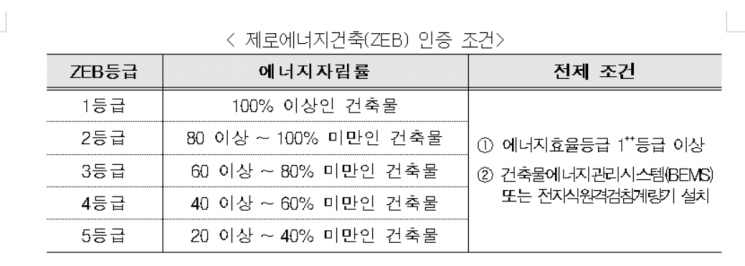
The ZEB certification system quantitatively evaluates five major energy uses in buildings?cooling, heating, hot water supply, lighting, and ventilation?and certifies building energy performance, assigning five grades from 5 (lowest) to 1 (highest) based on energy self-sufficiency rates.
To promote high-performance green buildings like ZEB, the Ministry announced a 'ZEB Mandatory Roadmap' in 2020, aiming to gradually expand ZEB from the public sector to the private sector.
Accordingly, the mandatory ZEB certification, which was applied to public buildings with a total floor area of 1000㎡ or more, will be expanded from January 2023 to include public buildings with a total floor area of 500㎡ or more and public sale/rental apartment complexes with 30 or more households.
In particular, for public apartment complexes, the schedule for mandatory ZEB certification has been advanced from 2025 to 2023 to actively respond to the enhanced 2030 Nationally Determined Contribution (NDC) announced in November 2021.
Um Jeong-hee, Director of Building Policy at the Ministry of Land, Infrastructure and Transport, said, "Before the full-scale mandatory Zero Energy Building implementation in the private sector in 2025, the mandatory ZEB certification target has been expanded to proactively apply to small and medium-sized public buildings and apartment complexes." She added, "We will continue to strengthen efforts to spread Zero Energy Buildings through the improvement of building energy-related systems to contribute to carbon neutrality in the building sector and reduce energy cost burdens for the public."
The amendment to the 'Enforcement Decree of the Green Building Creation Support Act,' reflecting the changes in the mandatory ZEB certification targets, is expected to be applied from January next year for applications for building permits and project plan approvals.
© The Asia Business Daily(www.asiae.co.kr). All rights reserved.

















