投入 in 377 Projects, 13.5% Increase Compared to Last Year
[Asia Economy Reporter Lim Cheol-young] The Ministry of the Interior and Safety announced that it has notified the Ministry of Economy and Finance on the 30th of the '2023 Disaster Safety Budget Pre-Consultation Plan' to enhance the investment efficiency of the government disaster safety budget after review by the Central Safety Management Committee.
The disaster safety budget pre-consultation is a system where the Ministry of the Interior and Safety reviews budget requests from each ministry and notifies the Ministry of Economy and Finance of investment directions and priorities by the 30th. Based on the pre-consultation results, the Ministry of Economy and Finance drafts the government’s disaster safety budget proposal for the next year.
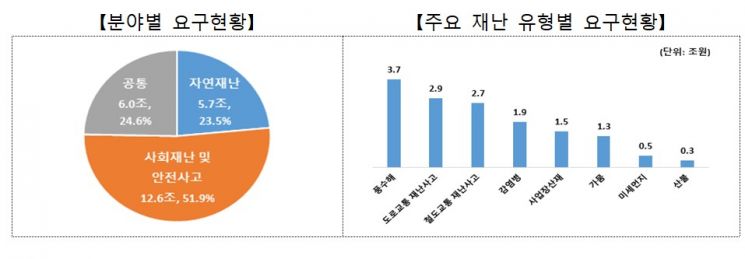
The total disaster safety budget requested by all central administrative agencies, excluding research and development (R&D) projects, amounts to KRW 24.3 trillion for 377 projects next year, which is a 13.5% increase compared to this year’s KRW 21.4 trillion.
By sector, the social disaster and safety accident sector (26 types) accounts for the largest share with KRW 12.6 trillion (51.9%), followed by the natural disaster sector (9 types) with KRW 5.7 trillion (23.5%), and the common sector including disaster relief and recovery (8 types) with KRW 6.0 trillion (24.6%). By disaster type, requests include KRW 3.7 trillion (15.3%) for wind and flood damage, KRW 2.9 trillion (12.1%) for road safety, KRW 2.7 trillion (11.0%) for railway safety, and KRW 1.9 trillion (7.8%) for infectious diseases.
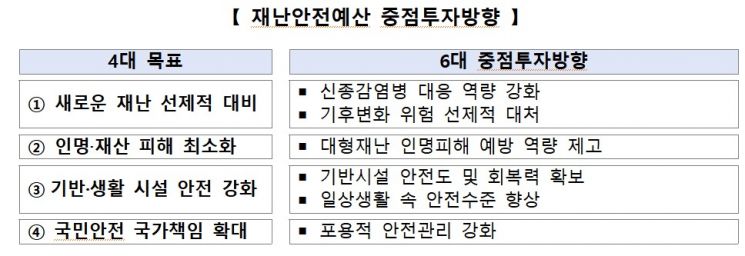
The Ministry of the Interior and Safety selected four major goals and six key investment directions based on analysis of past damage records, recent concentrated risk factors, and future risk forecasts to prepare the 2023 pre-consultation plan.
Additionally, investment priorities were determined comprehensively considering the whole-of-government disaster safety policies, evaluations of disaster safety projects, advice from private experts, and opinions from relevant ministries. The review focused on △ enhancing proactive response capabilities to new disasters △ minimizing damage to citizens’ lives and property from disasters △ strengthening infrastructure and daily life safety △ and reinforcing inclusive safety management. As a result of reviewing investment priorities for 377 disaster safety projects, 116 projects (KRW 8.0 trillion) were selected for increased investment, 190 projects (KRW 14.6 trillion) for maintained investment, and 71 projects (KRW 1.7 trillion) for reduced investment.
First, to proactively prepare for new disasters, key investments will focus on strengthening response capabilities against new infectious diseases by preventing their domestic inflow and swiftly responding to livestock epidemics. To prepare for climate change risks, disaster-prone areas will be maintained, and climate disasters such as large wildfires, droughts, and heatwaves will be intensively managed.
To minimize human and property damage, investments will focus on strengthening on-site safety inspections to prevent recurrence of major accidents at construction sites and fire-vulnerable facilities. Safety management support will be concentrated on small-scale workplaces with fewer than 50 employees, and investments to protect workers’ health from occupational diseases will also be enhanced.
To strengthen infrastructure and daily life safety, investments will be expanded to secure the safety of infrastructure by inspecting and repairing aging road facilities such as bridges and tunnels, as well as railway and port facilities. Efforts to reduce fine dust emissions from pollution sources around living areas will continue, and investments will focus on creating pedestrian safety environments to ensure traffic safety.
Furthermore, to expand the state’s responsibility for public safety, investments will focus on eradicating crimes against socially vulnerable groups such as children and women, and preventing secondary damage from digital sex crimes. Customized support projects considering risk factors for safety-vulnerable groups will also be actively promoted.
Minister Lee Sang-min stated, “Proactive disaster safety investment is essential to minimize human casualties caused by large-scale disasters such as recurring large wildfires and building collapses, and to effectively prepare for unexpected new disasters,” adding, “We will further develop the disaster safety budget pre-consultation system and actively strive to ensure that the budget is invested appropriately to protect the safety of the people.”
© The Asia Business Daily(www.asiae.co.kr). All rights reserved.


















