[Asia Economy Reporter Song Hwajeong] As concerns grow over the reduction of private mid-interest rate loans due to rising interest rates, financial authorities have taken steps to improve the interest rate requirements for private mid-interest rate loans.
On the 29th, the Financial Services Commission announced that it will adjust the upper limit of private mid-interest rate loan interest rates every six months according to the fluctuation range of funding costs and will set differentiated upper limits for private mid-interest rate loan interest rates by industry sector.
Recently, with the Bank of Korea raising its base rate, the interest rates on new credit loans, mainly from banks and mutual finance institutions, have risen sharply, raising concerns about the reduction of private mid-interest rate loans. A Financial Services Commission official explained, "If it becomes difficult to apply the current mid-interest rate loan interest level recognized for middle- and low-credit borrowers due to rising interest rates, financial companies may sharply increase loan interest rates for these borrowers," adding, "It is necessary to rationalize the standards so that the rise in interest rates is reflected in the private mid-interest rate ceiling requirements and to encourage the expansion of private mid-interest rate loans."
First, the upper limit of private mid-interest rate loans will be adjusted every six months according to the fluctuation range of funding costs. Banks will use the COFIX based on the new transaction amount two months prior to the interest rate change date as the funding cost standard. Therefore, the private mid-interest rate ceiling requirement to be implemented on the 1st of next month will be based on May. Mutual finance institutions and savings banks will use the weighted average interest rate of new one-year term time deposits two months prior to the interest rate change date, while card companies and capital companies will use the weighted average of the funding cost on the total borrowing balance of the previous quarter and the new issuance rate of credit-backed bonds at the end of two months prior.
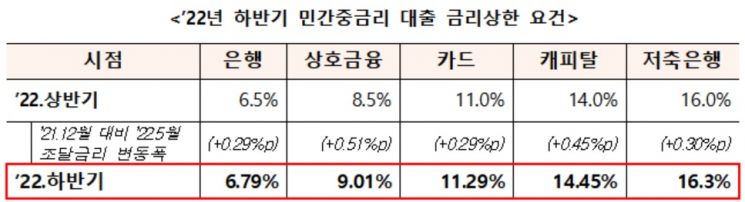
Considering the purpose of mid-interest rate loans and the statutory maximum interest rate level, the upper limit of private mid-interest rate loans will be differentiated by industry sector to prevent excessive increases due to rising funding costs. Currently, compared to the private mid-interest rate requirements, banks, mutual finance, and card sectors have an upper limit set at +2 percentage points, while capital and savings banks have +1.5 percentage points. The current upper limit requirements by sector are ▲Banks 6.5% ▲Mutual Finance 8.5% ▲Card 11.0% ▲Capital 14.0% ▲Savings Banks 16.0%, and the adjusted upper limits considering this are ▲Banks 8.5% ▲Mutual Finance 10.5% ▲Card 13.0% ▲Capital 15.5% ▲Savings Banks 17.5%.
The reference point for calculating the fluctuation range of funding costs is set at December 2021, and due to the rise in funding costs, the private mid-interest rate loan upper limit requirements for each sector in the second half of this year are ▲Banks 6.79% ▲Mutual Finance 9.01% ▲Card 11.29% ▲Capital 14.45% ▲Savings Banks 16.3%. A Financial Services Commission official said, "By rationalizing the mid-interest rate loan interest requirements and providing appropriate incentives to financial companies, it is expected that middle- and low-credit borrowers who previously used high-interest loans beyond the existing private mid-interest rate loan ceilings will be able to access lower mid-interest rate loans."

The supply of mid-interest rate loans has grown significantly from 1.3 trillion KRW in 2016 to 21.5 trillion KRW last year. The amount of mid-interest rate loans in the first quarter of this year was approximately 6.2 trillion KRW. Since 2016, financial authorities have been operating the mid-interest rate loan system to provide funds more smoothly to middle- and low-credit borrowers and to alleviate the interest rate gap phenomenon. Non-guaranteed credit loans executed for the bottom 50% of credit borrowers that meet the upper limit interest rate requirements by sector are recognized as private mid-interest rate loans and are given incentives.
© The Asia Business Daily(www.asiae.co.kr). All rights reserved.
![Clutching a Stolen Dior Bag, Saying "I Hate Being Poor but Real"... The Grotesque Con of a "Human Knockoff" [Slate]](https://cwcontent.asiae.co.kr/asiaresize/183/2026021902243444107_1771435474.jpg)

















