KCCI Seminar on 'Rational Electricity Market Reform and Energy Policy Direction'
Experts: "Electricity Bill Normalization... Must Establish a Rational Pricing System First"
"Public Consensus Needed That Increased Renewable Energy Use May Raise Electricity Bills"
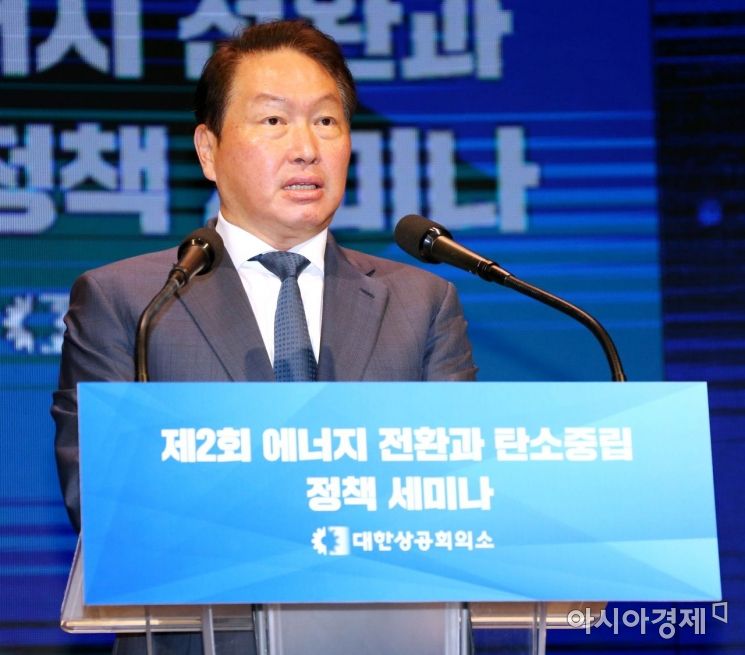 Choi Tae-won, Chairman of the Korea Chamber of Commerce and Industry, is delivering the opening remarks at the 2nd Energy Transition and Carbon Neutrality Policy Seminar held at the Korea Chamber of Commerce and Industry building on the 29th.
[Asia Economy Reporter Oh Hyung-gil] Although the government decided to raise electricity rates in the third quarter despite the burden of rising prices, experts have argued that a rational pricing system must be established for energy transition and carbon neutrality.
The Korea Chamber of Commerce and Industry (KCCI) held the 2nd Energy Transition and Carbon Neutrality Policy Seminar on the 29th at the KCCI building under the theme of "Rational Electricity Market Reform and Energy Policy Direction." About 300 key figures from various sectors, including KCCI Chairman Chey Tae-won, government officials, businesses, academia, and civic groups, attended the seminar, showing great interest in recent controversies such as KEPCO's deficit, electricity rates, and nuclear phase-out policies.
In his opening remarks, KCCI Chairman Chey Tae-won said, "In the short term, the ongoing Ukraine war is causing rapid fluctuations in energy raw material prices and disruptions in supply," adding, "Energy security, which means securing energy stably worldwide, has become more important than ever."
He continued, "In the long term, there are concerns close to a shock due to changes in the electricity market and pressures on the energy industry structure," pointing out, "Companies that viewed carbon neutrality as a leap forward for the Korean economy amid the energy transition are now facing burdens and uncertainties."
He added, "If we gradually narrow the angle of the joined hands to solve the problem, the will and strength will converge in one direction, making the weight of the shared burden lighter," emphasizing, "Finding a consensus on rational solutions and efficient pathways is as important as accelerating the energy transition."
Professor Park Joo-heon of Dongduk Women’s University, who participated in the new government’s energy policy formulation as part of the 20th Presidential Transition Committee, said in the keynote speech, "Residential electricity rates in Korea are at 59% of the OECD average, ranking 36th out of 37 countries, and industrial electricity rates are at 87% of the OECD average, ranking 22nd out of 37 countries," adding, "It is important to gain public understanding that electricity rates may increase compared to the past as the use of renewable energy rises for carbon neutrality."
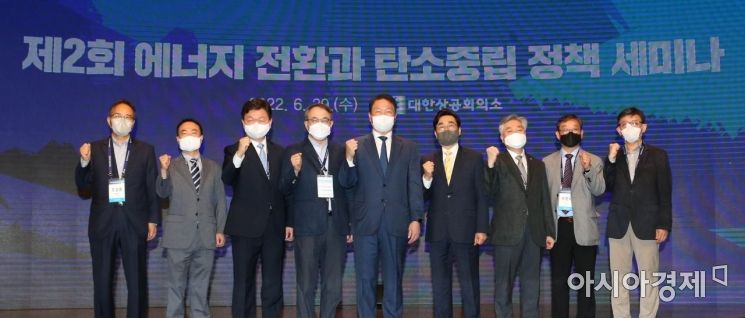 Chairman Chey Tae-won of the Korea Chamber of Commerce and Industry (fifth from the left) is taking a commemorative photo with key participants at the 2nd Energy Transition and Carbon Neutrality Policy Seminar held at the Korea Chamber of Commerce and Industry building on the 29th.
He then explained the new government’s energy policy directions, including ▲ industrialization of nuclear power exports and revitalization of the nuclear ecosystem ▲ strengthening nuclear energy cooperation diplomacy ▲ enhancing competitiveness of next-generation nuclear technology and industry ▲ advancement of solar and wind industries linked to stable supply of renewable energy ▲ realization of a high-efficiency, low-consumption energy structure and expansion of new energy industries such as hydrogen.
Professor Park Jong-bae of Konkuk University argued, "Normalizing electricity rates is an urgent task, and to achieve this, it is necessary to establish the already introduced cost-reflective pricing system and secure the independence and expertise of the electricity rate regulatory body to enable rational pricing decisions."
Professor Cho Sung-bong of Soongsil University also suggested, "KEPCO’s operating losses ultimately result in taxpayers paying what electricity consumers should pay, so considering the expansion of KEPCO’s operating losses and rising international energy prices, normalizing electricity rates is inevitable," adding, "The KEPCO-centered electricity monopoly structure restricts consumer choice and limits the development and dynamism of the electricity industry, so it is necessary to promote limited competition in the electricity sales sector through the activation of Power Purchase Agreements (PPAs)."
Professor Joo Byung-ki of Seoul National University emphasized, "In the energy transition process, it is important to minimize the impact on employment in fossil fuel industries and regional economies, and as renewable energy with high intermittency and variability expands, the public nature of the electricity industry must be strengthened to ensure stable power supply."
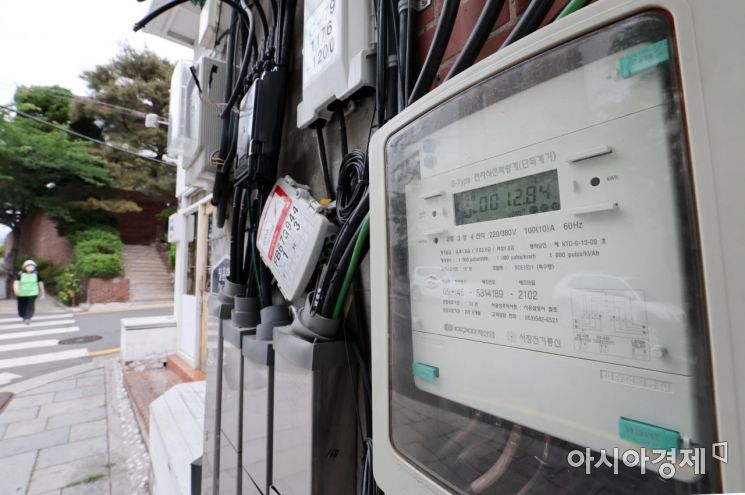 The electric meter installed in a residential area in Seoul on the 19th, as the announcement on whether to raise electricity rates approaches. With prices of essential goods and energy soaring across the board, and even public utility charges such as electricity, water, and gas increasing, these have become major causes of rapid inflation, deepening the concerns of inflation authorities. If the government accepts Korea Electric Power Corporation's request for an electricity rate hike, there are concerns that the consumer price inflation rate, which has already recorded mid-5%, could exceed 6%. Photo by Kim Hyun-min kimhyun81@
Additionally, advice on a rational power mix and activation of new energy industries was provided. Professor Cho Hong-jong of Dankook University said, "In the context of rapid inflation in the global energy market, it is necessary to make scientific, economic, and democratic decisions on the power mix considering energy security," arguing, "Electricity rates must be rationalized to restore price signals, and the energy market should be restructured through efficient market competition."
Lee Yoo-soo, Director of the Energy Economics Institute, said, "While technological innovation and business model development are important for new energy industries, building a foundation to enhance feasibility is paramount," adding, "The growth of the future energy industry will depend on the utilization of diverse technologies and data, and for this, flexible energy operation systems and the introduction of competition in the electricity market are essential."
Woo Tae-hee, Executive Vice President of the Korea Chamber of Commerce and Industry, said, "We plan to hold three more seminars related to energy transition," adding, "We will gather opinions from experts and stakeholders across government, industry, academia, and civic groups in various fields such as industry, finance, and carbon market policies to propose alternatives to the government."
© The Asia Business Daily(www.asiae.co.kr). All rights reserved.



















