Ministry of Science and ICT to Hold National Science and Technology Advisory Council Meeting on 28th and Finalize Budget Proposal
[Asia Economy Reporter Kim Bong-su] As the government finalized its investment in science and technology research and development (R&D), the previous administration's nuclear phase-out policy sharply reversed to nuclear revitalization, significantly increasing related budgets. On the other hand, the hydrogen economy budget, which was a key national agenda during the Moon administration, has effectively decreased when considering inflation rates.
◇R&D Investment Reverses After 5 Years
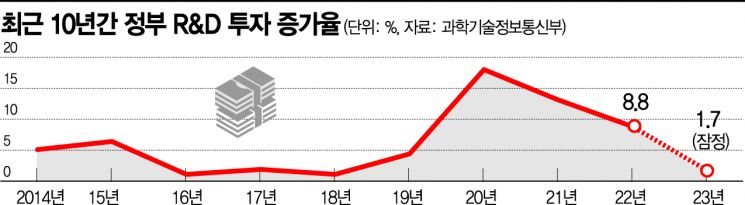
The Ministry of Science and ICT held a National Science and Technology Advisory Council review meeting on the afternoon of the 28th and finalized the 2023 national R&D project budget allocation and adjustment plan at 24.6601 trillion KRW. This is a slight increase of 1.7% (about 500 billion KRW) compared to this year's 24.2363 trillion KRW. The most notable point is that the growth trend that continued for the past five years has been broken. The government's R&D budget maintained high growth rates of 4.4% in 2019, 18.0% in 2020, 13.1% in 2021, and 8.8% this year. Previously, from 2016 to 2018, the growth rate was in the 1% range. The increased R&D investment during the Moon Jae-in administration to respond to crises such as Japan's export restrictions causing the materials, parts, and equipment (SoBuJang) crisis and COVID-19 has now reverted to previous levels.
Joo Young-chang, head of the Science and Technology Innovation Bureau at the Ministry of Science and ICT, explained at a pre-briefing held at the Government Seoul Office on the 27th, "In recent years, the government’s R&D budget was significantly expanded to respond to crises such as Japan’s export restrictions and COVID-19, but considering the recent economic situation and external uncertainties, limited resources were strategically allocated. We induced expenditure restructuring across ministries to save about 1.3 trillion KRW and also saved about 1 trillion KRW through reviewing and eliminating similar and overlapping projects and monitoring execution during the review process, reinvesting these savings into key policy areas and new projects."
◇Nuclear Power 50.5%↑ VS Hydrogen 0.5%↑
Investment in sectors included as major national agendas of the Yoon Suk-yeol administration increased significantly. The R&D budget for next-generation nuclear power increased by 50.5% (from 19.8 billion KRW this year to 29.7 billion KRW next year). Core technologies in next-generation system semiconductors and displays, representative fields of the ‘super-gap strategic technology’ development policy, increased by 8.5% (from 451 billion KRW this year to 489.5 billion KRW next year), and secondary batteries increased by 31.1% (from 75.7 billion KRW this year to 99.2 billion KRW next year). The quantum sector also rose sharply by 36.3% (from 66.9 billion KRW this year to 95.3 billion KRW next year), and the space and aerospace sector increased by 13.2% (from 741.1 billion KRW this year to 839.2 billion KRW next year). The digital transformation sector related to the ‘Digital Platform Government’ pledge also increased by 17.2% to about 2.42 trillion KRW compared to this year. Additionally, advanced bio (8.6%↑), artificial intelligence (AI) and robotics (11.7%), and cybersecurity (8.9%) also saw significant increases.
On the other hand, sectors that were spotlighted during the Moon administration effectively saw budget cuts. The R&D budget for establishing a hydrogen ecosystem, which remains one of the 110 national tasks under the current government, was only 290.8 billion KRW. Although it increased by 1.3 billion KRW (0.5%↑), the growth momentum has significantly diminished compared to the beginning of the year. The budget for core source technologies of 5G and 6G also only slightly increased by 4.3% to 194.5 billion KRW. Budgets for talent development (567.2 billion KRW, 4.7%↑), corporate R&D support (1.57 trillion KRW, 4.1%↑), and carbon neutrality (2.33 trillion KRW, 3.7%↑) remained largely stagnant.
© The Asia Business Daily(www.asiae.co.kr). All rights reserved.

















