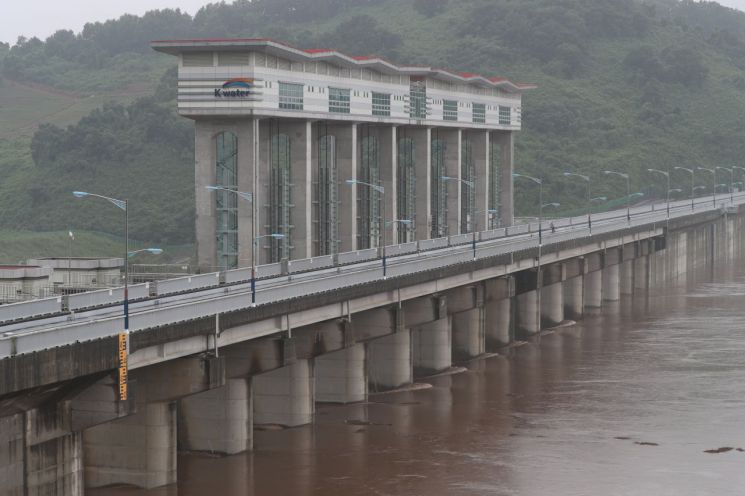
[Asia Economy Yang Nak-gyu, Military Specialist Reporter] The military is on high alert as the water level at Pilsunggyo, the northernmost point of the Imjin River, continues to rise. Although North Korea has not yet opened the Hwanggang Dam, heavy rainfall in North Korean territory has increased the likelihood of wooden box mines being washed away.
The Han River Flood Control Office sent a text message at around 10:40 p.m. on the 28th stating, "Due to heavy rain expected early tomorrow morning, the water level at Pilsunggyo in Yeoncheon County is expected to reach 7.5m. We are issuing a crisis alert at the interest stage," and urged people to refrain from using riverside areas.
As of 10:30 p.m. on the 28th, the water level at Pilsunggyo on the Imjin River was 6.06m. This is about 1.44m lower than the 7.5m level, which is the "interest stage" for crisis response in border areas, but with heavy rain forecasted to exceed 50mm per hour in the metropolitan area early tomorrow morning, the water level could rise sharply, requiring caution.
Gunnam Dam is located downstream of Pilsunggyo, the northernmost point of the Imjin River, and is only 56km away from North Korea’s Hwanggang Dam. Since the storage capacity of Hwanggang Dam is five times larger than that of Gunnam Dam, if North Korea opens the sluice gates without warning, the water level could rise rapidly, posing a danger.
There are three main ways to confirm whether Hwanggang Dam is releasing water. The first is satellite images of Hwanggang Dam. The second is visual confirmation when water overflows from Dam No. 1 on April 5. The overflow status of Dam No. 1 on April 5 can be immediately confirmed by Gunnam Dam and the military. The third is monitoring water level changes at the Hoengsan Water Level Station, which allows for an approximate estimation of the discharge volume.
Heavy rain in North Korean territory also increases the possibility of wooden box mines being washed downstream. A "wooden box mine" is an anti-personnel mine made of pine wood. In the front-line areas, wooden box mines washed away during the monsoon season have been found in the past. North Korean wooden box mines are wooden boxes measuring 20cm wide, 9cm long, and 4.5cm high, containing 200g of explosives and a detonator. If the box is opened or subjected to a certain amount of pressure, it is designed to explode, with a lethal radius known to be within 2 meters.
Wooden box mines are designed to explode when approximately 10kg of weight is applied to the top, and even if the box lid is forcibly opened, the pressure causes detonation. Inside the box are about 220g of TNT explosives, an MUV fuse as the detonator, a safety pin, a ball, and a spring. Recently, some mines made of plastic instead of wood have also been identified. Because they are made of pine wood, newer mines tend to emit a strong pine resin smell. Due to their wooden or plastic materials, these mines are not detected by metal detectors, which are commonly used for mine detection, making them particularly dangerous.
Civilians have occasionally been injured by North Korean mines washed away by floods. In 2017, a wooden box mine was found on Achado Island in Ganghwa County, Incheon. In July 2010, a resident named Han (50), who was illegally fishing inside the civilian access control line in Jangnam-myeon, Yeoncheon County, Gyeonggi Province, near the Imjin River tributary Sami Stream, picked up two wooden box mines, one of which exploded and caused his death at the scene.
© The Asia Business Daily(www.asiae.co.kr). All rights reserved.

















