Merger Completed on July 1... Sales Reach 4 Trillion KRW, Leap to 2nd Place in Industry
Integration of Purchasing and Production Networks... Expected Improvement in Operational Efficiency
[Asia Economy Reporter Eunmo Koo] The merger between Lotte Confectionery and Lotte Foods is just two days away. Once the merger is finalized, the second-largest comprehensive food company in South Korea, with sales approaching 4 trillion won, will be born. With the launch of the integrated corporation, Lotte Confectionery is expected to improve the efficiency of its existing businesses and actively expand new businesses to overcome growth stagnation.
The Birth of the Second-Largest Mega Food Company in South Korea
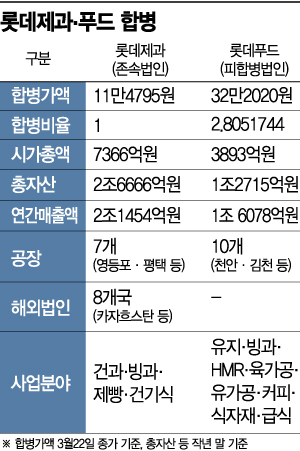
According to the Financial Supervisory Service's electronic disclosure system on the 29th, Lotte Confectionery and Lotte Foods plan to complete their merger on the 1st of next month. This merger will be structured with Lotte Confectionery as the surviving company absorbing Lotte Foods, which will be dissolved after the merger. Lotte Confectionery formalized the merger by finally approving the merger resolution of the two companies at the extraordinary general meeting of shareholders held on the 27th of last month.
Once the merger is completed, a mega food company with sales of 3.7 trillion won as of last year will be created. It will be the number one in the confectionery and ice cream sectors and the second largest overall food company after CJ CheilJedang. The integrated corporation's business areas are expected to cover the entire food industry, including ice cream, bakery, health functional foods, home meal replacements (HMR), meat processing, dairy products, coffee, and food ingredients.
The CEO of the integrated corporation will be Young-Gu Lee, the current CEO of Lotte Confectionery. Lee concurrently served as head of Lotte Group’s Food Business Unit and CEO of Lotte Confectionery at the end of 2020, and was appointed as the head of the food division (HQ) within the group in the regular executive personnel reshuffle last November. Lee is known for leading the integration of Lotte Chilsung Beverage and Lotte Liquor, which were previously operated under separate CEOs in the beverage and liquor business divisions, contributing to the profitability improvement of Lotte Chilsung.
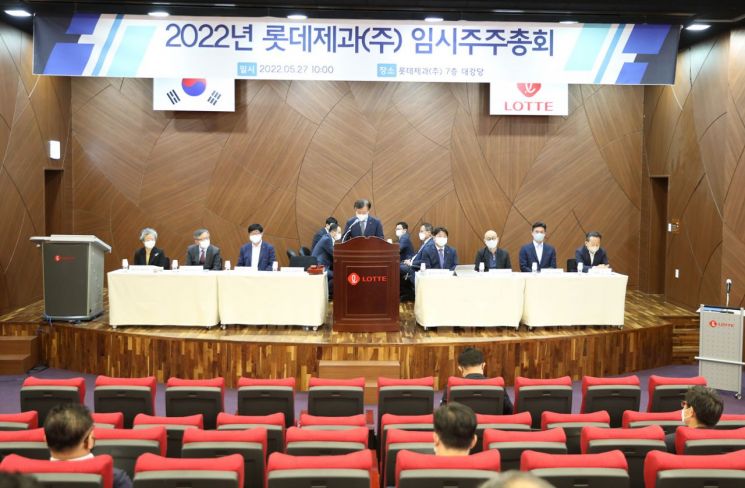 Lotte Confectionery held an extraordinary general meeting of shareholders on the 27th of last month and officially finalized the merger by approving the merger resolution with Lotte Food.
Improvement in Management Efficiency... Expectations for Profitability Enhancement
Through this merger, Lotte Confectionery is expected to reduce overlapping elements in management and efficiently utilize human and physical resources, thereby improving operational efficiency. Ultimately, this is expected to enable improvements in the company’s financial structure and profitability. Although Lotte Confectionery and Lotte Foods each hold strong market dominance in their respective areas, key businesses such as confectionery, oils, and dairy products are facing growth stagnation. Recently, the business environment has been rapidly changing with the acceleration of online channel transitions and rising raw material prices, requiring more agile market responses than before. In this context, the merger is seen as an opportunity to respond integrally to market changes, improve efficiency, and explore various new business opportunities based on an expanded portfolio.
Jungwon Eom, a senior researcher at Korea Ratings, said, "Since Lotte Foods’ profitability is lower than Lotte Confectionery’s, profitability indicators may slightly decline after the merger, but if the purchasing, production, and distribution networks of the two companies are integrated and overlapping businesses consolidated, operational efficiency will improve." He added, "The merger with Lotte Foods, which has a relatively strong financial structure, will also improve financial stability indicators such as debt ratio and reliance on borrowings."
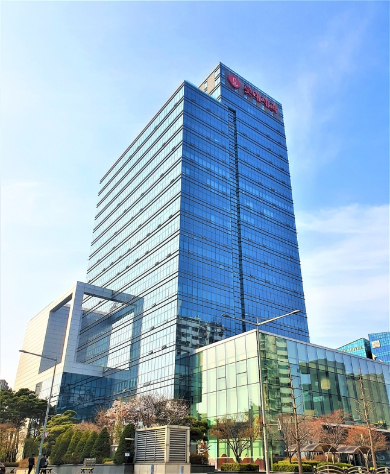
In the short term, there is high anticipation for strengthened competitiveness through the integration of the overlapping ice cream businesses. The domestic ice cream market is worth 1.4 trillion won, and as of the first half of last year, Binggrae led with a combined market share of 40% (Binggrae 28.0% + Haitai 12.3%). However, with the merger of Lotte Confectionery (30.6%) and Lotte Foods (14.7%), the combined market share will exceed 45%, changing the top position.
The separately operated e-commerce organizations are also expected to undergo unification. By integrating their own malls, they aim to increase operational efficiency and plan to expand the e-commerce organization in the mid to long term. Through online business strategy consulting and other measures, they are reviewing dedicated logistics centers, aiming to increase the online sales ratio, currently below 10%, to over 25% by 2025.
New businesses and overseas operations for mid- to long-term growth are also expected to accelerate. Until now, the two companies have struggled to aggressively expand similar new businesses such as senior food and health foods, but through the merger, they are expected to strengthen brand competitiveness by building a food portfolio covering the life cycle from infant formula to silver food. Additionally, Lotte Foods, which was mainly domestic-focused, is expected to be able to actively sell overseas by utilizing Lotte Confectionery’s overseas sales network.
© The Asia Business Daily(www.asiae.co.kr). All rights reserved.
!["The Woman Who Threw Herself into the Water Clutching a Stolen Dior Bag"...A Grotesque Success Story That Shakes the Korean Psyche [Slate]](https://cwcontent.asiae.co.kr/asiaresize/183/2026021902243444107_1771435474.jpg)


















