Research Team of Prof. Choi Byung-yoon at Bundang Seoul National University Hospital and Prof. Kim Bong-jik at Sejong Chungnam National University Hospital
Study on Vestibular Organ Cochlear Implant Electrode Insertion Surgery with Long-Term Follow-Up
Everyday Conversation Possible Within 4 Years...Same Level as Patients Without Deformities Within 7 Years
World's First Identification of 'GREB1L' Gene Mutation Causing Cochlear Aplasia
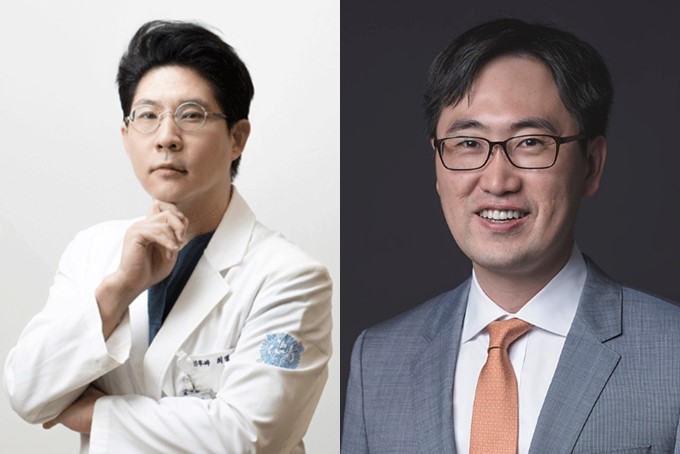 Professor Choi Byung-yoon (left), Department of Otorhinolaryngology, Bundang Seoul National University Hospital, and Professor Kim Bong-jik, Department of Otorhinolaryngology, Sejong Chungnam National University Hospital.
[Asia Economy Reporter Lee Gwan-joo] The first research results have shown that the effectiveness of cochlear implantation performed on patients without a formed cochlea is at a level equivalent to that of general implantation.
The research team led by Professor Choi Byung-yoon of the Department of Otorhinolaryngology at Bundang Seoul National University Hospital (in collaboration with Professor Kim Bong-jik of Sejong Chungnam National University Hospital) announced on the 29th the world's first long-term outcome study results of cochlear implantation in patients with cochlear aplasia.
The cochlea is formed during the fetal period, but malformations can occur due to genetics, drugs, or other mechanisms. When the malformation is mild, hearing aids are used, but in severe cases, no matter how much the sound is amplified with hearing aids, the patient cannot hear. Therefore, cochlear implantation is performed, which directly stimulates the auditory nerve and converts speech into electrical signals to enable hearing.
However, cochlear aplasia patients, who lack a formed cochlea where the cochlear implant electrodes are inserted, have been contraindicated for cochlear implantation. As a result, these patients inevitably suffer from hearing impairment as well as language development disorders and other disabilities.
To address this issue, the research team has been conducting studies since 2012 on cochlear implantation in patients with cochlear aplasia. After examining the condition of the cochleovestibular nerve to assess the possibility and safety of inserting cochlear implant electrodes into the vestibular organs of six patients with cochlear aplasia, the optimal electrode position was identified for each patient and the cochlear implant was inserted. Additionally, the patients' hearing was evaluated through an average of six years of follow-up and observation, including ▲CAP score (Categories of Auditory Performance) ▲word and sentence recognition ▲pronunciation.
The results showed that all six patients achieved CAP5 within four years after surgery, a level at which short sentences can be understood without lip-reading, and three patients reached CAP7, the highest level of auditory performance, enabling even telephone conversations. Furthermore, within three years post-surgery, more than half of the words, sentences, and pronunciations were recognized, and within seven years, their progress matched that of patients without malformations who had undergone cochlear implantation.
Through this study, it is expected that cochlear implantation and follow-up observation in patients without a cochlea can prevent hearing and language development disorders at an early stage.
Professor Choi Byung-yoon explained, "This study proved the effectiveness of cochlear implantation in cochlear aplasia patients, which was previously considered contraindicated," adding, "For successful cochlear implantation in cochlear aplasia patients, electrodes must be implanted considering the condition of the cochleovestibular nerve and the electrically evoked compound action potentials during surgery."
Additionally, through another study with Professor Kim, Professor Choi identified for the first time that the hearing loss gene causing cochlear aplasia is ‘GREB1L (Growth Regulation by Estrogen in Breast cancer 1-Like)’. By utilizing molecular genetic diagnosis and analyzing 421 cases of cochlear implantation performed at Bundang Seoul National University Hospital from 2012 to 2019, GREB1L gene mutations were confirmed in 60% of cochlear aplasia cases. Moreover, it was found that this gene follows a non-Mendelian inheritance pattern, not adhering to Mendel's laws such as dominance, segregation, and independence.
According to the research results, if GREB1L gene mutations are confirmed in the test results of cochlear aplasia patients and the cochleovestibular nerve condition is not poor, patients are expected to receive early cochlear implant electrode insertion into the vestibular organs and grow up without hearing or language development problems. Professor Kim said, "Mutations in the GREB1L gene are the main cause of cochlear aplasia," and added, "We will continue research to identify genes causing hearing loss, including cochlear aplasia."
The research results were published in the SCI-level international journals ‘Clinical Otorhinolaryngology’ and ‘Clinical and Experimental Otorhinolaryngology’.
© The Asia Business Daily(www.asiae.co.kr). All rights reserved.
![User Who Sold Erroneously Deposited Bitcoins to Repay Debt and Fund Entertainment... What Did the Supreme Court Decide in 2021? [Legal Issue Check]](https://cwcontent.asiae.co.kr/asiaresize/183/2026020910431234020_1770601391.png)