[Asia Economy Reporter Kim Min-young] Since the private land price ceiling regulation was applied, apartment prices in less regulated provincial areas have risen about twice as much as those in the Seoul metropolitan area. However, if the price ceiling system is reformed and regulations are eased, apartment prices are expected to rise mainly in reconstruction and redevelopment projects in the Seoul metropolitan area, where prices have been suppressed by regulations.
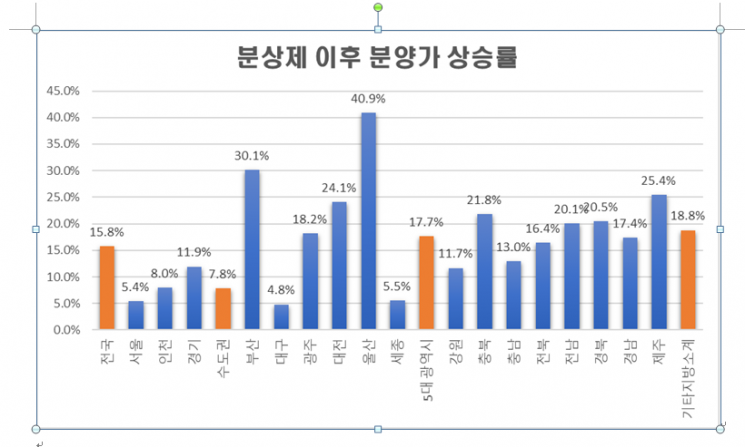
According to an analysis of the monthly average sale prices from the National Statistical Portal (KOSIS) by Real House, a specialized sales evaluation company, as of May, the average apartment sale price nationwide based on exclusive area was 14.44 million KRW per 3.3㎡ (average from June 2021 to May 2022). This represents a 15.8% increase compared to July 2020 (12.46 million KRW), before the private land price ceiling was applied.
By region, the increase in sale prices varied depending on the level of regulation. In the Seoul metropolitan area, including Seoul, where most projects are subject to price regulations, prices rose by an average of 7.78% over the past 22 months, which is lower than the inflation rate during the same period. Looking at changes in the metropolitan area, Seoul rose 5.43% (28.21 million KRW per 3.3㎡), Incheon 8% (15.81 million KRW per 3.3㎡), and Gyeonggi 11.94% (16.03 million KRW per 3.3㎡). Sejong City also saw a modest increase of 5.55% (11.93 million KRW per 3.3㎡) over 22 months since the implementation of the private land price ceiling.
On the other hand, less regulated areas saw much higher increases during the same period: Ulsan rose 40%, Busan 30%, and Jeju 25.4%. Daejeon, Chungbuk, Jeonnam, and Gyeongbuk also recorded increases exceeding 20%. Thus, the rise in sale prices differed significantly between the Seoul metropolitan area and provincial regions depending on the degree of regulation.
The price ceiling system limits housing sale prices based on land cost, basic construction cost, and additional construction costs. It was applied to private land on July 29, 2020, to curb speculative demand and protect actual buyers.
The industry expects that once the reform of the price ceiling system is fully implemented in July, sale prices in the metropolitan area will gradually rise. Prices for reconstruction and redevelopment apartments are expected to increase by up to 4% compared to before.
Kim Seon-ah, head of the sales analysis team at Real House, said, "Once the price regulation lock on reconstruction and redevelopment projects, which account for most private land supply in the metropolitan area, is officially released, developers will try to raise prices as much as possible to supply, reflecting the pent-up demand." She added, "Since the basic construction cost, which can be raised twice a year, is steadily increasing and financial costs are also included in the cost, the perceived increase in sale prices will be much greater."
© The Asia Business Daily(www.asiae.co.kr). All rights reserved.
![Clutching a Stolen Dior Bag, Saying "I Hate Being Poor but Real"... The Grotesque Con of a "Human Knockoff" [Slate]](https://cwcontent.asiae.co.kr/asiaresize/183/2026021902243444107_1771435474.jpg)
















