Faster by 2 Years Compared to 6 Years for 4G
High 5G Adoption Rates in North America and Northeast Asia
Korea Leads in 5G Traffic Usage
 Ericson LG Senior Network Consultant Byungseong Park stated at an online press briefing on the 28th, "The number of 5G subscriptions worldwide is expected to exceed 1 billion in 2022." Photo by screen capture
[Asia Economy Reporter Minyoung Cha] It is predicted that the number of global 5G network subscriptions will exceed 1 billion within this year. The spread of 5G is faster than the previous generation wireless communication standard 4G (LTE), resulting in a subscriber growth rate approximately two years ahead.
Byungseong Park, Senior Network Consultant at Ericsson LG, stated at an online press briefing on the latest Ericsson Mobility Report on the 28th, "The number of global 5G subscriptions is expected to surpass 1 billion in 2022," adding, "It took six years during the 4G era."
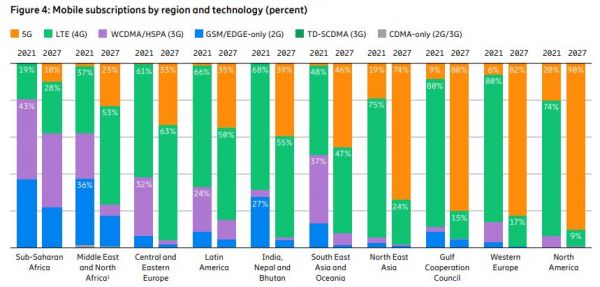
Regionally, North America and Northeast Asia boast the highest 5G subscription rates. As of 2021, North America stands at about 20%, and the Northeast Asia region at around 19%. By 2027, these are expected to increase to approximately 90% and 74%, respectively. Western Europe (82%) and the Gulf Cooperation Council region (80%) are also projected to have high 5G subscription rates. Consultant Park noted, "Since 4G was introduced very rapidly in Korea, the spread of 5G is slower than 4G, but compared to the global propagation speed, it is faster."
Along with the increase in 5G subscribers, global mobile network data traffic has doubled over the past two years. Monthly data usage per smartphone by users in the US and Europe is expected to rise from 15GB in 2021 to 52GB in 2027. Korea has already recorded a usage of 59GB as of April this year.
Ericsson LG analyzes that the traffic increase is due to the rise in smartphone and mobile broadband usage and the digitalization of society and industry. This is driven by strong demand for robust data connectivity and digital services. The addition of hundreds of millions of new mobile broadband subscribers annually also contributes to this trend.
Devices supporting standalone 5G (SA), known as "real 5G," are also increasing. Unlike 5G non-standalone mode (NSA), SA processes both data and control solely through the 5G network. Consultant Park said, "About half already support it," and added, "In particular, China started with NSA but is rapidly transitioning its network to SA." SA networks are expected to double by the end of this year.
He emphasized, "Currently, NSA captures both 4G and 5G simultaneously, so it must utilize two resources together, but SA services operate solely on 5G resources, allowing traffic generated on 4G to be transferred to 5G." He continued, "SA simplifies the network by using only 5G, which helps in network management."
© The Asia Business Daily(www.asiae.co.kr). All rights reserved.
![User Who Sold Erroneously Deposited Bitcoins to Repay Debt and Fund Entertainment... What Did the Supreme Court Decide in 2021? [Legal Issue Check]](https://cwcontent.asiae.co.kr/asiaresize/183/2026020910431234020_1770601391.png)
















