350 Pterosaur Footprints 2-6 cm Concentrated at Seoyuri Fossil Site, Hwasun, Jeonnam
[Asia Economy Honam Reporting Headquarters, Reporter Yoon Jamin] Professor Heo Min's team at Chonnam National University has discovered fossils that prove the communal living of pterosaurs for the first time in the world.
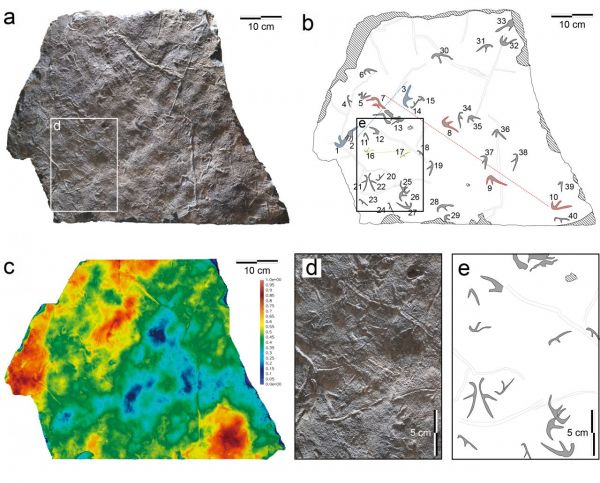
According to Chonnam National University on the 28th, Professor Heo Min (Department of Earth Environmental Sciences, Director of the Korea Dinosaur Research Center) and his research team recently found fossils containing over 350 pterosaur footprints, ranging from 2 to 6 cm in size, densely clustered at the dinosaur fossil site in Seoyuri, Hwasun-gun, Jeonnam, formed during the Mesozoic Cretaceous period.
These pterosaur footprints are so densely packed that there are almost no gaps, and the preservation state is excellent enough to clearly see both the front and hind footprints.
The research team views this fossil as definitive evidence that about 90 million years ago, pterosaurs of various sizes?from very small footprints to relatively large ones?lived together, indicating the presence of both juvenile and mature individuals.
Until now, claims of pterosaur communal living were based on skeletal fossils or nest fossils and remained speculative. However, with the discovery of footprint fossils left by living pterosaurs this time, the communal living behavior of pterosaurs has finally been proven for the first time worldwide.
This research was conducted as an international joint study led by first author Jeong Jong-yoon, a doctoral student at Chonnam National University (Department of Geological Environmental Sciences, Korea Dinosaur Research Center), and corresponding author Professor Heo Min, in collaboration with the University of Leicester in the UK and the China University of Geosciences. The related paper was published on the 23rd in the latest issue of Scientific Reports, a sister journal of Nature.
Based on this paper and follow-up research, the team plans to present additional studies at the 11th Cretaceous Symposium commemorating the 200th anniversary of Cretaceous research, held in Warsaw, Poland, this August, and at the 82nd Annual Meeting of the Society of Vertebrate Paleontology in Toronto, Canada, this November.
The Seoyuri dinosaur footprint fossil site in Hwasun-gun has yielded about 1,500 dinosaur footprints and played a decisive role in determining the running speed of carnivorous dinosaurs. It is also the site where the world's first dinosaur acceleration theory was proposed.
Designated as Natural Monument No. 487 and a geological site of the Mudeungsan UNESCO Global Geopark, this fossil site’s recent world-class fossil discovery is expected to greatly aid in the future re-certification of the UNESCO Global Geopark.
© The Asia Business Daily(www.asiae.co.kr). All rights reserved.

















