2030 User Concentration Disappears
Significant Growth with 4050 Share Increasing Sharply
Accelerated Loans Approaching 40 Trillion Won
[Asia Economy Reporters Sim Nayoung and Boo Aeri] #Office worker Park Yuri (32, pseudonym) recently spread her money across accounts at KakaoBank, Toss Bank, and K Bank instead of using her Shinhan Bank account, which she had used for over 10 years since her university days. She found it more convenient to handle banking through applications and believed that financial products offered by internet-only banks were better than those of traditional banks.
Park uses Toss Bank's deposit and withdrawal account, which offers a 2% annual interest rate with daily interest payments, for living expenses, and switched her savings to KakaoBank's flexible savings account with an interest rate in the 2.2% range. A week ago, she also signed up for K Bank's flexible savings account with a 5% interest rate. Park said, "I was conservative and only used traditional banks, but now internet-only banks feel more stable, and their savings products seem to have many more advantages."
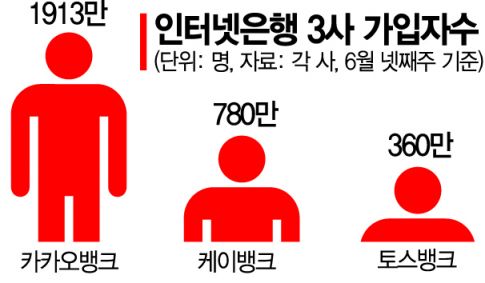
The era of 30 million subscribers to internet-only banks (hereafter referred to as InBank) has arrived. Since K Bank opened in April 2017, about half of South Korea's population has become subscribers to InBank in just 5 years and 2 months. According to the three InBanks as of the previous day, KakaoBank had 19.13 million subscribers, K Bank had 7.8 million, and Toss Bank had 3.6 million. Including overlapping subscriptions, the total reached 30.53 million, marking the start of the 30 million subscriber era this month.
As the number of subscribers increased, the phenomenon of InBank users being concentrated in their 20s and 30s has disappeared. Looking at Toss Bank, which opened the latest in October last year, the age distribution of customers as of June shows that customers in their 20s (25.1%) and 30s (25.4%) were about as many as those in their 40s (23.8%) and those aged 50 and above (19.2%). For KakaoBank and K Bank, the proportion of customers aged 50 and above (as of May) reached 18% and 17%, respectively. Office worker Seo Min-gi (37, pseudonym) said, "My parents found it difficult to sign up at first, so I helped them, and because the user interface was intuitive, they quickly adapted to InBank. Now, they find it convenient not to have to go to a bank."
With the explosive increase in subscribers, loan amounts have also rapidly grown, approaching a total of 40 trillion won. As of the end of May, KakaoBank recorded 26.5445 trillion won, K Bank 8.49 trillion won, and Toss Bank surpassed 4 trillion won this month. An InBank official evaluated, "InBank expanded the market by absorbing loan demand from middle-credit borrowers who could not borrow from traditional banks and had no alternative but high-interest card loans." Toss Bank's proportion of middle- to low-credit borrowers is 36%, exceeding the initial pledge of 34.9% at its launch.
Yang Heewon, a researcher at the ESG Research Team of the Corporate Governance Service, said, "Internet-only banks have very low fixed costs compared to traditional banks because, due to the nature of the industry, labor costs and rent expenses are relatively low. They enjoyed an oligopolistic advantage with no initial competitors due to high entry barriers caused by licensing difficulties. However, with the digital pursuit by traditional banks, there is a possibility of relatively slower growth compared to the past."
© The Asia Business Daily(www.asiae.co.kr). All rights reserved.
![User Who Sold Erroneously Deposited Bitcoins to Repay Debt and Fund Entertainment... What Did the Supreme Court Decide in 2021? [Legal Issue Check]](https://cwcontent.asiae.co.kr/asiaresize/183/2026020910431234020_1770601391.png)
















