Technology Differentiation Speed... Samsung Expands "Mupung Ecosystem"
"Consumers Prefer 'Comfortable Breeze' Over 'Strong Wind'"
"Consumer Demand Remains Steady Despite Rising Prices and Electricity Bills"
"Slight Increase Expected Compared to Previous Years... Approximately 2 Million Units Anticipated"
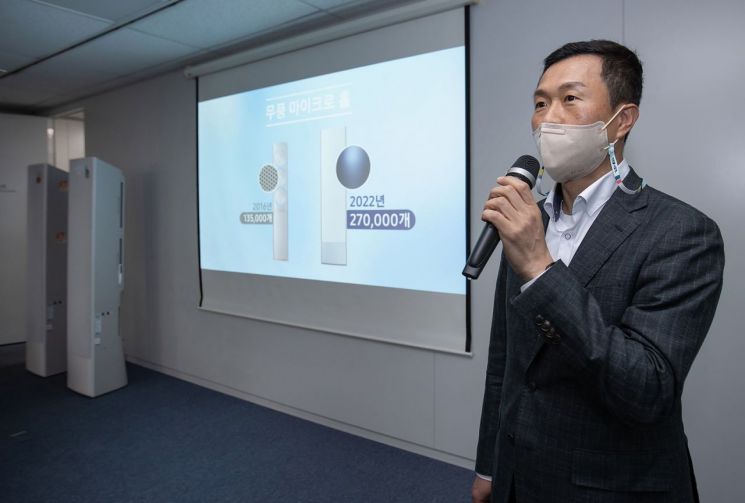 Nosuhyuk, Executive Director of Samsung Electronics' Home Appliance Business Division, is seen explaining the Samsung Wind-Free Air Conditioner to reporters on the morning of the 28th at the Taepyeong-ro Building in Jung-gu, Seoul. (Photo by Samsung Electronics)
[Asia Economy Reporter Moon Chaeseok]
"The biggest technological aspect of our air conditioners is 'Mupung' (Wind-Free). It is a technology perfected through scientific analysis, design efforts, and process trial and error to provide coolness without the sensation of airflow. We confidently see ourselves as the only company in the world that makes Wind-Free air conditioners, and expanding this lineup is the biggest technological differentiator compared to other companies."
On the 28th, Noh Suhyuk, Executive Director of Samsung Electronics' Home Appliance Business Division, said this during a meeting with reporters at the Taepyeongro Building in Jung-gu, Seoul. Wind-Free air conditioners account for about 90% of Samsung's total air conditioner sales. The reason for their phenomenal popularity is that they can create wind with minimal airflow sensation. The concept is based on the scientific principle of the Seokbinggo (traditional Korean ice storage) that emits cool air without direct wind.
Samsung Electronics revealed that consumers prefer to enjoy comfortable air for a long time while paying lower electricity bills rather than feeling a 'strong' wind. Considering that the average daily air conditioner usage time is 4 hours and 40 minutes, their goal was to provide "strong wind for the first 10 minutes, and comfortable wind for the remaining 4 hours and 30 minutes," which they have achieved.
Executive Director Noh explained, "The success of Samsung's Wind-Free air conditioners lies in increasing cooling capacity by 30% while reducing power consumption by 10%," adding, "Through high-efficiency technology, we have reduced consumers' electricity bills and enhanced cooling performance." He also said, "Looking at monthly electricity bills, Grade 1 products can save about 9,000 to 11,000 KRW compared to Grade 2 products."
He said concerns about consumer demand due to electricity price increases are not significant. The domestic air conditioner market is expected to achieve sales of about 2 million units this year, similar to last year.
Lee Kyungjoo, Product Planning Professional for Samsung Electronics' Air Solution, who accompanied the site visit, said, "As predicted by the industry, Samsung Electronics also expects to sell about 2 million units, slightly more than last year," adding, "Since the early heatwave started from April to May this year, weather will begin to affect sales from now on." She added, "We believe we are leading the market with Wind-Free air conditioners, so we are not worried about demand variables."
Wind-Free air conditioners were first developed by Samsung Electronics in 2016, the world's first product of its kind. They are currently sold in 78 countries. It is said that more than 2 million units of domestic stand-type air conditioners have been sold. There are 60 models currently on the market. The newly introduced 'eco-friendly R32 refrigerant' enables energy savings and carbon reduction. Since 2020, the 'Easy Open Panel' feature, which allows easy cleaning by detaching the panel, has been applied for convenient home use. It also has the 'Bespoke Wind-Free Air Conditioner' function that provides warm air not only in summer but also in spring, fall, and transitional seasons.
© The Asia Business Daily(www.asiae.co.kr). All rights reserved.

















