Price Inflation Rate Solidifies at 6% Range
Labor Unions Demand Wage Hikes, Increasing Pressure of 'Wage-Driven Inflation'
Deputy Prime Minister Choo Kyung-ho Warns of "Vicious Cycle of Price-Wage Spiral"... Urges Restraint on Excessive Wage Increases
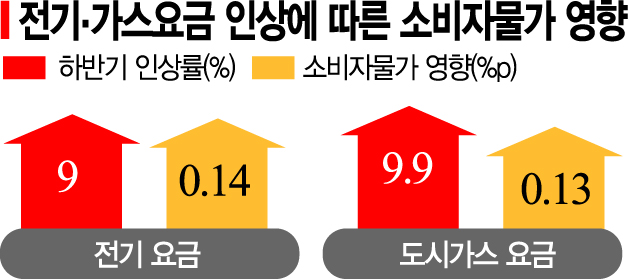
[Asia Economy Sejong=Reporters Kwon Haeyoung and Son Seonhee] Starting next month, if electricity and gas rates increase simultaneously, consumer prices in the second half of the year are expected to rise by at least 0.27 percentage points. The increase in public utility rates due to electricity and gas price hikes not only makes entering the 6% inflation range a foregone conclusion but also raises concerns that inflation could soar to levels seen during the International Monetary Fund (IMF) foreign exchange crisis. To make matters worse, pressure from 'wage-driven inflation' is also increasing, prompting Deputy Prime Minister and Minister of Economy and Finance Choo Kyung-ho to urge the business community to refrain from excessive wage increases.
On the 28th, based on the Consumer Price Index item weights from Statistics Korea, it was analyzed that electricity rates will rise by 9% and city gas rates by 9.9% in the second half of the year, pushing consumer prices up by 0.14 percentage points and 0.13 percentage points respectively.
Currently, the electricity rate is about 110 won per kWh. The government and Korea Electric Power Corporation decided yesterday to raise the fuel cost adjustment unit price for the third quarter electricity rates by 5 won per kWh and plan to further increase the standard fuel cost by 4.9 won per kWh in October. This means electricity rates will rise by 9% in the second half compared to now. According to Statistics Korea, a 1% increase in electricity rates raises consumer prices by 0.0155 percentage points (electricity rate weight in the Consumer Price Index is 15.5), so this electricity rate hike is calculated to increase prices by a total of 0.14% in the second half.
City gas rates will also increase by 1.11 won per MJ in July and 0.4 won in October, rising 9.9% compared to the current average residential rate (15.2858 won). A 1% increase in city gas rates raises consumer prices by 0.0127 percentage points (city gas rate weight is 12.7), so the city gas rate hike in the second half is expected to push inflation up by 0.13 percentage points.
With just these electricity and city gas rate hikes, consumer prices in the second half are expected to rise by at least 0.27 percentage points, signaling that inflation in the 6% range is imminent. Inflation has been rapidly rising since surpassing 3% in October last year, exceeding 4% in March and 5.4% in May this year. Deputy Prime Minister Choo stated on the 26th, "We can expect inflation rates in the 6% range in June or July-August," effectively confirming the 6% inflation rise. If inflation exceeds 6%, it will be the first time in 24 years since November 1998 (6.4%) during the foreign exchange crisis.
This sharp rise in inflation is mostly due to overseas factors such as the Ukraine war causing increases in international oil and grain prices. Liquidity injected into the market to manage the COVID-19 crisis is also pushing prices upward.
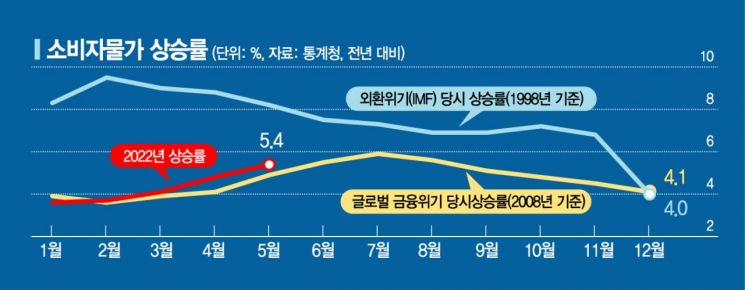
What is even more concerning is that the pass-through effect between prices and wages is becoming visible. Labor unions are demanding wage increases in response to high inflation. This could create a vicious cycle of 'price increase → wage increase → corporate product price increase → further price increase.' There are fears that inflation could reach levels seen during the foreign exchange crisis, when inflation peaked at 9.5% (February 1998).
Deputy Prime Minister Choo also held a meeting with the Korea Employers Federation (KEF) on the same day, urging restraint on excessive wage increases, saying, "Competitive price and wage hikes riding on the inflation trend will cause a 'price-wage spiral,' leading to difficulties for the entire economy and society." He pointed out, "Recently, some IT companies and large corporations have shown a tendency for high wage increases, which is very concerning as it appears to be spreading to other industries and companies. Excessive wage increases not only worsen the high inflation situation but also widen the wage gap between large corporations and small and medium enterprises (SMEs), increasing the relative deprivation of SMEs and vulnerable workers, which could amplify social conflicts." He added, "Excessive wage increases beyond productivity in large corporations will deepen labor market polarization and worsen job mismatches across workplaces. Ultimately, companies will find it difficult to maintain competitiveness under this high-wage, high-cost structure."
He also emphasized minimizing price increases through productivity improvements and cost reduction efforts. Deputy Prime Minister Choo said, "Wages are fundamentally a matter to be decided autonomously between labor and management, but considering the current difficulties in our economy, the business community should refrain from excessive wage increases and raise wages to an appropriate level within the scope of productivity improvements. Efforts should be made to absorb various cost increases through productivity improvements, such as expanding investments." He stressed, "Since inflation caused by global energy and grain price surges and other external shocks is somewhat inevitable, all economic actors need to unite and cooperate with the government's efforts to stabilize prices to overcome these difficulties."
Professor Kang Insu of the Department of Economics at Sookmyung Women's University said, "The electricity rate hike will lead to increased production costs and product prices for companies, which will push prices up further with a time lag. If wage increases continue due to high inflation, it could lead to a vicious cycle of further price increases, so sharing the pain by minimizing wage hikes is necessary."
© The Asia Business Daily(www.asiae.co.kr). All rights reserved.


















