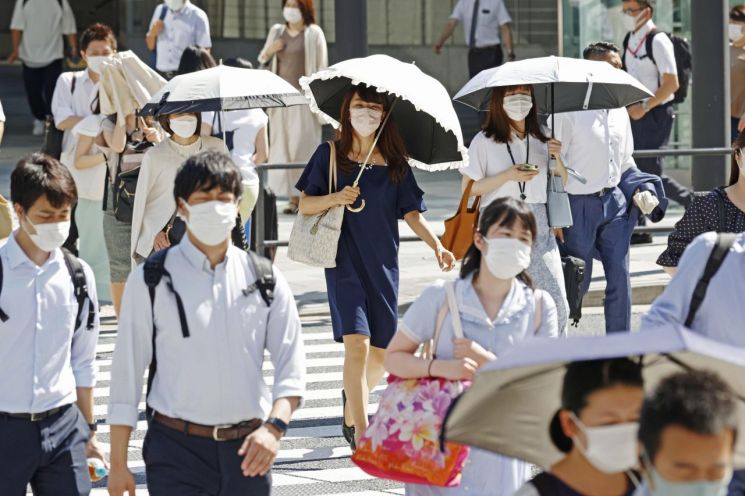
 Citizens in Tokyo, Japan are crossing an intersection amid a heatwave on the 27th. As an early heatwave hits and power shortages become severe, the Japanese government issued a power supply caution for two consecutive days, from the 27th to the 28th.
 [Photo by AP]
[Asia Economy Reporters Byunghee Park, Jinju Han, and Dongwoo Lee in Sejong] The temperature in Japan in June, after the rainy season ended, reached an all-time high. In South Korea, tropical nights, which usually begin in July, started to intensify from June, indicating that this summer, the entire world will have to struggle against heatwaves. With energy prices soaring, there are also concerns about power emergencies.
◆ Heatwave in June for the first time in 147 years in Japan = The Ministry of Economy, Trade and Industry of Japan issued a power supply cautionary notice for the Tokyo metropolitan area on the 28th, following the previous day. This is the first time Japan has issued a power caution notice for two consecutive days due to a historic June heatwave causing a significant increase in electricity usage.
According to Nihon Keizai Shimbun, for the first time on record for June, Tokyo's city center experienced three consecutive days of heatwave this month. Considering the forecasted temperatures for the remaining three days of June, the average temperature for the last ten days of June is expected to be 32.8°C, the highest in 147 years since the Japan Meteorological Agency began keeping records in 1875. This is expected to be 2 degrees higher than the previous highest late June records of 30.8°C set in 1946 and 1963.
Japan experienced an unusually early end to the rainy season, leading to an early start of the heat. The Japan Meteorological Agency announced that the rainy season in the so-called Kanto-Koshin region, including Tokyo, Saitama, Gunma, Nagano, Yamanashi, Kanagawa, Chiba, Ibaraki, and Tochigi prefectures, began on June 6 and ended around the 27th. The rainy season lasted only 21 days, the shortest since records began in 1951.
Europe is also suffering from severe heatwaves. In Spain, temperatures exceeded 40°C daily in mid-June. France is also enduring heatwaves above 40°C, with analyses showing temperatures this month are 10 to 14 degrees higher than average. Germany recorded its highest June temperature on the 19th at 39.2°C.
◆ Tropical nights already intensifying = In South Korea, tropical nights occurred during the rainy season. Tropical nights, which usually start in July, began intensifying from June this year. The inflow of hot and humid southwesterly winds and cloudy weather prevented temperatures from dropping, causing many places to experience tropical nights overnight. On the 28th, the Korea Meteorological Administration reported minimum temperatures at locations recording tropical nights at 6 a.m. as follows: Seoul 25.8°C, Suwon 27.7°C, Cheongju 28.2°C, Daejeon 27.4°C, Gwangju 25.8°C, Jeonju 27.3°C, and Jeju 28.9°C. In Seoul, the first tropical night last year occurred on July 12, making this year’s occurrence 16 days earlier. Tropical nights are expected to continue mainly along parts of the East Coast, Jeju coastal areas, some Chungcheong regions, and southern inland areas. The Korea Meteorological Administration has analyzed a 50% chance that July and August will be hotter than average.
◆ Power supply emergency = The early heatwave has triggered an emergency in domestic power supply. With increased electricity usage in summer, energy import costs are also expected to surge. The Korea Power Exchange forecasted the maximum expected power usage on the 28th at 84,200 MW, with a supply reserve margin falling below 10,000 MW to 9,808 MW. The industry generally considers a reserve margin of 10,000 MW and a reserve rate of about 10% as the minimum for stable power supply. This month alone, the supply reserve margin has fallen below 10,000 MW for a total of four days until the previous day. On the 23rd, the supply reserve margin dropped to 7,955 MW (reserve rate 9.5%) for the first time this year. There are concerns that the reserve rate could drop further if power demand peaks during the full onset of the heatwave in July and August. The government has formed a power supply expert advisory task force (TF) and plans to announce detailed power supply forecasts and countermeasures in early next month.
© The Asia Business Daily(www.asiae.co.kr). All rights reserved.
![User Who Sold Erroneously Deposited Bitcoins to Repay Debt and Fund Entertainment... What Did the Supreme Court Decide in 2021? [Legal Issue Check]](https://cwcontent.asiae.co.kr/asiaresize/183/2026020910431234020_1770601391.png)















