Savings banks, 44.9% of credit loans under 14% interest
Single-digit rate loans rise from 4.3% to 11.7%
Lower maximum interest rate makes borrowing harder for low-credit borrowers
Estimated 30,000-50,000 people borrowed from illegal lenders last year
[Asia Economy Reporter Song Seung-seop] The secondary financial sector, which used to operate targeting low-credit borrowers, is recently attracting borrowers with high credit scores. They have also significantly lowered loan interest rates, targeting those who could not borrow enough money from the primary financial sector. This is because there is little profit left from loans to low-credit borrowers, raising concerns that the loan cliff phenomenon for financially vulnerable groups is intensifying.
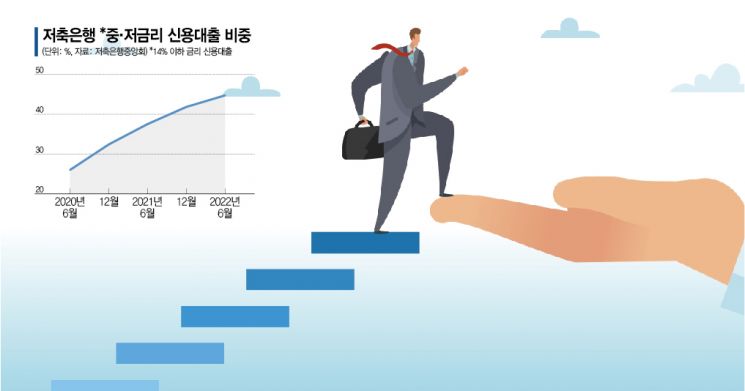
According to the Korea Federation of Savings Banks on the 29th, household credit loans with medium to low interest rates of 14% or less accounted for 44.9% of the total this month. This means that about half of the loans were made up of medium to low interest rate loans. Loans with single-digit interest rates below 10% also accounted for 11.7%.
The proportion of medium to low interest rate loans is steadily increasing. In June last year, the proportion of medium to low interest rate loans was only 37.7%. Compared to two years ago when it was 26.2%, it increased by 18.7 percentage points. At that time, loans with interest rates below 10% accounted for 4.3% of the total. Although the base interest rate rose from 0.5% to 1.75%, low-interest loans actually increased.
Mortgage loan interest rates are also on a downward trend. This month, the mortgage loan interest rates in the savings bank industry are around 4.74% to 5.73%. This is slightly lower than June last year (4.77% to 6.04%) and decreased by 0.32 to 0.72 percentage points compared to June 2020 (5.06% to 6.45%).
High-credit borrowers have also been observed borrowing money from credit unions. The CSS (Credit Scoring System) loan product of credit unions allows borrowing up to 150 million KRW for up to 10 years, with interest rates decreasing as credit scores increase. Although the designed interest rate can rise to the mid-teens in the 10% range, in reality, loans with interest rates in the 4-5% range predominated. At Dongho Credit Union in Seongdong-gu, Seoul, loans were even issued at a low interest rate of 3.857%, comparable to the primary financial sector.
If Loan Supply to Low-Credit Borrowers Decreases, Illegal Private Loans Will Be the Only Option
The same applies to Saemaeul Geumgo. As of last month, one-third of all credit loans at Samseon Saemaeul Geumgo were given to high-credit borrowers with grades 1 to 3. The average interest rate was 3.78%. At Hoegi Hwikyung Saemaeul Geumgo, half of all loans were executed for high-credit borrowers, with an average interest rate of 4.13%.
The secondary financial sector mainly targets high-credit borrowers who could not get the desired amount of loans from private commercial banks or have special circumstances. A savings bank official explained, "Most high-credit borrowers come to fill the gap in their funds," adding, "Even if the credit score is good, if there are multiple debts, it is difficult to get loans from private banks, so they borrow money here."
Industry insiders agree that since the statutory maximum interest rate was lowered from 24% to 20% per annum in July last year, it has become difficult to provide loans to low-credit borrowers. In the secondary financial sector, funding channels are limited and there are many cases of defaults, making the cost of loans expensive. For low-credit borrowers, the loan cost alone is around 20-23%. The industry’s position is that it is difficult to lend money to borrowers with credit grades 7 to 8 while bearing the risk.
As low-interest loans increase due to the secondary financial sector’s business targeting high-credit borrowers, it is pointed out that low-credit borrowers have nowhere to turn. The situation is similar in the tertiary financial sector, classified as loan businesses, so ultimately, they have no choice but to turn to illegal private loans. According to the Korea Institute of Financial Services for the Underprivileged, about 637,000 people were rejected for loans by loan companies last year. Among them, it is estimated that 37,000 to 56,000 borrowed money from illegal private loan companies.
© The Asia Business Daily(www.asiae.co.kr). All rights reserved.
![From Hostess to Organ Seller to High Society... The Grotesque Scam of a "Human Counterfeit" Shaking the Korean Psyche [Slate]](https://cwcontent.asiae.co.kr/asiaresize/183/2026021902243444107_1771435474.jpg)
















