Improvement of In-flight Services... Also Considering New Hiring of Flight Crew Members
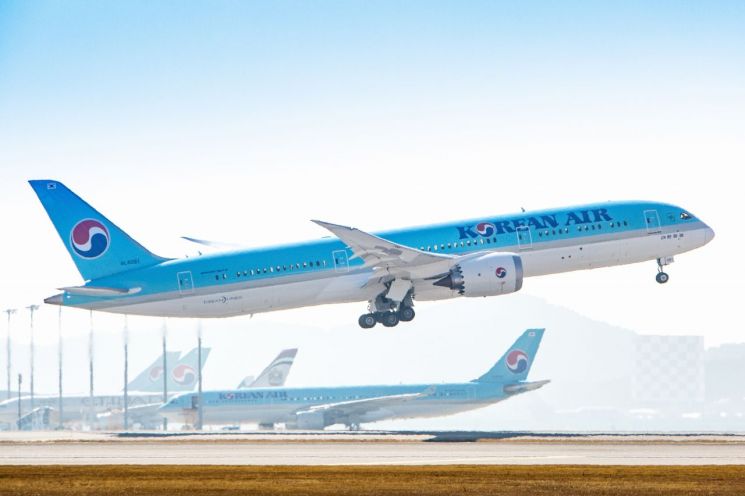
[Asia Economy Reporter Kiho Sung] Korean Air is actively working to accelerate the recovery of international passenger routes that had been halted due to COVID-19.
Korean Air announced on the 28th, "We plan to restore international flight seat capacity to 50% of pre-COVID-19 levels by September."
First, Korean Air will significantly increase passenger route supply during the peak season in July and August. Currently, June's passenger supply is only about one-third of pre-COVID-19 levels. Accordingly, Korean Air plans to restore September's available seat kilometers (ASK) to over 50% compared to before the pandemic. This timeline is about three months earlier than the previous plan to recover 50% supply by the end of the year.
For transpacific routes, the Incheon-Los Angeles route operates 14 times weekly (twice daily), and the Incheon-New York route will increase from 7 to 12 weekly flights in July, then to 14 weekly flights (twice daily) from August. The Incheon-Washington and Incheon-Honolulu routes will increase from 5 to 7 weekly flights, and the Incheon-Vancouver route from 6 to 7 weekly flights. Along with the Incheon-Atlanta and Incheon-San Francisco routes, these will operate daily flights starting in July. The Incheon-Boston route will increase from 3 to 4 weekly flights, and the Incheon-Chicago route from 4 to 5 weekly flights. The previously suspended Incheon-Las Vegas route will resume with 3 weekly flights in July.
European routes will see similar increases. The Incheon-Paris route will operate daily flights, increasing from 5 to 7 weekly flights starting in July. The Incheon-Frankfurt and Incheon-Amsterdam routes will increase from 3 to 5 weekly flights. The Incheon-Milan and Incheon-Vienna routes, suspended since March 2020 due to COVID-19, will resume 3 weekly flights from July. The Incheon-Barcelona and Incheon-Rome routes will also resume 3 weekly flights from September.
Southeast Asian routes are also rapidly recovering. From July, the Incheon-Bangkok, Incheon-Singapore, Incheon-Manila, and Incheon-Ho Chi Minh routes will increase from 10 to 14 weekly flights, operating twice daily. The Incheon-Hanoi and Incheon-Jakarta routes will increase to 7 weekly flights from July, and the Incheon-Da Nang and Incheon-Bali routes will resume operations with 7 weekly flights each starting in July.
For Japan routes, the popular tourist route Incheon-Sapporo will resume with 2 weekly flights in July and 7 weekly flights in August. The Incheon-Okinawa route will resume 3 weekly flights in August. The Gimpo-Haneda route will operate twice weekly starting June 29 with the reopening of Gimpo Airport's international flights, and Korean Air plans to continue expanding the Gimpo-Haneda and Gimpo-Osaka routes according to Gimpo Airport's international capacity.
The Incheon-Hong Kong route will increase from 4 to 7 weekly flights in July, the Incheon-Taipei route from 3 to 4 weekly flights, and the Incheon-Ulaanbaatar route from 4 to 7 weekly flights. Flights to China remain limited due to China's quarantine policies, but Korean Air plans to increase flights based on future bilateral international flight negotiations between Korea and China.
Meanwhile, Korean Air plans to deploy A380 aircraft daily on the New York route and three times weekly on the Hong Kong route starting July, and daily on the Narita route starting September to meet the surging passenger demand.
Passenger planes previously used for cargo return to their original roles... In-flight service upgrades
Passenger aircraft that had been deployed on cargo routes due to the sharp decline in passenger demand and increase in cargo demand during the COVID-19 pandemic are returning to passenger service.
Among Boeing 777 aircraft, 3 out of 10 planes that had their seats removed will have seats reinstalled sequentially starting in July and resume passenger flights. For A330 aircraft, one plane that had seats removed will also have seats reinstalled and operate as a passenger plane in July. Additionally, some aircraft that were used exclusively for cargo without seat removal will be redeployed on passenger routes.
Korean Air plans to carefully monitor the increasing passenger demand and changes in cargo demand while conducting cabin restoration work, which takes about 10 days per aircraft for seat installation, to proactively respond to changing market conditions.
Various in-flight services will also return to pre-COVID-19 levels.
During the pandemic, Korean Air operated with strict quarantine measures, using disposable items and reducing service procedures such as food and beverage offerings and menus. However, as the COVID-19 situation stabilizes, in-flight meals, beverages, headphones, blankets, and other amenities have been gradually restored since May, with full normalization of in-flight services planned for July.
In-flight meal menus will also be diversified. In addition to Korean Air's signature Korean dish bibimbap, new Korean dishes will be introduced seasonally. Since March this year, new menus such as spicy pork wraps (Jeyuk Ssambap) and braised mackerel have been introduced, and from July, bulgogi cold noodles (Bulgogi Mukbap) and bibim noodles (Bibim Guksu) will be newly offered.
Snacks, desserts, alcoholic beverages, and drinks will also be enhanced beyond pre-COVID-19 levels. First class will feature sherbet, fresh fruit puree jelly, and detox juices; Prestige class will offer various desserts including cheese and fruit; and economy class will have an enhanced appetizer course.
Additionally, preparations are underway for the return to work of employees who had been on long-term leave. A lounge space is being created to support employees returning to work, and a mobile-accessible environment is being established to allow frequent review and learning of guidelines and regulations necessary for job performance. Permanent training courses related to safety and service are also being operated.
Korean Air is actively considering proactive recruitment to ensure safety and service are not compromised amid the surge in passenger demand. Flight crew recruitment is already underway, and depending on passenger demand recovery, new hires for cabin crew, many of whom are currently on leave, are also being considered.
© The Asia Business Daily(www.asiae.co.kr). All rights reserved.

















