Ministry of Employment Evaluates Last Year's Financially Supported Job Projects
41.4% Improved or Reduced Funding... Increase in Poor Performance Compared to Last Year
Reducing Simple Labor and Inefficient Projects, Fostering New Industries
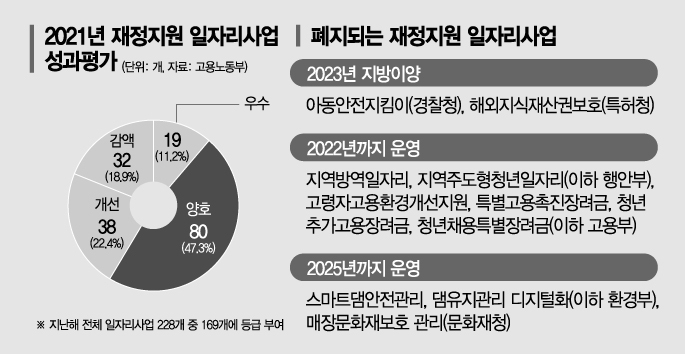
The Moon Jae-in administration's job creation projects, which received 35 trillion won in funding last year, were judged 'ineligible' due to poor performance in about 40% of the cases. The Yoon Suk-yeol administration has decided to cut the budgets of 32 projects with low job creation effects and abolish initiatives such as smart dam safety management, which was promoted as part of the Green New Deal under the previous government, and the special employment promotion subsidies introduced during the COVID-19 outbreak.
On the 28th, the Ministry of Employment and Labor reported these details in the 'Evaluation and Improvement Plan for Financially Supported Job Projects' at the Cabinet meeting. Among the 228 job projects carried out last year, 169 were graded: 19 were excellent, 80 were good, 38 required improvement, and 32 had budget cuts. The combined rate of projects needing improvement or budget cuts, indicating ineligibility, rose significantly to 41.4% compared to 34.4% last year.
With the increase in the improvement and budget cut rates in the first evaluation of financially supported job projects since the launch of the Yoon Suk-yeol administration, analyses suggest that Yoon's job policy initiatives will be actively pursued. President Yoon criticized the Moon administration as a "fake job government" during his candidacy, stating, "Jobs are created by companies, not the government. The next administration will make revolutionary improvements to job issues."
The Moon Jae-in administration invested 35.2208 trillion won in job projects last year, including the original budget and supplementary budgets. As a result, 1,011,000 direct jobs and 2,532,000 unemployment income beneficiaries, totaling 7,765,000 people, benefited. However, issues such as decreased efficiency due to excessive financial support, low job retention rates, and declining job quality were pointed out.
In line with the COVID-19 resolution phase, the government plans to reduce the budget for 32 inefficient job projects next year. The child safety guardian program, a campaign promise of President Moon, will be transferred to local governments by next year, and smart dam safety management and dam maintenance digitalization projects, part of the Digital New Deal, will be phased out by 2025.
Special employment promotion subsidies, youth additional employment subsidies, and special youth hiring subsidies introduced to support companies and youth affected by the COVID-19 spread will also end this year. While youth additional employment subsidies will be integrated into youth job leap subsidies, their scale is expected to be significantly reduced.
An official from the Ministry of Employment and Labor explained, "We plan to maintain the appropriate scale of job projects while streamlining them around high-performance projects. Since last year’s direct job projects were often criticized as mere 'firefighting jobs' involving simple labor, the aim is to improve efficiency and reduce overlapping similar projects."
The Ministry of Employment and Labor plans to increase quality jobs through support for new industries such as semiconductors. To this end, they will allocate collaborative budgets for new industry sectors and expand specialized training related to job transition and career support. Minister of Employment and Labor Lee Jeong-sik stated, "We will expand manpower supply and demand and corporate innovation support in new industries such as semiconductors to build a labor market environment for private sector-led job creation."
© The Asia Business Daily(www.asiae.co.kr). All rights reserved.

















