"North Korea Nuclear Test, Only Political Decision Left"
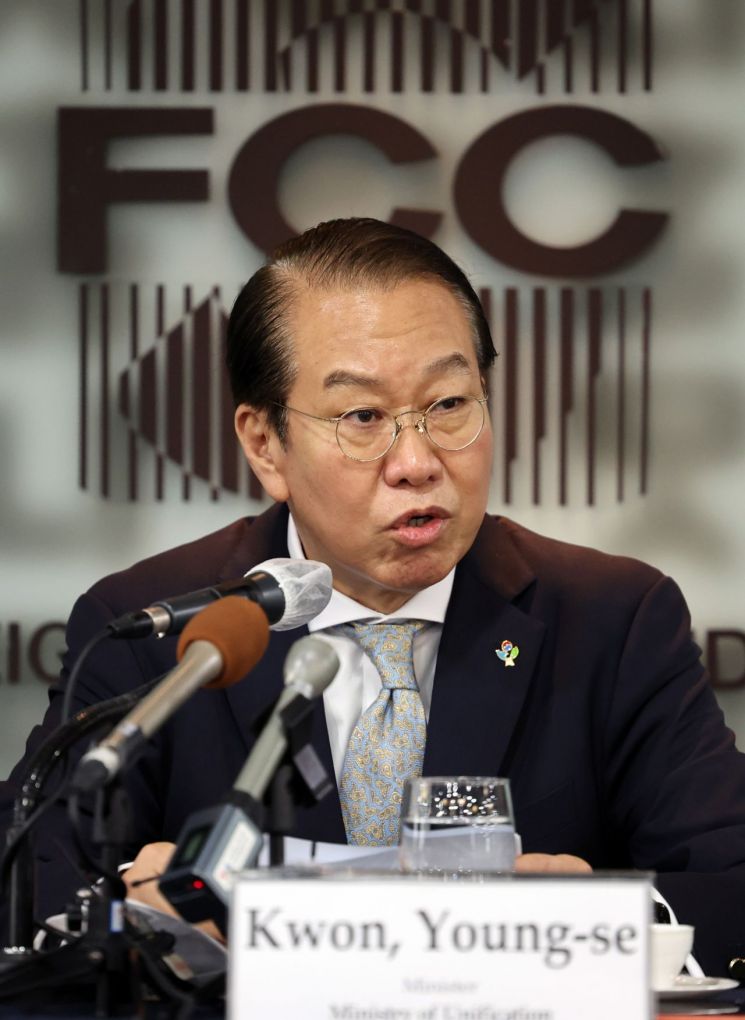
[Asia Economy Reporter Ki-min Lee] On the 27th, Kwon Young-se, Minister of Unification, emphasized regarding North Korea's recent nuclear weapons development trend, "I think North Korea wants to have offensive capabilities against both the United States and the Republic of Korea simultaneously."
At a luncheon hosted by the Seoul Foreign Correspondents' Club (SFCC) held at the Press Center in Jung-gu in the afternoon, Minister Kwon responded to related questions by pointing out, "Considering the change in the range of (North Korea's) ballistic missiles from 'long range' to 'short range,' and the shift from strategic nuclear weapons to tactical nuclear weapons, it can be seen that the target is aimed at the Republic of Korea."
He stated, "In that regard, those who said North Korea's nuclear weapons are not aimed at the Republic of Korea are mistaken."
However, Minister Kwon judged that it is premature to say that North Korea's overall weapons development pattern has shifted from targeting the United States to targeting the Republic of Korea, adding, "It is difficult to see a fundamental change in North Korea's strategy just because the focus of recent (weapons) tests has shifted to short-range."
When asked whether North Korea's recent indication of deploying tactical nuclear weapons at the front line against the South, by adding operational missions to front-line units at the expanded meeting of the Party Central Military Commission, could lead to the termination of the September 19 inter-Korean military agreement, he said, "I think the decisions made by the Central Military Commission also violate the spirit of the September 19 military agreement."
However, he added, "In some respects, the part mainly aimed at the Republic of Korea also gives a hopeful expectation that North Korea might soon engage in dialogue with the Republic of Korea."
Regarding the specific timing of the 7th nuclear test, he replied, "To summarize in one sentence, all preparations are complete, and only a political decision remains," adding, "North Korea is likely observing domestic and international situations to maximize the effect of the nuclear test."
Minister Kwon cited the new Cold War structure in international affairs as the reason for North Korea accelerating its nuclear and missile development. He said, "North Korea is trying to change the status quo through nuclear development by exploiting this gap," and expressed concern, "For us, who aim to achieve peaceful unification of the Korean Peninsula through North Korea's denuclearization and normalization of inter-Korean relations, this change is a very serious and fundamental challenge."
Addressing North Korea, he said, "(If the nuclear test is carried out) it will face tremendous criticism from the international community, and the criticism will not stop at words," adding, "I hope the leaders, including Chairman Kim Jong-un, will abandon the nuclear test and come out on the path of cooperation with the international community."
He also urged, "It is necessary for China, which is evaluated to have significant influence over North Korea, and the international community to continue advising North Korea to refrain from conducting nuclear tests."
© The Asia Business Daily(www.asiae.co.kr). All rights reserved.

















