Young Radish, Potato, Onion, etc... Soaring Agricultural Product Prices
Monthly Food Expenses for a Family of Four Exceed 1 Million Won
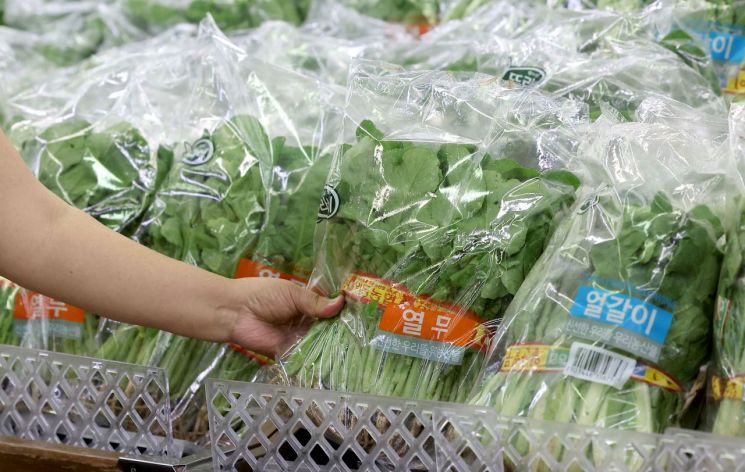
[Asia Economy Reporter Heo Midam] This spring, prices of some agricultural products such as young radish leaves (yeolmu), potatoes, and onions have risen sharply due to drought conditions. Furthermore, as the full-scale rainy season (jangma) begins, vegetable prices are expected to fluctuate even more, deepening the worries of ordinary citizens.
According to agricultural product distribution information (KAMIS) provided by the Korea Agro-Fisheries & Food Trade Corporation (aT) on the 27th, the price of yeolmu surged by 60% in the past week. On the 17th, the wholesale price of yeolmu was on average 8,532 KRW per 4 kg, but by the 24th, it rose to an average of 13,280 KRW. This is about 1.6 times the price from a year ago (average 8,384 KRW).
Potatoes and onions also saw significant price increases compared to last year due to poor crop yields caused by the spring drought. The wholesale price of 20 kg of potatoes was 40,480 KRW as of the 24th of this month, a 71.1% increase from 23,660 KRW a year ago. Onions, at 15 kg wholesale price, rose to 22,160 KRW, which is 110.4% higher than a year ago (10,530 KRW). Compared to a month ago (11,468 KRW), the price increased by 93.2%.
Amid this, there are forecasts that agricultural product prices may rise further as the full-scale jangma begins. Prolonged jangma worsens growing conditions and, combined with farmers’ sluggish shipping operations, most vegetables including lettuce, napa cabbage, and radish see price increases. Especially yeolmu and spinach are prone to spoilage, so their supply inevitably decreases during the jangma season.
With vegetable prices already as precious as gold showing signs of further increases, the worries of ordinary people are deepening day by day. Food expenses are a representative essential spending category, and even if prices rise, there is a limit to how much can be economized, so low-income groups are hit harder.
Ms. Kang, a housewife in her 50s, said, "Prices have risen a lot compared to a year ago. Especially just last week, a bunch of yeolmu was 3,000 to 3,500 KRW, but within a few days, the price rose to 6,000 KRW. It seems the yeolmu price increased a lot because the jangma season is approaching." She added, "In the past, I shopped without much worry, but as the food expenses burden grows, I now think twice before spending."
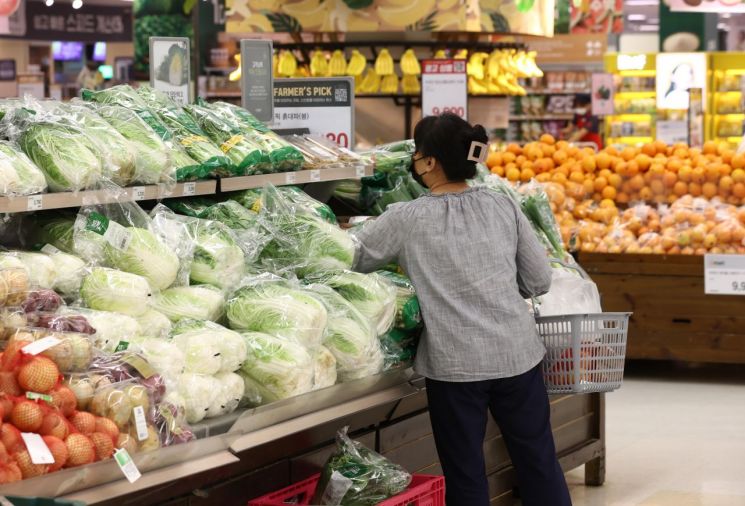
With the rapid rise in grocery prices, the monthly food expenses for a family of four have exceeded 1 million KRW. According to an analysis of microdata from Statistics Korea by Yonhap News, the average monthly food expenses (groceries + dining out) for a four-person household in the first quarter of this year were 1,066,902 KRW. This is a 9.78% increase from a year ago (972,286 KRW).
By category, spending on groceries and non-alcoholic beverages (587,730 KRW) increased by 4.3%, while dining out expenses (486,129 KRW) rose by 17% over the past year.
Meanwhile, the Bank of Korea forecasted that inflationary pressure due to soaring grain prices will further intensify in the second half of this year. In a report titled "Price Stability Target Operation Status Check" published on the 21st, the Bank of Korea stated, "International food prices have significantly increased due to the Russia-Ukraine war and export restrictions by major producing countries," and analyzed, "International food prices, including grains, are likely to remain at high levels for a considerable period due to the war’s aftermath, export restrictions by major producers, and poor crop yields caused by abnormal weather."
© The Asia Business Daily(www.asiae.co.kr). All rights reserved.
![Clutching a Stolen Dior Bag, Saying "I Hate Being Poor but Real"... The Grotesque Con of a "Human Knockoff" [Slate]](https://cwcontent.asiae.co.kr/asiaresize/183/2026021902243444107_1771435474.jpg)

















