[Asia Economy Reporter Song Hwajeong] Financial holding companies and banks are actively expanding their capital by consecutively issuing hybrid capital securities.
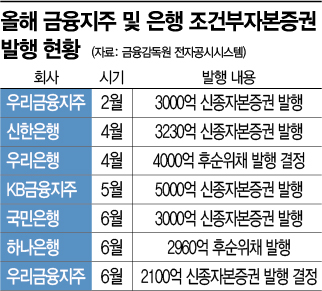
According to the Financial Supervisory Service's electronic disclosure system on the 27th, Woori Financial Group announced on the 24th that it decided to issue 210 billion KRW worth of amortizing contingent convertible bonds (hybrid capital securities). Woori Financial Group explained that the purpose of the fund-raising is "to enhance the Bank for International Settlements (BIS) capital adequacy ratio through the expansion of additional Tier 1 capital" and that "the funds will be used for operating capital and other purposes."
Earlier, Woori Bank decided at its board meeting in April to issue 400 billion KRW worth of amortizing contingent convertible bonds (subordinated bonds), and in February, Woori Financial Group issued 300 billion KRW of hybrid capital securities to secure funds for acquiring other companies' securities and operating capital.

Not only Woori Financial Group and Woori Bank but also other financial holding companies and banks have recently issued contingent convertible bonds to expand their capital. Hana Bank issued subordinated bonds worth 296 billion KRW on the 22nd for the purpose of loan and securities management, and Kookmin Bank issued 300 billion KRW worth of hybrid capital securities on the 23rd to enhance the BIS total capital ratio. Previously, Hana Financial Group issued 400 billion KRW worth of hybrid capital securities on the 10th, and KB Financial Group issued 500 billion KRW worth of hybrid capital securities in May. Shinhan Bank also issued 323 billion KRW worth of hybrid capital securities in April.
Contingent convertible bonds, also known as "CoCo bonds," are broadly divided into two types: hybrid capital securities and subordinated bonds. Subordinated bonds are bonds whose principal and interest repayment order is behind that of general senior bonds. Since they are repaid last after other creditors' debts are settled, they carry a higher risk of loss and thus offer higher interest rates than general bonds. International organizations such as the BIS recognize long-term subordinated bonds with maturities of five years or more issued by banks as capital. Hybrid capital securities, which have characteristics of both stocks and bonds, either have no maturity like stocks or have very long maturities such as 30 years, and pay fixed interest or dividends annually like bonds. Hybrid capital securities are also classified as capital rather than liabilities in accounting, which improves capital ratios upon issuance.
The reason financial holding companies and banks are expanding capital through issuing subordinated bonds or hybrid capital securities is interpreted as an effort to enhance soundness. With recent global economic uncertainties such as rising interest rates and inflation, regulatory pressure to strengthen soundness, including provisioning requirements, has intensified. Concerns about credit risk are also growing as the repayment deferral measures for small and medium-sized enterprises and small business owners are set to end by the end of September. Junseop Jeong, a researcher at NH Investment & Securities, said, "Due to increased concerns about economic downturn, financial authorities are demanding banks to increase loan loss provisions, and accordingly, financial holding companies are expected to make additional provisions starting from the second quarter."
As financial holding companies and banks actively expand capital, the issuance of financial holding company bonds and bank bonds has also surged. According to the Financial Supervisory Service, the issuance amount of financial holding company bonds in May was 1.21 trillion KRW, up 120% from the previous month, and bank bonds surged by 237.5% to 8.033 trillion KRW. The proportion of bank bonds in total corporate bond issuance rose from 14.3% in the previous month to 43%.
Meanwhile, NH Nonghyup Bank issued a global social bond worth 600 million USD. The bonds were issued as a dual-tranche consisting of 300 million USD each for 3.5 years and 5 years. The interest rates were fixed at 4.074% (3.5 years) and 4.318% (5 years), which are 90 basis points (1bp=0.01 percentage point) and 110 basis points above the US 3-year and 5-year Treasury yields, respectively.
An NH Nonghyup Bank official said, "Despite recent market volatility due to global inflation, actively promoting the importance of being the only agricultural policy financial institution in Korea drew a positive response from overseas investors." He added, "In particular, this issuance is a social bond among ESG bonds, and the raised funds will be used exclusively for social projects supporting socially vulnerable groups, farmers, small business owners, and small and medium-sized enterprises."
© The Asia Business Daily(www.asiae.co.kr). All rights reserved.


















