The Proportion of Multicultural Family Children Raised Only Domestically is 90.9%
Multicultural Children’s College Enrollment Rate is 40.5%, Significantly Lower Than General Population
Multicultural Families with Children Aged 6 and Older Face Greater Difficulties in Academic Guidance
[Asia Economy Reporter Han Jinju] As the length of residence of multicultural families in Korea increases, half of their children have entered adolescence, but they are experiencing difficulties in guiding their children's learning.
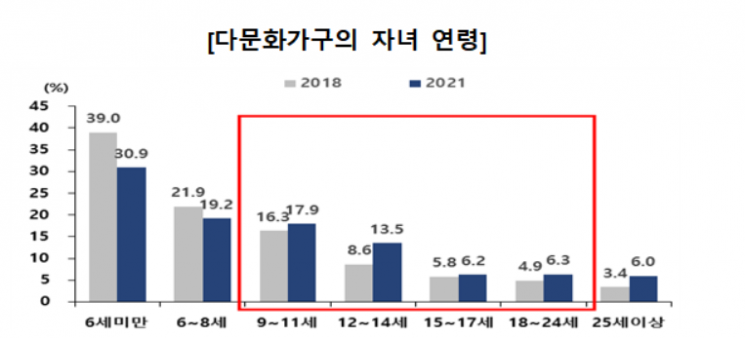
According to the results of the "2021 National Multicultural Family Survey" conducted by the Ministry of Gender Equality and Family on 15,578 multicultural households on the 27th, the proportion of children aged 9 to 24 among all multicultural family children was 43.9%. This is an increase of 8.3 percentage points compared to the previous survey in 2018.
There are a total of 346,017 multicultural households, with marriage immigrant households accounting for 82.4% and other naturalized citizens 17.6%. The proportion of those who have lived for more than 15 years increased by 123 percentage points compared to the previous survey, reaching 39.9%. The average household size is 2.82 members, and the average number of children is 0.88.
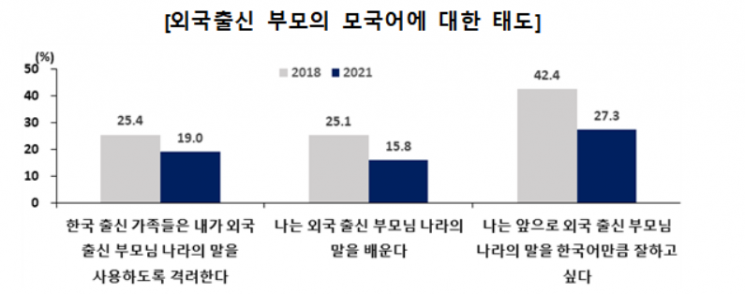
The settlement period of multicultural households is lengthening, and the proportion of school-age children is also increasing. The proportion of multicultural family children who have grown up only in Korea was 90.9%, up from 83.3% in 2018. The proportion of children who answered that they want to speak their foreign-born parents' native language as well as Korean was 27.3%, down 15.1 percentage points from 42.4% in 2018.
The college enrollment rate of multicultural family children was found to be lower than that of the general population. The enrollment rate in higher education institutions for multicultural children was 40.5%, which is 31 percentage points lower than the overall population (71.5%). The enrollment rates by school level for multicultural children were 95.3% in elementary, 95.7% in middle school, and 94.5% in high school, similar to the overall population (elementary 98.4%, middle 97.9%, high 96.1%).
Kim Sukja, Director of Family Policy at the Ministry of Gender Equality and Family, said, "In Korea's educational environment, parental interest and role are very important, but marriage immigrants face relatively difficult language communication and lack experience and information about the Korean school system, which causes many difficulties in educating their children." She added, "Although some college enrollment is achieved, it seems difficult to enter college at the appropriate age, and we will consider various support measures when establishing this basic plan to help students enroll on time."
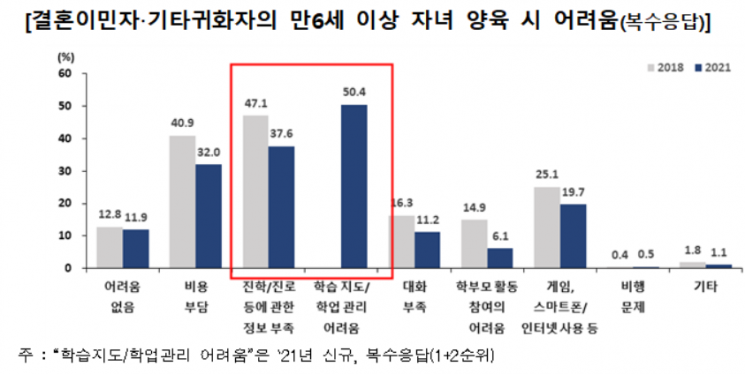
The proportion of multicultural families with children aged six or older who reported difficulties in child-rearing was 88.1%. Compared to previous surveys, the proportion of those experiencing difficulties raising children under five decreased, while it increased for those with children aged six or older. The main difficulties in child-rearing were Korean language instruction (26.8%) for children under five and learning guidance (50.4%) for children six and older.
The experience of discrimination against multicultural families because they came from abroad has decreased to half the level of three years ago. The proportion of those who answered that they had experienced discrimination in Korea was 16.3%, significantly down from 30.9% in 2018.
The proportion of those who experienced difficulties living in Korea also decreased from 70.1% in 2018 to 62.1%, indicating a higher level of adaptation to life in Korea. The main difficulties were language problems (22.9%), economic difficulties (21.0%), and loneliness (19.6%), in that order.
The discrimination experience of multicultural family children also decreased to 2.1%, down 7.1 percentage points from 9.2% in 2018. The proportion of peers such as friends or seniors as counseling partners increased compared to parents. In 2018, parents (38.3%) were the most common, but in this survey, friends and seniors (40.2%) surpassed them.
Based on the survey results, the Ministry of Gender Equality and Family plans to establish the "4th Basic Plan for Multicultural Family Policy (2023?2028)" that presents policy directions and visions for multicultural families and includes tailored education and care systems for school-age children.
This year, the basic learning support project for multicultural family children, operated at 90 family centers, and academic and career counseling services conducted at 78 family centers will be expanded. Through the family centers' "Bilingual Family Environment Creation Project," effective bilingual communication methods within the home will also be taught.
Kim Hyun-sook, Minister of Gender Equality and Family, said, "We are promoting the national agenda to strengthen the customized support system for multicultural family children so that they can grow without discrimination and become talents with international sensibility." She added, "Based on the survey results, we will actively discover policies needed by multicultural family members and faithfully reflect them in the currently being established 4th Basic Plan for Multicultural Family Policy."
© The Asia Business Daily(www.asiae.co.kr). All rights reserved.



















