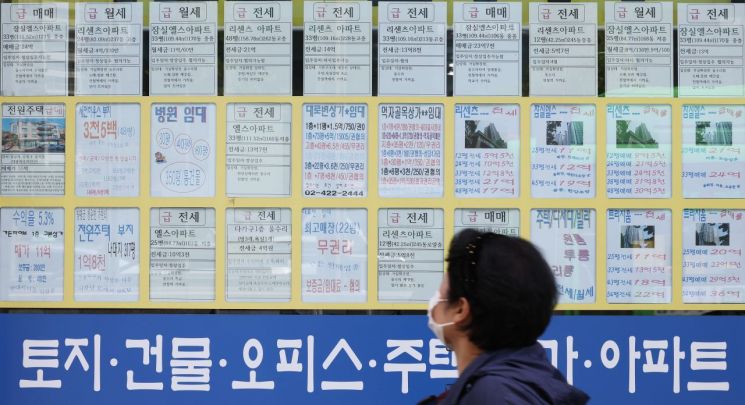
Concerns Over August Jeonse Crisis Eased
Seoul Jeonse Prices Up 35% Compared to Two Years Ago
Private Sector Regulations Must Be Relaxed to Increase Supply
Measures Needed to Resolve Phenomenon of Withheld Listings
[Asia Economy Reporter Kim Min-young, Sejong=Reporter Kwon Hae-young] The government’s consideration of reviving apartment rental business operators following the ‘Win-Win Landlord’ system stems from the judgment that stable supply of jeonse units is difficult through government-led efforts alone due to a shortage of mid- to long-term move-in volumes. Although recent trends show stabilization in jeonse prices, easing concerns over an ‘August Jeonse crisis,’ there remain 9.2 million non-homeowner households as potential demand in the rental market, indicating the need to relax regulations in the private sector to increase supply. However, experts advise that supplementary measures are necessary to address concerns such as withheld listings during mandatory registration periods, potential stimulation of housing prices, and speculative actions by multi-homeowners.
According to the Korea Real Estate Board on the 27th, the nationwide apartment jeonse price index change rate for the third week of June (as of the 20th) was -0.02%, the same as the previous week (-0.02%). Although the jeonse price index has shown relatively stable trends this year, moving from 104.4 in January to 104.3, the situation is not yet reassuring. Tenants who used the two-year contract renewal right in August must consider the deposit reflecting four years of price increases. The average jeonse deposit for apartments in Seoul was 677.09 million KRW at the end of May, a 35.6% increase from 499.22 million KRW in July 2020. While the jeonse price index is stable, the actual jeonse prices have already risen significantly, making even a 5% increase burdensome for tenants.
Supply volumes related to jeonse are also expected to decrease in Seoul. According to Real Estate R114, the expected number of apartment move-ins in Seoul for the second half of this year is 8,326 units, less than the 14,000 units in the second half of last year.
In this context, the revival of the apartment registered rental business operator system could help compensate for the limitations of the 2+2 Lease Protection Act. Since landlords must lease for at least 10 years, stable residence during this period is possible, and rent increases are capped at 5%. Ham Young-jin, head of the Zigbang Big Data Lab, said, "Given the high preference for apartment leases and the recent price weakness in the housing market due to reduced transactions, it is worth considering including apartments in the purchase rental type from the perspective of supplying rental housing."
Statistics also confirm that private rentals can be supplied at prices as low as 60% of market rates. According to an analysis by Yoo Kyung-jun, a member of the People Power Party, comparing registered rental housing and general housing rents from 2018 to 2020, rents for registered rental housing provided by registered rental business operators were 30-40% cheaper than general market rents.
Moreover, while revising the Lease Protection Act is realistically difficult in the current opposition-majority parliament, reviving the apartment registered rental business operator system can be done through government ordinance amendments alone. If the government includes apartments again in registered rental housing, tax benefits such as exemption from capital gains tax surcharges, special provisions for owner-occupied housing (excluding registered rental housing from the housing count for non-taxation on owner-occupied housing transfers), and exemption from comprehensive real estate tax can be extended to apartment rental business operators.
Experts say that since there are concerns about stimulating housing prices, tax benefits should be granted together with supplementary measures to resolve the withheld listings phenomenon. The Presidential Transition Committee also discussed reviving the apartment registered rental business operator system but reportedly had differing opinions, citing the risk of sparking housing price increases.
Yoon Ji-hae, a researcher at Real Estate R114, said, "In 2020, many multi-homeowners registered as rental business operators to avoid strengthened holding taxes, which led to criticism that listings in central Seoul dried up," adding, "There needs to be sufficient discussion on the extent of tax incentives and other benefits to be granted to apartment registered rental business operators."
© The Asia Business Daily(www.asiae.co.kr). All rights reserved.

















