Korea Federation of SMEs' "National Appeal to Freeze Minimum Wage"
"Insufficient Payment Capacity Leads to Reduced Working Hours and Employment"
Also Highlights Skilled Worker Shortage and Aging Workforce Issues
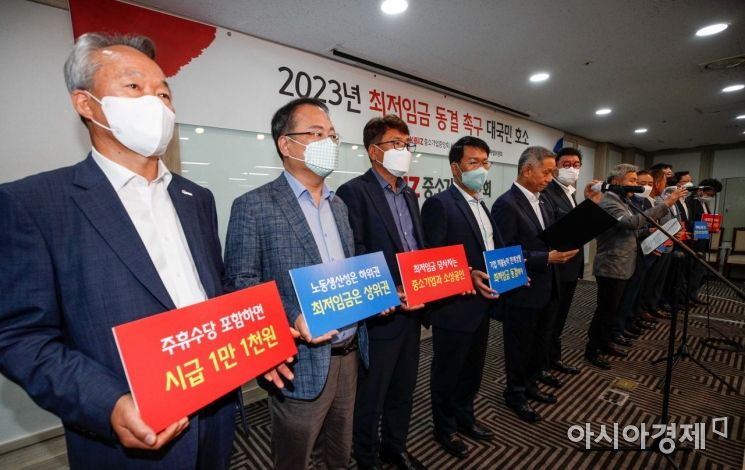 On the 27th, representatives of small and medium enterprise cooperatives held a press conference appealing to the public to freeze the 2023 minimum wage at the Korea Federation of SMEs in Yeouido, Seoul. Photo by Jinhyung Kang aymsdream@
[Asia Economy Reporter Kim Bo-kyung] The small and medium-sized enterprise (SME) sector has appealed to freeze next year's minimum wage at 9,160 won, the same as this year, to ensure business survival and job creation. They stated that including the weekly holiday allowance, the minimum wage is already at about 10,992 won, making any further increase unbearable.
The Korea Federation of SMEs held a press conference titled "Public Appeal to Freeze the Minimum Wage for 2023" on the morning of the 27th at the Federation's office in Yeouido, Seoul, advocating for a freeze on the minimum wage. This press conference was organized to convey the voices from the field of SMEs and small business owners and to urge the Minimum Wage Commission to make a reasonable decision. Representatives from 19 cooperative associations and industry groups participating on the day appealed that next year's minimum wage should be frozen considering the payment capacity of vulnerable small and micro enterprises and small business owners.
Joo Bo-won, Chair of the Labor and Workforce Committee at the Federation, said, "According to a recent survey by the Federation, half of SMEs have no countermeasures if the minimum wage increases, and the other half plan to respond by reducing employment." He added, "The minimum wage should be decided at a freeze level to both save SMEs and protect workers' jobs."
According to the Federation, Korea's minimum wage is 61.2% of the median wage, which is higher than the OECD average of 55.2%. Including the weekly holiday allowance, this year's minimum wage amounts to about 10,992 won. When factoring in severance pay and the four major social insurance contributions that companies must bear, the labor cost per person is estimated at 2.38 million won per month. Due to low labor productivity and insufficient corporate capacity to pay labor costs, 3.22 million workers earned less than last year's minimum wage.
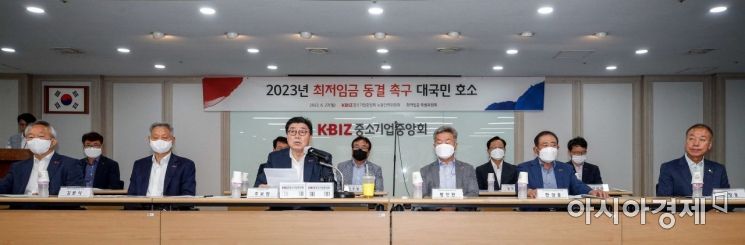 Jubo Won, Chairman of the Labor and Workforce Committee of the Korea Federation of Small and Medium Business, is delivering a speech at the "2023 Minimum Wage Freeze Urgent Appeal to the Public Press Conference" held at the Korea Federation of Small and Medium Business in Yeouido, Seoul on the 27th. Photo by Jinhyung Kang aymsdream@
Yoon Young-bal, Chairman of the Korea Vending Machine Operators Cooperative, said, "Although the minimum wage is increasing, sales are not rising, so we are coping by reducing working hours to 4 days a week instead of 5, and 5 to 6 hours a day." He added, "Since this year, paid holidays have been introduced for workplaces with five or more employees, increasing labor cost burdens."
Kim Chang-woong, Chairman of the Korea Construction Machinery Maintenance Association, stated, "Although most already pay above the minimum wage, if the minimum wage rises, wages for existing workers must also be increased accordingly, increasing labor costs."
Park Gil-soo, CEO of Samwoo, lamented that the minimum wage increase is making it difficult to nurture skilled workers. If the minimum wage rises excessively, it becomes difficult to provide additional wage increases based on skill level, making it harder to secure skilled workers.
In technical industries where skills must be developed through on-the-job training, the issue of no new workforce influx was also raised. CEO Park explained, "Workers are aging, and it has become difficult to find young and agile youth. The average age of workers is over 50, and even men in their 70s operate heavy equipment."
Attendees commonly mentioned the need to discuss sector-specific application of the minimum wage and requested cooperation from labor groups. Lee Tae-hee, Director of the Smart Jobs Headquarters at the Federation, argued, "The minimum wage has increased by about 42% over the past five years. Due to lack of payment capacity, the rate of workers earning below the minimum wage is high, and there are large differences between industries. Vulnerable and difficult sectors such as food service and accommodation should be given consideration."
Meanwhile, the Labor and Workforce Committee expressed concern in a statement that rapid minimum wage increases are leading to the spread of unmanned stores and the introduction of industrial robots like kiosks, resulting in 'jobless growth.' They said, "We earnestly appeal to freeze the minimum wage so that SMEs and small business owners, who are enduring with pride to develop the national economy despite difficult circumstances, can escape survival threats and continue to create jobs."
© The Asia Business Daily(www.asiae.co.kr). All rights reserved.


















