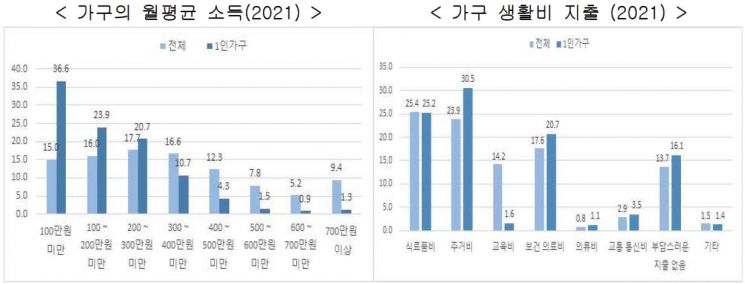
[Asia Economy (Suwon) = Reporter Lee Young-gyu] It was found that 36.6% of single-person households in Gyeonggi-do have an average monthly income of less than 1 million won. In addition, among the households receiving the National Basic Livelihood Security in the province, 68.1% were single-person households. Furthermore, 20% of single-person households are in their 30s, and about 30% of their living expenses are spent on housing costs.
Gyeonggi-do announced on the 27th the "2022 Gyeonggi-do Single-Person Household Statistics," which reanalyzed data from the 2020 Population Census and Housing Census by Statistics Korea, the 2020 Family Status Survey by the Ministry of Gender Equality and Family, the 2020 National Basic Livelihood Security Recipient Status by the Ministry of Health and Welfare, and the 2021 Social Survey by Gyeonggi-do.
According to the statistical data, as of 2020, there were approximately 1.4 million single-person households in Gyeonggi-do, accounting for 21.2% of the total 6.64 million households nationwide.
The proportion of single-person households among all households in the province increased annually from 23.8% in 2016 to 25.2% in 2018 and 27.6% in 2020. By age group, those in their 30s accounted for the largest share at 19.4%, followed by those in their 50s (17.0%), 20s (16.9%), and 40s (16.3%).
The average monthly income of single-person households (as of 2021) was less than 1 million won for 36.6%, the highest proportion. This was followed by ▲1 million to 2 million won at 23.9%, ▲2 million to 3 million won at 20.7%, ▲3 million to 4 million won at 10.7%, ▲4 million to 5 million won at 4.3%, and ▲over 5 million won at 3.7%.
In particular, those earning less than 2 million won accounted for 60.5% of the total. This is about twice as high compared to the average monthly income of all households in Gyeonggi-do, where 15.0% earn less than 1 million won and 16.0% earn between 1 million and 2 million won.
Additionally, single-person households accounted for 68.1% of the National Basic Livelihood Security recipient households (as of 2020).
Analysis of living expenses for single-person households showed that housing costs accounted for the largest share at 30.5%, followed by food expenses (25.2%) and health and medical expenses (20.7%). Considering that the overall household expenditure proportions in Gyeonggi-do are food expenses (25.4%), housing costs (23.9%), and health and medical expenses (17.6%), it was analyzed that single-person households bear relatively higher burdens for housing and health/medical expenses.
The residential area of single-person households (as of 2020) was 5.4% for 20㎡ or less, 26.3% for 20?40㎡, 35.6% for 40?60㎡, and 22.8% for 60?85㎡. It was found that 31.7% of single-person households live in spaces of 40㎡ (approximately 12 pyeong) or less.
Regarding health status, 48.1% of single-person household members responded that their health was "good," while 23.3% answered "poor." Compared to the responses of all households in Gyeonggi-do (good 58.6%, poor 11.6%), the proportion of "good" responses was relatively lower.
Ji Ju-yeon, Director of the Women's and Family Bureau of Gyeonggi-do, explained, "To comprehensively understand the distribution and needs of single-person households, we have reorganized and analyzed the statistics on single-person households in the province for the first time." She added, "We plan to use this as basic data for establishing future policies for single-person households."
© The Asia Business Daily(www.asiae.co.kr). All rights reserved.

















