Continued Downward Pressure on Stock Market
"Trend Rise Difficult" Major Trend
KOSPI Lowest at 2100~2200 Range
Some Say "Bigger Negative Factors Unlikely"
Technical Rebound Expected if Exchange Rate Stabilizes
[Asia Economy Reporters Junho Hwang, Myunghwan Lee] As South Korea's stock market remains unable to escape the inflation shock, domestic securities firms predominantly forecast that the market decline will continue in the second half of this year. However, some analysts suggest that depending on exchange rate fluctuations, the long-standing securities industry adage "buy on fear" could shine, presenting a technical rebound opportunity. With individual investors losing momentum even in bottom-fishing, attention is focused on whether a chance for reversal might emerge.
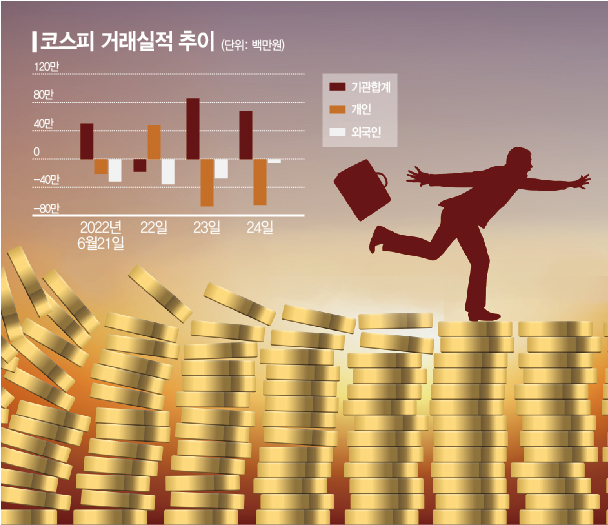
According to the Korea Exchange on the 27th, individual investors engaged in net selling worth 1.3039 trillion won over two consecutive trading days from the 23rd to 24th. This marks the first consecutive two-day net selling period this month. As the KOSPI dropped from 2,685.90 at the end of last month to 2,314.32 on the 23rd, the drive for bottom-fishing weakened.
It remains difficult to expect a sustained upward trend in the second half of this year. Economic slowdown due to high oil prices and high interest rates is anticipated, along with increased downward pressure on the stock market. Many domestic securities firms project the KOSPI's expected lowest point in the second half to be between 2,100 and 2,200. Labor Gil, a researcher at Shinhan Financial Investment, suggested a forecast range of 2,200 to 2,500 for next month, stating, "Since downward revisions of KOSPI earnings are expected to begin in earnest from July, valuation based on earnings is still unreliable."
However, a rebound opportunity is not out of the question. Given that all negative factors have already surfaced, paradoxically, it is unlikely that worse news will emerge. Lee Jaeman, a researcher at Hana Financial Investment, predicted, "It is unlikely that crude oil buying pressure will strengthen beyond the current level or that the Federal Reserve will raise benchmark interest rates more than currently expected." He added, "If international oil prices fall, the chemical sector?which is expected to experience the largest decline in operating profit margins due to rising oil prices?will benefit; if market interest rates decline, healthcare and media sectors?which have seen the largest valuation drops from their peaks?will improve; and if the dollar index falls, Samsung Electronics, which has been the focus of foreign net selling, will see the fastest improvement in supply and demand."
In particular, if the government intervenes to stabilize the foreign exchange market, a technical rebound could be possible. Lee Kyungmin, a researcher at Daishin Securities, noted, "Over the past weekend, the offshore won-dollar exchange rate dropped to the 1,288?1,289 won range," adding, "If it falls below 1,280 won, foreign demand and supply for the stock market will also change." From mid to late last month, the KOSPI successfully rebounded from the 2,550 level to 2,680, which is analyzed as a result of foreign investors starting net buying. During the same period, the won-dollar exchange rate exceeded 1,280 won before falling again. As of 9:35 a.m. today, the won-dollar exchange rate recorded 1,291.70, down 0.50% from the previous session.
The emergence of short-covering following last week's "short sale forced buy-in" that increased downward pressure on the domestic stock market could also serve as a rebound catalyst. Lee said, "It is important to note that after past forced buy-in shocks, the KOSPI attempted short-term rebounds of 10?15%," adding, "Applying this to the KOSPI, the target for the first technical rebound (July?August) is around 2,640." In this context, sectors to watch are those with excessive declines, including media/education, construction, cosmetics/apparel, IT hardware, securities, semiconductors, software, and displays. Quant-based stock recommendation service QuantKey pointed out that forced buy-ins are likely to flow mainly into stocks with high short sale balances and lending balances among excessively declined stocks. As of the 23rd, QuantKey identified Meritz Financial Group, LG Energy Solution, and K Car as KOSPI stocks with concentrated short selling.
© The Asia Business Daily(www.asiae.co.kr). All rights reserved.
![Clutching a Stolen Dior Bag, Saying "I Hate Being Poor but Real"... The Grotesque Con of a "Human Knockoff" [Slate]](https://cwcontent.asiae.co.kr/asiaresize/183/2026021902243444107_1771435474.jpg)
















