[Asia Economy Reporter Byunghee Park, New York=Special Correspondents Seulgina Jo and Hyunwoo Lee] The leaders of the Group of Seven (G7) have agreed to invest $600 billion (approximately 777.6 trillion KRW) to counter China's Belt and Road Initiative (一帶一路, the land and maritime Silk Road). They plan to ban imports of Russian gold and impose additional import sanctions on crude oil. These measures aim to strengthen containment against Russia, which invaded Ukraine, and China, which is supporting Russia.
On the first day of the G7 summit, June 26, U.S. President Joe Biden posted on his Twitter account, "The G7 will jointly announce a ban on gold imports from Russia," adding, "Gold is a key export resource that brings Russia billions of dollars." Gold is Russia's second-largest export resource after energy. As of 2020, Russia's gold exports accounted for 5% of the global total, amounting to $19 billion.
However, there are criticisms that banning Russian gold imports may only drive up gold prices and reduce the effectiveness of sanctions. Some analysts interpret this as an attempt to guide global speculative capital, previously focused on crude oil, into gold investments to alleviate inflation.
The G7 summit is being held from June 26 to 28 at Elmau Castle in Bavaria, Germany. According to officials, the G7 leaders discussed additional sanctions related to Russian crude oil imports on the first day. The G7 plans to impose a price cap on Russian oil and restrict transport insurance to sanction Russian crude oil imports.
An official stated that sales of Russian crude oil and petrochemical products will only be permitted below the agreed price. The leaders have in principle agreed on additional sanctions, but detailed discussions on the price cap level and other specifics are needed. It is expected that an agreement will be reached before the summit concludes.
Charles Michel, President of the European Council, said, "The G7 leaders will discuss the details related to the price cap, but many obstacles remain to be overcome." However, since China and India have recently significantly increased their imports of Russian crude oil, and Russia is reportedly developing its own transport insurance measures in response to restrictions, there are expected debates about the effectiveness of these sanctions.
President Biden announced that the G7 will invest $600 billion by 2027 in infrastructure worldwide, including buildings, networks, and health systems, as an alternative to China's Belt and Road Initiative. Ports, railways, and power grids are also included. Bloomberg News reported, "The U.S. will support $200 billion," but noted that "details such as the division between private and public sector funding remain unclear."
Earlier, Jake Sullivan, White House National Security Advisor, said regarding infrastructure investment, "It depends on how much financial support comes from the private sector," adding, "Direct financial support from the U.S. government will be relatively limited."
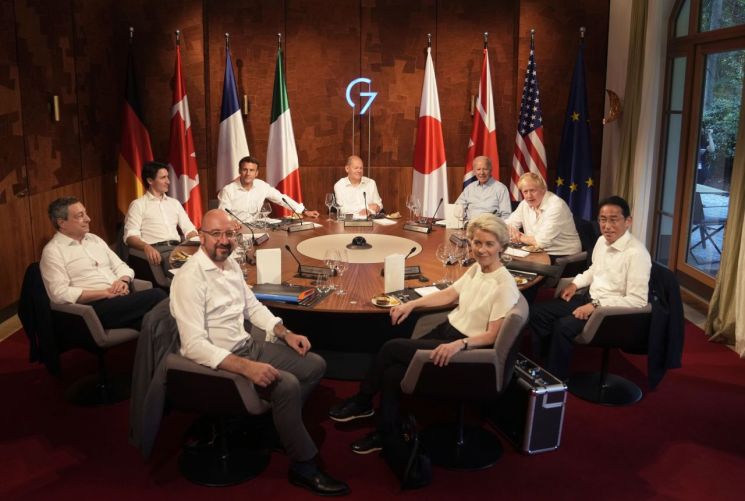 On the 26th (local time), the leaders of the Group of Seven (G7), Charles Michel, President of the European Council (front row left), and Ursula von der Leyen, President of the European Commission (front row right), took a commemorative photo at Elmau Castle in Bavaria, Germany, where the G7 summit will continue until the 28th.
 Photo by AP Yonhap News
Ukraine has called on the West to designate Russia as a state sponsor of terrorism and to sanction Russian gas imports. Andriy Yermak, Chief of Staff to the Ukrainian President, tweeted, "We appreciate the G7's decision to ban Russian gold imports, but gas must also be included in the new EU sanctions," emphasizing, "Designating Russia as a state sponsor of terrorism is absolutely necessary."
Russia launched a large-scale missile attack on Kyiv, the capital of Ukraine, coinciding with the opening of the G7 summit. This is the first missile strike on Kyiv in three weeks since June 5. It is widely analyzed as a show of force in response to the West's intensified sanctions against Russia.
The New York Times (NYT) analyzed, "Russia's missile attack on Kyiv after three weeks is a clear challenge to the new measures isolating Russia and to the world's largest democracy summit held that day." The attack destroyed residential areas and a kindergarten building, resulting in one death and six injuries.
Meanwhile, Russian President Vladimir Putin announced that he will undertake his first overseas trip since the invasion of Ukraine. After visiting Tajikistan and Turkmenistan, former Soviet republics, this week, he is expected to attend the Caspian Summit, a consultative body among Central Asian countries, to demonstrate the closeness among former Soviet states to the West.
The Caspian Summit will be attended by leaders from Azerbaijan, Kazakhstan, Iran, and Turkmenistan. Analysts suggest this meeting is held with awareness of the Western G7 summit and the subsequent North Atlantic Treaty Organization (NATO) summit.
Joko Widodo, President of Indonesia, the chair of this year's Group of Twenty (G20), announced plans to visit Ukraine and Russia to mediate between the two countries. The Indonesian Ministry of Foreign Affairs stated that President Joko Widodo was invited to the G7 summit as the G20 chair and plans to visit Russia and Ukraine consecutively after the G7 summit.
Before departing for Germany, President Joko Widodo said at a press conference, "I will ask President Vladimir Putin to open a dialogue and immediately stop the war," adding, "We will seek solutions to the global food and energy crises."
© The Asia Business Daily(www.asiae.co.kr). All rights reserved.
![User Who Sold Erroneously Deposited Bitcoins to Repay Debt and Fund Entertainment... What Did the Supreme Court Decide in 2021? [Legal Issue Check]](https://cwcontent.asiae.co.kr/asiaresize/183/2026020910431234020_1770601391.png)















