Rising Food Prices... Deepening Sighs
Vegetable Prices Surge... Yeolmu Up 53% in a Week
Rainy Season Expected to Prolong the Uptrend
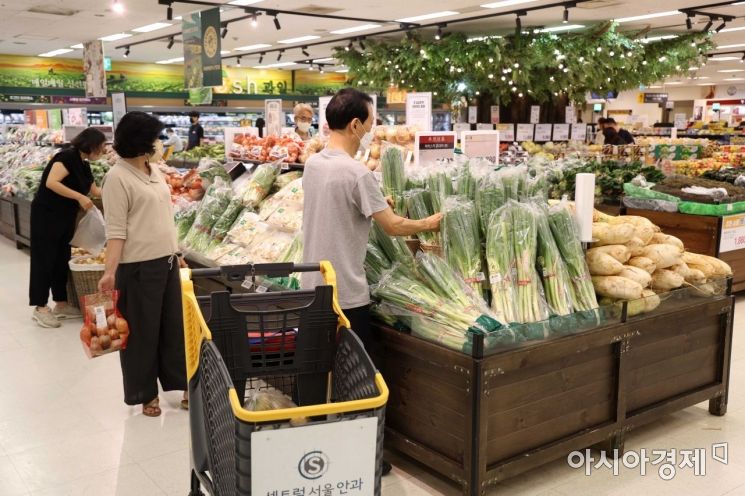
[Asia Economy Reporter Song Seung-yoon] "I just did a simple grocery shopping, but it quickly exceeded 100,000 won."
Cho Hyun-ah (36), a housewife living in Seongbuk-gu, Seoul, is afraid of grocery shopping these days. With prices rising across meat, fruits, and vegetables, it has become difficult to confidently fill her shopping basket with ingredients. Compared to a year ago, the cost of purchasing food ingredients has nearly doubled. Her salary and living expenses remain the same, but her spending keeps increasing. Cho said, "Even if prices rise, they have gone up too much. Now, 100,000 won is not nearly enough to buy ingredients for a family of four for a week," adding, "With children, I can't avoid buying meat or vegetables, but every time I go to the supermarket, I feel suffocated."
As forecasts predict inflation could reach 6% as early as this month, the worries of ordinary people are deepening. Prices of essential daily items such as fuel and food are soaring daily, making even a home-cooked meal a cause for concern. Especially with drought and monsoon rains overlapping, vegetable prices have recently surged dramatically.
According to the Korea Agro-Fisheries & Food Trade Corporation on the 27th, as of the 24th, the wholesale price of 10kg of napa cabbage averaged 10,480 won, up 7.4% from a week earlier (9,750 won). Compared to a year ago (6,130 won), the price has risen by more than 70%. Young radish leaves (yeolmu) also averaged 13,280 won for 4kg, more than 53% higher than a week ago (8,638 won). At that time, yeolmu prices were similar to a year ago (8,384 won). Onions were priced at 22,160 won for 15kg, more than 110% higher than the same period last year (10,530 won), and domestic peeled garlic averaged 176,000 won for 20kg, up over 22% from a year ago (143,167 won). Korean zucchini (aehobak) also rose more than 52% to 24,700 won for 20 pieces compared to the same period last year (16,248 won), and perilla leaves (kkaennip) increased 35% to 22,220 won for 2kg from a year ago (16,344 won).
This sharp rise in vegetable prices is analyzed to be due to a combination of international oil price hikes caused by Russia's invasion of Ukraine and poor crop yields due to the early heatwave. The industry expects that as the monsoon season fully begins, supply of some vegetables will become more difficult, and the price increase trend will continue for some time. With most food ingredient prices rising, a new trend of 'one-day one-shopping' has emerged, where people buy only what they need on the day of consumption. Among self-employed business owners, stockpiling of items expected to rise in price is still ongoing.
Meanwhile, the Korea Agro-Fisheries & Food Trade Corporation plans to proactively prepare for unstable agricultural product supply caused by adverse weather during the monsoon season and minimize price fluctuations by urgently purchasing and stockpiling 6,000 tons of spring napa cabbage and 2,000 tons of spring radish. The stockpiled agricultural products will be sold in wholesale markets or supplied to processing companies such as kimchi manufacturers through government consultations if prices rise due to weather, natural disasters, or supply-demand imbalances.
© The Asia Business Daily(www.asiae.co.kr). All rights reserved.

















